

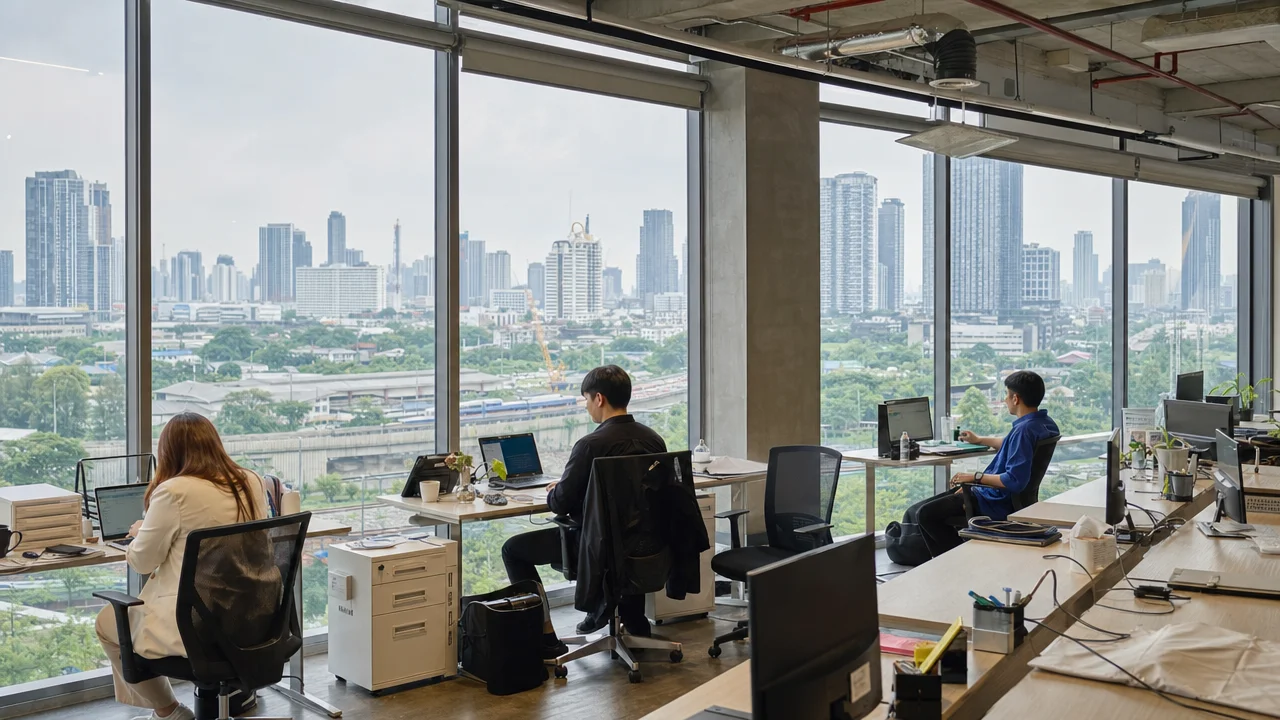

Bangkok's office real estate market is experiencing a fundamental shift: companies are massively abandoning expensive addresses in the central business district in favor of peripheral locations with more favorable conditions. In the second quarter of 2026, owners of the capital's business centers are offering not only discounts, but also barter deals, fully fitted offices and compensation for renovation costs.
According to consulting company Cushman & Wakefield Thailand, competition is shifting from price concessions to flexible tools for attracting tenants. The total office space in Bangkok amounted to 9.15 million square meters, with 38% being Class A, 58% Class B and only 4% Class C. The average rental rate for Class A offices remained at 943 baht per square meter per month, but the actual deal terms include numerous incentives that reduce the effective cost by 15-25%.
Why tenants are leaving the center
In the first quarter of 2026, the vacancy rate for Class A offices in the central business district reached 23.3%. By the second quarter, the indicator decreased to 21.9%, but the reason is not increased demand for premium locations, but a mass relocation of companies to modern complexes outside the CBD.
Of the 5.03 million square meters of office space in the central business district, a significant portion is represented by buildings constructed 15-20 years ago. They are inferior to new projects in terms of engineering systems, energy efficiency and comfort of workspaces. Owners of old Class A and B properties are facing rising vacancies and are forced to carry out reconstruction.
Tenants gain a strong negotiating position. Companies can choose from a wide range of offers and dictate terms. Head of Office Real Estate at Cushman & Wakefield Thailand, Aukit Pronpattanapairot, noted that office building owners are increasingly using partnership agreements instead of traditional rate reductions.
New geography of office demand
By 2031, Bangkok plans to introduce another approximately 616 thousand square meters of new offices. Half of this volume - 436 thousand square meters - will be delivered in 2026. Increasingly, new projects are appearing outside the city center.
Active construction areas:
- East Sukhumvit
- Bang Na-Trat Road
- Phahon Yothin
The main reason is the high cost of land in central areas, making new office construction economically less attractive. Developers are choosing locations with access to transport arteries and growing residential stock, where demand is forming from medium and small companies.
The total volume of leased space in the second quarter of 2026 exceeded 102 thousand square meters. Net absorption amounted to about 25 thousand square meters. These figures show that the market is active, but demand is distributed unevenly.
What office owners are offering
Owners prefer not to lower the official rental cost in order not to worsen the value of their assets. Instead of direct price dumping, they offer incentive packages that make the deal profitable for the tenant but keep the nominal rate at an acceptable level.
Typical conditions in the second quarter of 2026:
- fully ready-to-use offices with furniture and equipment
- premises with partial finishing according to tenant requirements
- flexible relocation conditions with compensation for logistics costs
- compensation for renovation and refurbishment costs
- rent holidays for 3-6 months
- more flexible contract terms with early termination options
Green certified buildings account for approximately 36% of total supply and demonstrate better net absorption. Companies are willing to pay a premium for modern engineering systems, low operating costs and ESG compliance.
Comparison of conditions by office class
| Office Class | Average Rate (baht/m²/month) | Typical Incentives | Occupancy Level |
|---|---|---|---|
| A (CBD) | 943-1247 | Rent holidays 3-6 months, renovation compensation | 77-78% |
| A (periphery) | 650-850 | Ready-made offices, flexible contracts | 72-75% |
| B (CBD) | 580-720 | Partial finishing, discounts up to 15% | 68-72% |
| B (periphery) | 420-580 | Extended holidays, barter deals | 65-70% |
Barter instead of discounts
Business center owners are offering unusual forms of cooperation. Barter deals are becoming a reality: a company receives office space in exchange for services, products or partnership programs.
Examples of barter schemes:
- IT company receives an office in exchange for implementing building automation systems
- Marketing agency rents space for promoting the business center
- Restaurant group opens a location in the building at a preferential rate in exchange for servicing corporate events
Such schemes are beneficial to both parties: the owner fills vacant space and receives additional services, the tenant saves on cash payments.
Forecast for 2026-2027
The introduction of 436 thousand square meters in 2026 will create additional pressure on the market. Competition will intensify, especially in the Class B segment and in peripheral locations. Owners of old buildings without modernization investments risk facing high vacancy rates.
Premium Class A projects with green certification will maintain stable demand. Rates in this segment may even grow by 3-5% by the end of 2026. The middle market will face pressure: Class B rates may decline by 5-8% in real terms, taking into account all incentives.
Class C offices and outdated buildings without reconstruction will lose competitiveness. Some of these properties will be repurposed for residential real estate, coworking spaces or mixed formats.
Lessons for commercial real estate investors
Bangkok trends provide clear signals for office real estate investors of any scale:
Quality beats location. A modern building on the periphery with good transport accessibility attracts more tenants than an outdated property in a prestigious area.
Flexibility of terms is more important than the nominal rate. Tenants evaluate the full package: preferential periods, premises readiness, expansion options and early exit.
ESG certification becomes a competitive advantage. Buildings with green standards show occupancy 5-7 percentage points above the market average.
Small and medium companies form demand. Large corporations are reducing office space due to hybrid work formats. Growth is provided by companies with 20-100 employees.
Peripheral locations with infrastructure win. Access to metro, residential areas and services is more important than a CBD address.
What this means for commercial condo buyers in Pattaya
Bangkok trends directly affect the small commercial real estate market in Pattaya. The city is becoming a center of attraction for companies operating in the Eastern Economic Corridor zone. Demand for small office spaces of 30-80 square meters is growing.
Commercial condominiums in Jomtien and Na Jomtien areas attract IT companies, consulting agencies, and representative offices of manufacturing enterprises from EEC. These tenants are looking not for a prestigious address, but for value for money: modern infrastructure, stable internet, parking and proximity to residential complexes for employees.
Rental rates for commercial space in Pattaya are 350-550 baht per square meter per month. This is 1.5-2 times lower than in peripheral areas of Bangkok, with comparable quality of premises. Return on investment in Pattaya commercial condos reaches 7-9% per annum with long-term rental.
Purchasing a 50 square meter commercial condo in Jomtien costs 3.5-5 million baht. At a rate of 450 baht per square meter, monthly income will be 22.5 thousand baht, annual - 270 thousand baht. This yields 5.4-7.7% without taking into account asset value growth.
Advantages of investing in small commercial spaces in Pattaya:
- Low entry threshold compared to large office projects
- Stable demand from EEC companies and remote teams
- Possibility of freehold purchase for foreigners (up to 49% of project area)
- Flexibility of use: office, coworking, showroom, medical office
- Value growth of 3-5% per annum in locations with developed infrastructure
Risks require attention. Choose projects with ready infrastructure, legally clean documents and confirmed tenant demand. Avoid properties focused exclusively on tourist flow: long-term value correlates with proximity to EEC workplaces.
Verify the presence of Chanote (Nor Sor 4) for the land plot, building operating permits and common property management conditions. Demand transparency on utility payments and building maintenance fund.
Practical steps for investors
If you are considering purchasing a commercial condo in Pattaya, follow this algorithm:
Assess the location relative to completed EEC infrastructure. Jomtien and Na Jomtien are 20-30 minutes from industrial zones where thousands of specialists work.
Check transport accessibility. Availability of parking, proximity to main roads and public transport are critical for tenants.
Study the project's ownership structure. Freehold provides more flexibility for resale and inheritance transfer.
Request data on current occupancy of similar properties in the project or area. A level above 75% is a good indicator.
Calculate the total cost of ownership: utility payments, fund contributions, property tax, insurance.
Build in a buffer for vacancy periods. Plan for 10-11 months occupancy per year, not 12.
Consider the possibility of personal use. Commercial condos are suitable for starting your own business in Thailand.
Bangkok's office real estate market shows that tenants choose rationality over prestige. Pattaya benefits directly from this trend: companies are looking for quality space at reasonable prices in locations with growing economic activity. Investors who understand this logic and choose properties based on real demand receive stable income and capital growth.