Knight Frank: Bangkok market needs six years to clear surplus
In June 2026, Knight Frank Thailand published a report that made investors reconsider strategies across the country. Greater Bangkok has accumulated around 350,000 unsold condominiums. At current sales rates-60,000 units per year-it will take five to six years to clear inventory. This is not a forecast. This is mathematics.
The problem is not a lack of buyers. Demand exists. In the first quarter of 2026, the number of property transfers increased by 12.7% year-on-year. The government relaxed LTV (loan-to-value) rules and reduced transfer fees. People are buying. But supply is growing faster than the market can absorb.
Why developers left the central business district
In the first quarter of 2026, 6,174 new condominiums entered the Bangkok and suburban market. Not a single project launched in the CBD-the central business district. This is the first quarter without new launches in the center in eight years.
The reason is simple: purchasing power has shifted downward. More than 68% of new projects are priced below 80,000 baht per square meter. Developers have switched to the mass segment. The 1.5-3 million baht per unit range has become the main battlefield.
Previously, sellers dictated terms. Now buyers hold the power. Choice is enormous: discounts, installment plans, gifts, flexible payment schemes. The market has shifted from growth mode to survival mode.
Financial burden on developers grows every month
Every month a unit remains unsold, the developer bears costs. Loan servicing, property taxes, common area maintenance, marketing. Knight Frank directly states: the longer inventory hangs in the system, the higher the financial burden.
Some companies have begun selling entire blocks at 20-30% discounts to investment funds and bulk buyers. This allows them to close credit lines but crashes the average price per project. Buyers who purchased at launch at full price see their assets losing value even before completion.
Those who survive won't be those who launch the most projects. Those who survive will be those who accurately target the market's real purchasing power. This is a quote from the Knight Frank report, and it reflects the new reality.
Who is buying condos in Thailand after Americans and Chinese leave
In April 2026, Bangkok Post recorded a structural shift: American and Chinese buyers are massively leaving the market. Chinese demand has been falling for the third consecutive quarter. Tightening of currency controls in China, economic slowdown, restrictions on capital outflows.
Americans faced the strengthening of the baht against the dollar. Many switched to Mexico and Portugal, where residency conditions are simpler and currency risks lower.
The share of foreign transactions in the condominium segment decreased by 12-15% year-on-year in the first quarter of 2026. The vacuum is being filled by buyers from Russia, Middle Eastern countries, and Southeast Asia. Competition has decreased. Developers in Sukhumvit, Silom, and Rama 9 districts offer discounts and bonuses that weren't available two years ago.
The average condominium price in Bangkok remains stable: 130,000-150,000 baht per square meter in the mid-range segment. But this is an average. Real deals are closing with 10-20% discounts from list prices.
Pattaya: stabilization after period of oversupply
Pattaya went through its own overproduction crisis three years ago. In 2023-2024, the market was overloaded with studios and one-bedrooms oriented toward short-term rentals. Yields dropped to 3-4%. Many investors switched to Phuket.
In 2026, the situation is changing. The market has entered a stabilization phase. Prices aren't growing explosively, but they're not declining either. Compact studios and 1-bedrooms in Central Pattaya are in demand among buyers focused on long-term rentals. In East Pattaya and Wongamat, townhouses and villas are more commonly purchased.
Demand structure has become more balanced. The short-term model works in central areas and near the sea. High season brings strong occupancy, but competition among older stock remains high. Long-term rentals are gaining momentum: expats, remote workers, winter residents.
Development of the EEC (Eastern Economic Corridor) economic zone pushes rental rates up and attracts new business. But along with this, tenant requirements for housing quality are rising.
Realistic yields in Pattaya: 6-8% after all expenses
Marketers promise 10%, 12%, even 15% annually. Every billboard from Jomtien to Wongamat shouts numbers. Reality is more modest.
Strategic investors target 6-8% annual yield. This is net profit after deducting operating expenses, taxes, and depreciation. This figure includes:
- Property taxes and annual maintenance fees (sinking fund and common fee)
- Legalization of rental income through tax declaration
- Interior updates every 3-4 years
- Replacement of furniture, appliances, plumbing
- Vacancy periods between tenants
Buyers who expect 12% without accounting for these items face losses within a year. Projects promising guaranteed yields often build them into inflated unit prices.
Entry threshold: from 1.5 million baht in Pattaya
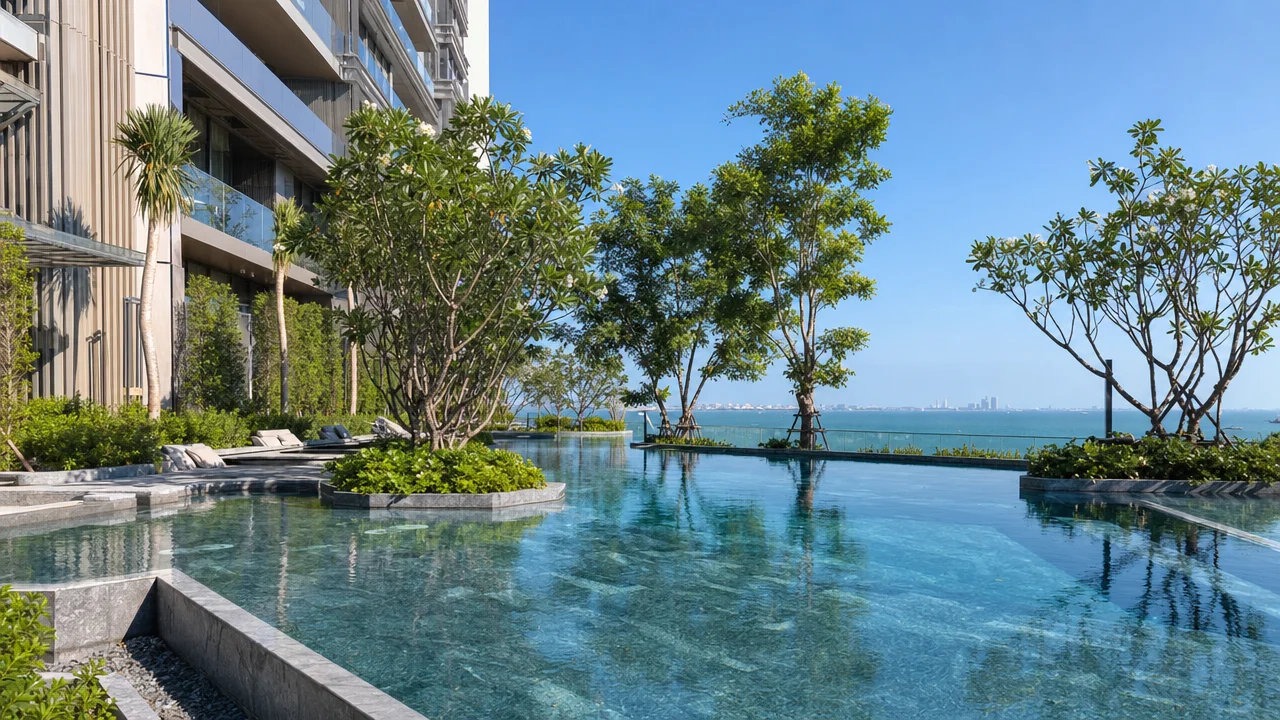
Pattaya remains one of the most affordable coastal locations in Thailand. Entry threshold starts from 1.5-2 million baht (approximately $42,000-55,000). This is a 25-30 m² studio in a second-line project from the sea.
In Bangkok and Phuket, starting positions begin at 3-4 million baht. Double the difference. For investors with limited budgets, Pattaya remains the entry point to the Thai market.
Liquid projects near the sea in Wongamat and Naklua are available at prices that seemed standard several years ago. Developers offer 2-3 year interest-free installments, up to 15% discounts for full payment, and bonuses in the form of furniture packages.
What this means for buyers in Pattaya
Oversupply in Bangkok creates a domino effect across the country. Developers who previously focused on the capital are now seeking alternative markets. Pattaya falls into the attention zone of major developers who didn't enter here before.
This increases competition among sellers and gives buyers more leverage for negotiations. Discounts, flexible payment terms, bonuses-all this is becoming the norm, not the exception.
For investors focused on long-term rentals, the current situation opens a window of opportunity. Prices are stable, supply is diverse, competition for tenants is high, but demand from expats and remote workers is growing.
Buyers should avoid projects with excessive supply of studios in one building. Better to choose complexes with diverse layouts where competition within the project is lower. Checking the developer, their financial stability, and history of completed properties is a mandatory step.
For investors with budgets lower than required for Phuket, Pattaya offers a reasonable entry point. For those considering seaside housing for personal use with rental potential, the current market provides choice without rush or pressure.
Pattaya won't become the new Phuket in one year. But it can become a reasonable entry point before the next growth stage. The main thing is not to chase promises of double-digit yields, but to calculate real numbers accounting for all expenses.
Conclusions: market shifted from sellers to buyers
350,000 unsold units in Bangkok-this is not a short-term correction. This is a structural shift that will change the rules of the game for the next five years. Developers who continue to launch projects without considering real purchasing power will face financial difficulties.
Buyers have gained power. Choice is enormous, competition is high, terms are flexible. This is the time for those ready to calculate, verify, and act without haste. The market no longer forgives impulsive decisions.