
Bangkok's Office Real Estate Market Enters Phase of Intense Competition
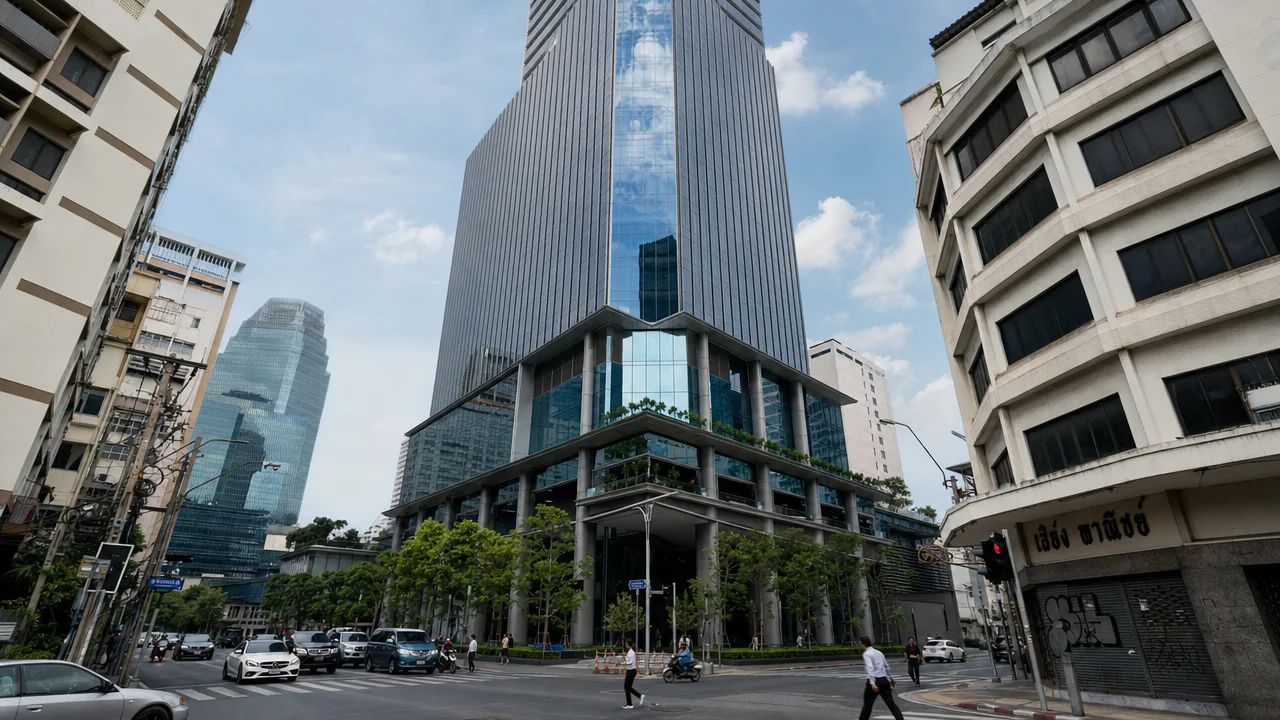
Between 2026 and 2031, over 616,000 square meters of new Grade A office space will enter Thailand's capital. Owners of buildings older than ten years face a choice: invest millions of baht in major upgrades or watch as large tenants migrate en masse to modern towers with advanced management systems and sustainability certifications. According to Cushman & Wakefield Thailand, Bangkok's total office stock stands at 8.93 million square meters, with 654,000 square meters of new space entering the market in 2025-2027 alone, more than half concentrated in the central business district.
Why Tenants Are Abandoning Older Offices en Masse
Corporate clients no longer focus solely on cost per square meter. Companies seek offices with measurable energy efficiency metrics, integrated building management systems (BMS), flexible layouts, and infrastructure for hybrid work. Modern towers offer high ceilings, natural lighting, relaxation zones, showers for cyclists, and ready-made IT infrastructure. Older Grade B buildings, which comprise 58% of the capital's office stock, physically cannot compete without deep reconstruction.
One Bangkok buildings already demonstrate the new standard. Tower 4 has reached 80-85% occupancy, and the management company has implemented a partnership with SH Living to provide tenants with ready-made furniture and meeting rooms. This reduces tenants' capital expenditure for move-in and addresses demand for business flexibility. Dusit Central Park is 60-65% occupied, creating pressure on surrounding older properties.
Numbers That Are Changing the Balance of Power
Colliers estimates new supply inflow as follows:
| Year | New Supply (sq. m) | Key Projects |
|---|---|---|
| 2026 | 243,000 | One Bangkok Tower 2, partially GR9 |
| 2027 | 81,000 | Central Embassy Phase 2 |
| 2028 | 200,000 | Signature Tower, The Central |
In Q1 2026, Bangkok's total office stock grew to 10.56 million square meters. Two new buildings added 84,303 square meters, both in the northern CBD. Leasing demand fell 14.6% quarter-on-quarter, but annual growth reached 29.7%, indicating gradual structural market alignment.
What Older Office Owners Are Doing to Survive
Rental rates for Grade A premises have stabilized at 943 baht per square meter per month. Direct rent reductions no longer work-tenants evaluate total cost of occupancy, not just the base rate. Owners have switched to incentive packages:
- Fit-out capital contributions
- Rent-free periods
- Flexible contract renewal terms
- Operating cost subsidies
Buildings with occupancy below 50% or those that have lost a major tenant and fallen below 70% are forced to freeze or reduce prices. According to Ukkrit Pornpattanapayiroj, Head of Office Leasing at Cushman & Wakefield Thailand, new buildings with occupancy above 50% and older ones with 80-90% can afford modest rate increases. The rest are fighting to retain existing clients.
Major Renovation as the Only Way Out
Buildings older than ten years require immediate investment:
Technical Systems. Replacement of outdated ventilation and air conditioning systems, BMS implementation for energy consumption control, installation of air quality sensors.
Common Areas. Lobby renovation, creation of coworking spaces, installation of showers and bicycle parking.
Digitalization. High-speed internet, mobile access control systems, apps for managing meeting room and parking space bookings.
Layout Flexibility. Floor plate modernization for quick reconfiguration to meet different tenants' needs.
The cost of such work runs into tens of millions of baht for a medium-sized building. Owners unwilling to invest are considering redevelopment-complete reorientation of the property for alternative use or demolition followed by new construction.
Geographic Expansion: Offices Move Beyond the CBD
New supply is spreading to the Bangna, Phahonyothin, and outer Sukhumvit areas. These locations attract companies seeking lower rental rates while maintaining modern standards. The northern CBD periphery saw average rates fall 4.8% in Q1 2026 due to two new buildings with low pre-commitment levels.
The central business district still holds over 5 million square meters-more than half of the capital's total stock. Midtown and suburbs occupy 2.41 and 1.71 million square meters respectively. But the balance is gradually shifting: companies that don't require a prestigious central address choose the periphery with better transport accessibility and parking.
When Will the Market Return to Equilibrium
Colliers identifies three conditions for returning to balance:
- Slower pace of new supply introduction
- Sustained net demand growth
- Accelerated withdrawal of obsolete Grade B buildings through conversion, renovation, or redevelopment
Recovery of equilibrium is not forecast before two years. Average occupancy continues to decline-Q1 2026 saw a 0.42% drop, with a 1.2% decline expected by year-end due to new supply exceeding absorption.
Risks and Opportunities for Investors
Capital Expenditure Risks. Obsolete assets require significant investment, reducing current yields and extending payback periods.
New Project Pressure. Introduction of 616,000 square meters may lead to localized vacancy spikes in specific micro-districts.
Quality Premium. Buildings with high ESG ratings and modern infrastructure trade at lower risk rates and attract more creditworthy tenants.
Geographic Diversification. Secondary hubs like Bangna and Phahonyothin may deliver better yield metrics with growing peripheral demand.
Investors need to revise discount models for older assets accounting for modernization capital expenditure. New properties with high pre-leasing are valued at lower capitalization rates, making them more attractive for conservative portfolios.
What This Means for Property Buyers in Pattaya
The situation in Bangkok's office market directly impacts the investment climate throughout Thailand. Major developers facing excess supply in the capital are shifting focus to secondary cities and resort zones. Pattaya and the Eastern Seaboard are receiving more attention as growth points for commercial and mixed-use projects.
For Russian investors, this means several things. First, competition for tenants in Bangkok is forcing management companies to raise service standards-these practices are gradually coming to Pattaya. Second, developers who previously built only in the capital are now launching projects on the coast with the same technologies and management systems. Third, investors who considered purchasing office space in Bangkok are switching to residential real estate in tourist zones with more predictable demand.
Pattaya benefits from this capital reallocation. The city receives higher-quality projects, and buyers gain access to modern construction and management standards previously available only in the capital. If you're considering investment in Thai commercial real estate, it's now wiser to look at mixed-use projects in growing locations than at obsolete office buildings in oversaturated Bangkok.
Conclusions: The Market Is Restructuring to New Standards
Bangkok's office market is undergoing structural transformation. Buildings constructed before 2015, without major renovation, are losing competitiveness. Tenants choose not by price but by total cost of ownership, energy efficiency, and space flexibility. New supply of 616,000 square meters through 2031 will increase pressure on older assets and force owners to either invest or exit the market.
For investors, the key question is assessing capital expenditure for modernization and tenants' willingness to pay a quality premium. For property buyers in Pattaya, this situation opens opportunities: developers are shifting attention to the coast, bringing modern technologies and management standards with them.