
Bangkok's Office Real Estate Market Faces Unprecedented Challenge
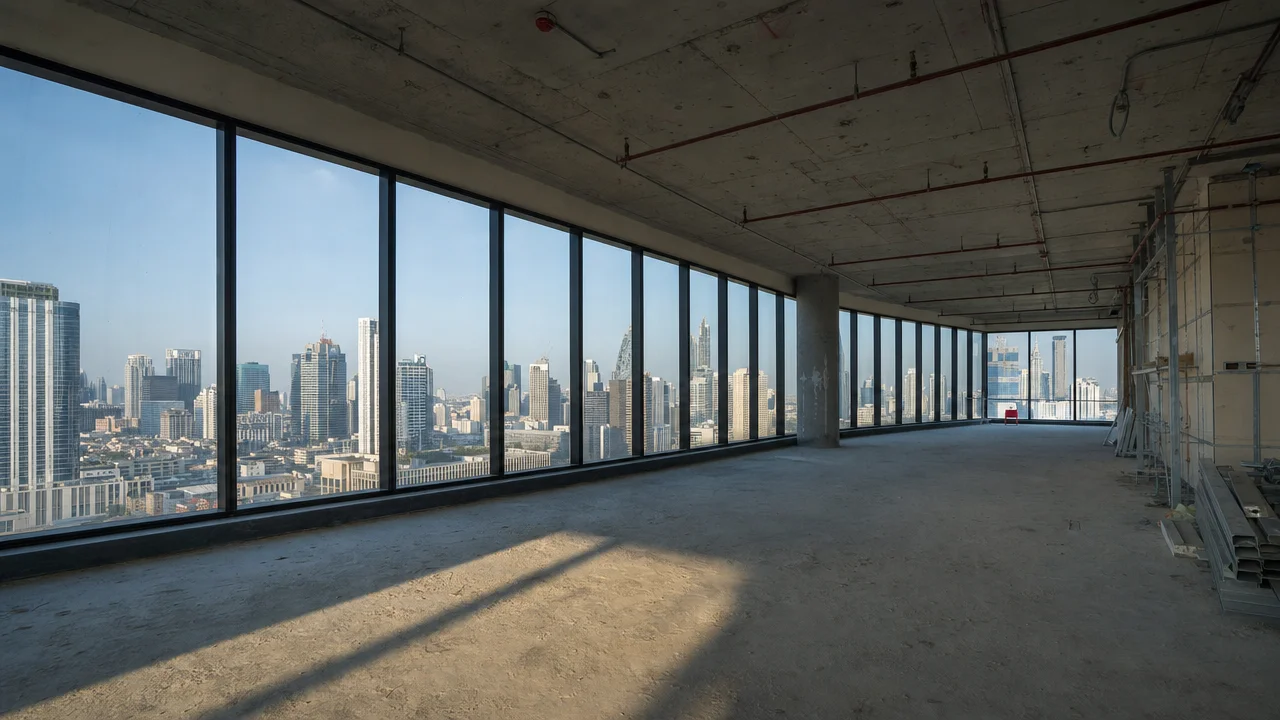
Bangkok is experiencing a structural crisis in office real estate. By the end of 2026, over 600,000 square meters of new Grade A supply will enter the market, while demand remains at 2019 levels. Older buildings constructed before 2010 are losing tenants: vacancy rates have exceeded 28%, while new complexes are only 65% occupied. The gap between modern and outdated properties has reached a critical point.
Why Record Supply is Entering the Market
Developers launched projects in 2022-2023, expecting demand to recover after the pandemic. Expectations were not met. Hybrid work format has reduced the need for office space by 20-30%. Companies are revising strategies: instead of renting 100 square meters for 10 employees, they take 70 meters and implement hot desking.
The largest 2026 projects are concentrated in the Silom and Sathorn areas. One complex with 85,000 square meters opened in March, a second with 120,000 meters is planned for November. Both offer rental rates from 950 baht per square meter per month. Owners of buildings from the 1990s-2000s cannot compete: their rates have dropped to 420-550 baht, but vacancy continues to grow.
What's Happening to Old Buildings
Buildings over 15 years old are losing ground for three reasons. First - energy efficiency. New complexes have LEED Gold or Platinum certification, electricity bills are 35-40% lower. Second - layouts. 1990s offices were designed for closed cabinets, modern companies require open space with coworking zones. Third - infrastructure. Tenants want electric vehicle charging stations, facial recognition systems, apps for booking meeting rooms.
Owners of old properties are trying to retain tenants with discounts. Rates have decreased by 15-22% over the past year. It helps little. Large corporations are moving to new buildings, vacated spaces remain empty for months. The average search time for a tenant in a 2005 building has grown from 4 to 9 months.
Numbers That Show the Scale of the Problem
The total volume of Grade A office space in Bangkok is 4.2 million square meters. Vacancy at the end of the second quarter of 2026 reached 18.7%. A year ago this figure was 14.3%. The difference of 4.4 percentage points means an additional 185,000 square meters are vacant.
Vacancy distribution by building age:
| Year of Construction | Vacancy, % | Average Rate, baht/m²/month |
|---|---|---|
| 2020-2026 | 12.5 | 920-1050 |
| 2015-2019 | 16.8 | 720-850 |
| 2010-2014 | 23.4 | 580-690 |
| Before 2010 | 28.9 | 420-550 |
New buildings are filling slower than forecasts. The complex opened in March had only leased 38% of space by July. The developer expected 60%. The reason - excess supply. Tenants are not rushing, knowing that in three months new options with more favorable terms will appear.
How Owners Are Responding to the Crisis
Some owners are converting office buildings to other formats. Two properties in the Asok area are being converted into serviced apartments. Conversion cost - about 15,000 baht per square meter. Payback at 70% occupancy will be 8-9 years. The risk is that the short-term rental market is also oversaturated.
Other owners are selling assets. In the first half of 2026, four office buildings with a total area of 92,000 square meters changed owners. Prices fell by 18-25% relative to 2024 valuations. Buyers - funds specializing in distressed assets. They plan deep reconstruction with subsequent resale or long-term ownership.
The third strategy - aggressive incentives. Some landlords offer rent-free periods up to 9 months for 5-year leases. Others cover fit-out and furniture costs. Fit-out budgets reach 8,000-12,000 baht per square meter. Such terms eat into margins but help avoid complete vacancy.
Forecast Through End of 2026
CBRE Thailand analysts expect vacancy to grow to 21% by December. Rental rates in buildings older than 10 years will decrease another 8-12%. New properties will fill at a rate of 3-4% per quarter, twice slower than pre-crisis pace.
Demand will not recover quickly. Companies are cutting office budgets. A survey of 340 corporations conducted in June 2026 showed: 62% plan to reduce rented space in the next two years. Only 11% are considering expansion. The rest will maintain current volumes.
Foreign companies that traditionally rented premium offices in central Bangkok are revising their Thailand presence strategies. Some are moving regional headquarters to Singapore or Hong Kong, leaving only sales departments in Bangkok. This reduces demand for spaces from 500 square meters.
Impact on Other Types of Commercial Real Estate
The office segment crisis affects adjacent markets. Retail on first floors of office buildings suffers from reduced traffic. Cafes and restaurants are losing visitors: office workers come 2-3 times a week instead of five. Revenue drops by 30-40%, retail rental rates have decreased by 12% over the year.
The coworking market is under pressure. Operators who rented space in office buildings are revising portfolios. Three chains closed 2-4 locations in Bangkok since the beginning of the year. The reason - cannibalization: companies rent their own offices at low rates instead of buying places in coworking spaces.
Parking spaces are getting cheaper. In buildings with high vacancy, monthly subscription cost dropped from 4,500 to 2,800 baht. Owners are trying to monetize idle infrastructure by opening parking to residents of neighboring condominiums.
What This Means for Real Estate Investors in Pattaya
The Bangkok office market crisis does not directly affect residential real estate in Pattaya, but creates three important effects. First - capital reallocation. Developers who lost money on office projects in the capital are curtailing programs in other cities. Two developers postponed the launch of condominiums in Pattaya scheduled for the fourth quarter of 2026.
The second effect - changing buyer priorities. Investors who previously considered commercial real estate are switching to residential. Demand for studios and one-bedroom apartments for tourist rentals grew by 14% in the second quarter of 2026. Yields of 6-8% per year look more attractive against the backdrop of office segment problems.
The third point - lessons for long-term planning. The Bangkok crisis shows the risks of excess supply. Pattaya has not yet faced such a problem in the residential segment, but the situation may change. The number of new projects grew by 23% over the year. If demand slows, the market will repeat the scenario of capital offices: prolonged vacancy, falling prices, owner losses.
Investors should choose projects with liquidity reserves. Buildings with modern infrastructure, low operating costs and flexible layouts will survive market correction. Properties without competitive advantages risk repeating the fate of old Bangkok offices: prolonged vacancy and forced sales.
Conclusions
Bangkok's office market is undergoing structural restructuring. Supply exceeds demand, vacancy is growing, rates are falling. New buildings are displacing old ones but filling slower than forecasts. Owners are lowering prices, offering incentives, converting assets to other formats.
The situation will not stabilize before 2028, when the cycle of new space delivery is completed. Until then, the market will remain under pressure. Real estate investors in Thailand should consider the risks of excess supply when choosing assets in any segment.