
Low-density condominiums with 30-80 units have become the main trend in Thailand's real estate market in 2025-2026. Investors from Russia and CIS countries are choosing between two poles: premium-class boutique projects on Phuket's west coast (Bang Tao, Cherng Talay, Surin) and mass complexes with 200+ units in Jomtien, Pattaya. The difference in entry price reaches 40-60%, but the difference in yield, liquidity and quality of life can be even greater. Let's analyze specific figures, risks and strategies for both directions.
What is low-density and why it matters for investors
Low-density (low-rise development with low density) refers to condominiums with 30-100 units, typically 3-5 floors, with an above-average ratio of total area to number of apartments. Typical example: 60 units on a 2-3 rai plot (3,200-4,800 m²), spacious lobbies, pools of 15+ meters, 1:1 parking.
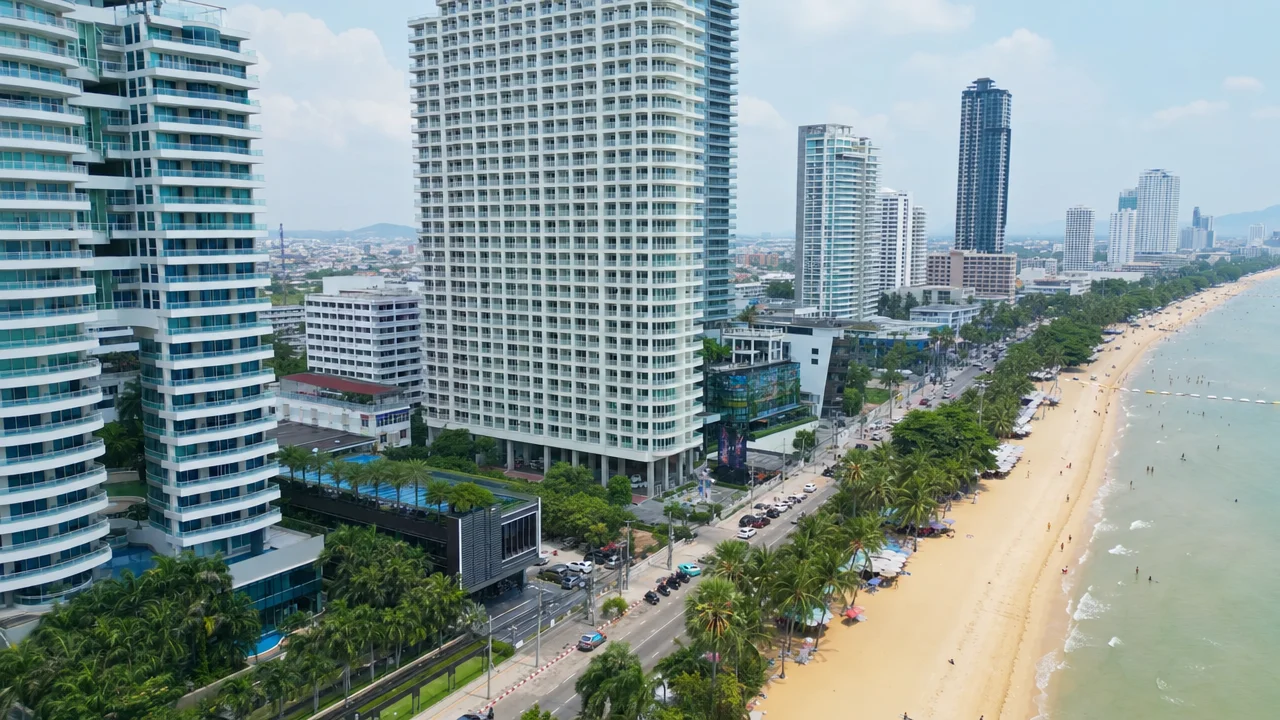
The opposite is high-density projects: 200-400 units in one or two buildings, studios from 22 m², parking for 50-60% of apartments, common areas minimized to reduce costs.
Low-density buyers pay for space, privacy and service. Tenants of such properties are mid to high-budget tourists (from 3,500 baht/night), long-term expats (from 25,000 baht/month), families. High-density projects attract budget travelers, short-term guests, young people. The difference in audience directly affects yield and wear-and-tear.
Bang Tao, Phuket: boutique projects for premium rentals
Bang Tao is a six-kilometer beach on Phuket's west coast, bordering the Laguna Phuket resort complex. The area ranks second in popularity among foreign buyers after Patong, but surpasses it in quality of life and capital growth.
According to web research data for May 2026, the average price of a 30-40 m² studio in Bang Tao is 4.5-6.5 million baht (125,000-180,000 rubles at the exchange rate of 27.5 rubles/baht). Two-bedroom apartments of 60-90 m² cost 8.5-16 million baht (230,000-440,000 US dollars). Price growth over the past five years has been 9-12% per year, which is above the Phuket average (7-8%).
Boutique projects in Bang Tao typically include 40-70 units, are managed by professional operators (often subsidiaries of the developer or international brands), and offer rental pools or guaranteed returns for the first 2-3 years. Typical net yield is 5-7% after deducting all expenses, including management, utilities, reserve fund and taxes.
Example: Origin Residences Bang Tao by public developer Origin Property (traded on SET under ticker ORN). The project includes studios from 28 m², priced from 4.1 million baht (about 11.7 million rubles). The developer offers rental management, projected yield of 8-10% per year. Freehold within the 49% foreign quota. Construction period is 2-3 years, expected off-plan price growth by completion is 20-28%.
Advantages of Bang Tao for investors
Infrastructure. Boat Avenue (shopping complex with restaurants, supermarkets, SPA), Porto de Phuket (mall with cinema), Laguna clinic 5-7 minutes away, international schools BIS and HeadStart within 10 km radius. Phuket Airport is 25-30 minutes by car, which is 15-20 minutes closer than from Patong or Karon.
Audience. Premium tourists (average rental rate for studio 4,000-6,000 baht/night in high season November-April), expats with children (long-term rental 30,000-50,000 baht/month for two-bedroom), digital nomads with DTV visa. Occupancy in high season is 80-90%, in low season 40-50%.
Capital growth. Bang Tao demonstrates steady price growth due to limited land supply (most belongs to Laguna Resorts & Hotels) and constant demand. Forecast for 2026-2030 is 40-55% increase from current off-plan prices.
Liquidity. Time to sell a completed property on the secondary market is 3-6 months, off-plan can be assigned within 60-90 days with buyer's premium (typically 5-10% of current price).
Disadvantages of Bang Tao
High entry threshold. Minimum price for a studio in a boutique project is 4.5 million baht (11.5 million rubles), which is 40-50% higher than similar properties in Jomtien.
Seasonality. Low season (May-October) reduces yield by 30-40%. Rains, waves, closure of some beach areas. Investors compensate for this with long-term rentals, but they require higher-class furniture and appliances.
Foreign quota. The 49% foreign quota in Phuket fills up faster than in Pattaya. In popular Bang Tao projects, the quota may close at the 50-60% construction stage. Alternative is 30-year leasehold with extension option, but this reduces liquidity and resale value by 15-25%.
Jomtien, Pattaya: mass projects for volume
Jomtien is the southern part of Greater Pattaya, a 6 km beach zone from Pratumnak Hill to the border with Na Jomtien district. Traditionally considered a quieter and more family-friendly alternative to central Pattaya, but in the last 5 years it has been built up with mass high-density projects of 200-400 units.
Average price for a 25-30 m² studio in a new Jomtien project is 2.5-3.5 million baht (6.5-9.5 million rubles). Two-bedroom 50-60 m² units cost 4.5-6.5 million baht. Price per square meter is 90,000-120,000 baht, which is 25-35% lower than Bang Tao.
Massive projects (200+ units) are built by mid-tier developers: Raimon Land, Sansiri (budget line), Heights Holdings, Unicca, Origin (mass line). Rental management is usually transferred to third-party companies or the owner themselves. Guaranteed returns are rare, rental pools are found in 30-40% of projects.
Typical net yield of a mass condo in Jomtien is 4.5-6.5% with active short-term rental management (Airbnb, Booking.com). Occupancy in high season (November-February) is 70-85%, in low season 30-45%. Average studio rental rate is 1,500-2,500 baht/night.
Advantages of Jomtien for investors
Low entry threshold. A studio can be purchased for 2.5-3 million baht (6.5-8 million rubles), which is accessible to buyers with a budget of up to 10 million rubles for the entire transaction including taxes and furniture.
High tourist traffic. Pattaya receives 8-10 million tourists per year (Tourism Authority of Thailand data for 2025), of which 30-35% stay in Jomtien. Demand for short-term rentals is stable year-round due to proximity to Bangkok (1.5 hours by car) and domestic tourism.
Developed infrastructure. Makro, Big C, Tesco Lotus supermarkets, dozens of cafes and restaurants, Jomtien night market, schools (rugby academy, ISE international school), Pattaya Memorial Hospital 10 minutes away. U-Tapao Airport is 30-40 minutes, Suvarnabhumi 1.5 hours.
Foreign quota. In Pattaya, the 49% quota fills up more slowly than in Phuket. Even in popular projects, it remains open until completion or closes only at the final sales stage.
Disadvantages of Jomtien
Oversupply. In 2024-2026, more than 40 new condominiums have been completed or are under construction in Jomtien, totaling 8,000+ units. Competition in the rental market is high, putting pressure on rates and occupancy. Weak projects (poor location, low-quality finishing, lack of management) show 3-4% yield or operate at a loss.
Low capital growth. Average price growth in Jomtien for 2020-2025 is 4-6% per year, which is below baht inflation and significantly below Bang Tao. The reason is excess new supply and lack of development restrictions. Forecast for 2026-2030 is 15-25% growth, but only for first-line projects or those with strong brands.
Construction and management quality. Mass projects often economize on materials, soundproofing, elevators, ventilation systems. Common areas wear out faster due to high resident density. Management companies in budget complexes perform worse than in the premium segment: slow response to requests, poor cleaning quality, reserve fund issues.
Resale difficulties. Time to sell a secondary property in a mass Jomtien project is 6-12 months, in some cases up to 18 months. Buyers prefer new projects with developer warranties, so secondary properties sell at a 5-10% discount from market prices of new analogues.
Comparison table: Bang Tao vs Jomtien
| Parameter | Bang Tao (boutique) | Jomtien (mass) |
|---|---|---|
| Studio price 30 m² | 4.5-6.5 million baht | 2.5-3.5 million baht |
| Price per m² | 140,000-180,000 baht | 90,000-120,000 baht |
| Net yield | 5-7% | 4.5-6.5% |
| Capital growth (5 years) | 40-55% | 15-25% |
| High season occupancy | 80-90% | 70-85% |
| Low season occupancy | 40-50% | 30-45% |
| Average rental rate/night | 4,000-6,000 baht | 1,500-2,500 baht |
| Secondary sale time | 3-6 months | 6-12 months |
| Foreign quota | Closes quickly | Closes slowly |
| Construction quality | High | Average/below average |
| Rental management | Professional | Often self-managed |
Risks of both directions
Bang Tao. Main risk is buying from an unreliable developer. Annually in Phuket, 2-3 projects are frozen or significantly delayed. Protection: check the developer's financial statements (for public companies available on SET website), presence of EIA (environmental assessment), construction permit and history of completed projects. Always engage an independent lawyer for due diligence.
Second risk is yield overestimation. Developers often promise 8-10% net yield, but actual figures after deducting all expenses (management fee 25-30%, utilities, repairs, reserve fund, taxes) may be 1.5-2% lower. Request detailed calculations with itemized breakdown.
Jomtien. Risk of market oversaturation. Within 1 km radius of your property there may be 5-7 competing projects with similar prices. If your complex doesn't stand out in location, design or service, yield will drop to 3-4% or lower. Before buying, check the map of new projects in the area, assess their construction stage and positioning.
Second risk is poor management quality. In mass projects, the management company is often hired by the developer on a minimum price basis, leading to maintenance problems, conflicts with residents, poor complex reputation on Airbnb and Booking. Before buying, clarify who will manage the building, their experience, and reviews.
Strategies for different investor types
Investor with budget of 6-10 million rubles, goal is short-term rental and exit in 3-5 years. Jomtien, studio 25-30 m² in a first-line project or within 300 meters of the beach. Choose developers with history (Sansiri, Raimon Land, Origin), verify presence of rental pool or management company. Expected yield is 5-6% net, capital growth 15-20% over 5 years. Total return including price growth is 20-26%.
Investor with budget of 12-20 million rubles, goal is stable yield and quality of life for personal use. Bang Tao, studio or 1-bedroom 35-45 m² in a boutique project 10-15 minutes walk from the beach. Use the property 2-3 months per year, rent out the rest through rental pool. Expected yield is 6-7% net accounting for personal use, capital growth 40-50% over 5 years. Total return is 46-57%.
Investor with budget of 20+ million rubles, goal is portfolio diversification and maximum capital growth. Bang Tao or Cherng Talay, two-bedroom 60-80 m² in branded residence or premium project by public developer. Purchase at off-plan stage with 30-40% installment until completion. Expected yield is 5-6% net (lower due to higher price), but capital growth is 50-60% over 4-5 years of construction and first 2 years of operation. Total return is 55-66%.
What this means for buyers in Pattaya
For investors already working with the Pattaya market, comparison with Phuket provides two practical conclusions.
First: Jomtien loses to Bang Tao in capital growth and quality of life, but wins in entry threshold and foreign quota availability. If your goal is to buy your first property with a budget up to 10 million rubles and learn rental management, Jomtien remains the optimal choice. But choose first-line projects (Jomtien Beach Road) or within 300 meters of the beach, avoid mass complexes on second-third line with density of 300+ units.
Second: if budget allows 12+ million rubles, consider diversifying between Pattaya and Phuket. One property in Jomtien for short-term rental and stable cash flow (yield 5-6%), second in Bang Tao for capital growth and personal use (capital gain 40-50% over 5 years). This strategy reduces the risk of oversaturation in one market and provides access to two different tenant audiences.
Third point: low-density projects also appear in Pattaya, but in limited quantities. Na Jomtien (south of main Jomtien) and Pratumnak Hill areas offer boutique condos with 40-80 units priced at 3.5-5 million baht for a studio. They provide a compromise between Pattaya's affordability and Phuket's quality, but require thorough verification of developer and location.
Conclusions: where is it more profitable to invest in 2026
Boutique condos in Bang Tao win in three parameters: capital growth (40-55% over 5 years vs 15-25% in Jomtien), quality of life (infrastructure, beach, audience) and liquidity (sale time 3-6 months vs 6-12). But they require a budget from 12 million rubles and readiness for yield seasonality.
Mass projects in Jomtien win in entry threshold (from 6.5 million rubles), foreign quota availability and stability of tourist flow year-round. But they lose in capital growth, construction quality and rental market competition.
The optimal strategy depends on budget and goals. Budget up to 10 million rubles - Jomtien, first line, verified developer. Budget 12-20 million - Bang Tao, boutique project, off-plan with installment. Budget 20+ million - diversification between two markets or premium property in Bang Tao for maximum capital growth.