Chinese Buyers Purchased Almost Half of All Foreign Condominiums in Thailand
In the nine months of 2023, Chinese citizens bought 4,991 residential units in Thai condominiums-47% of the total volume of transactions with foreigners. The total number of apartments sold to foreigners reached 10,703 units worth 52.3 billion baht (approximately 1.5 billion USD), which is 38% higher than the same period of the previous year. The data was published by the Real Estate Information Center (REIC), managed by the state-owned Government Housing Bank, based on Land Office registration records.
The share of Chinese transactions amounted to 24.7 billion baht. Almost 42% of all sales to foreigners occurred in Chonburi province, home to major beach resorts and industrial zones. Bangkok, the capital and main air gateway of the country, accounted for 37.5% of total sales to foreign buyers. Wichai Viratkapan, Acting Director of REIC, confirmed steady demand: buyers are purchasing apartments both for investment and as a second home in Thailand.
What Happened to the Pattaya Market Between 2023 and 2026
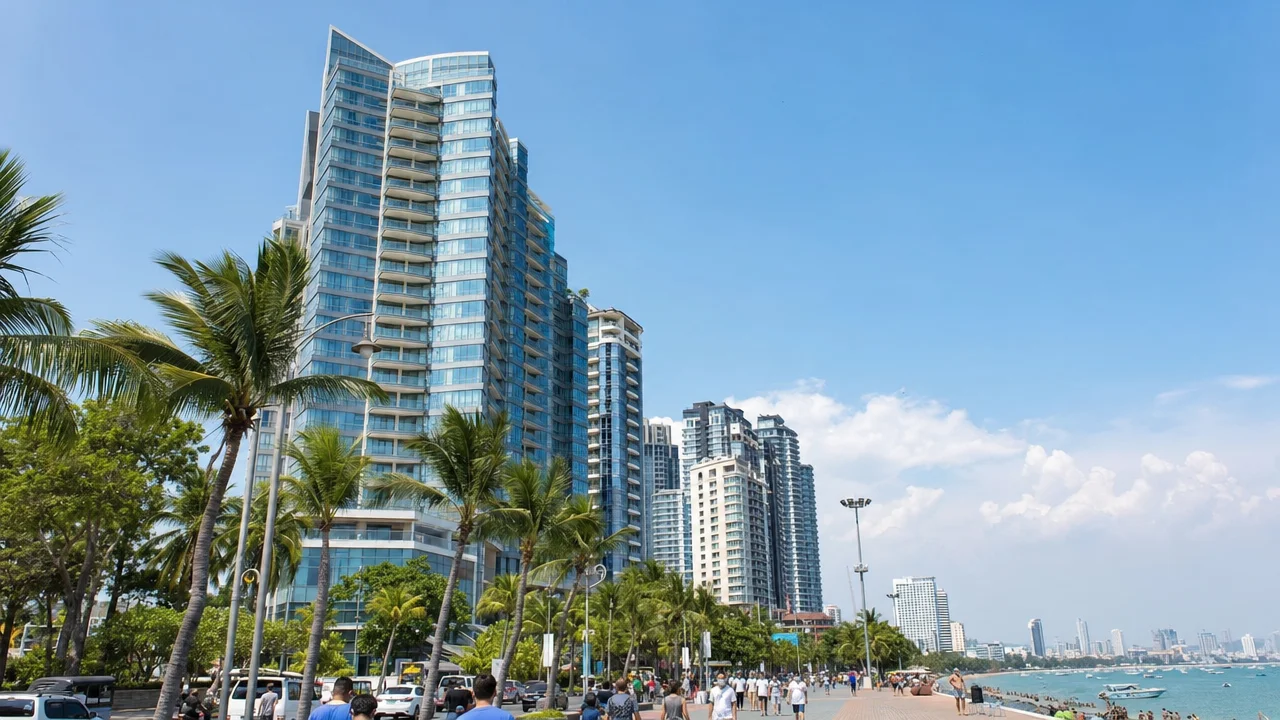
Chonburi province, where Pattaya is located, holds first place in transactions with foreigners. According to REIC estimates for 2025, Pattaya accounts for approximately 28-29% of all foreign condominium registrations in the country. In absolute numbers, this is about 4,200 units for 2025, an 8% increase compared to 2024. The forecast for full year 2026 suggests a further 3-5% increase.
New construction is also gaining momentum. According to CBRE Thailand and Colliers International, in 2025 developers launched about 11,500 new units in Pattaya, 14% more than the previous year. For 2026, approximately 13,000 units are in the pipeline. The average price of new construction across all areas rose from 108,000 baht per square meter in 2024 to 114,000 baht in 2025 (5.6% growth). The first quarter of 2026 showed a range of 118,000-122,000 baht per square meter, according to CBRE and Cushman & Wakefield.
Premium projects on the beachfront demonstrate higher dynamics. The average price of such apartments rose from 158,000 baht per square meter in 2024 to 173,000 baht in 2025 (9.5% growth). According to Knight Frank and analytics platform Hipflat, in 2026 the range is 180,000-200,000 baht per square meter. Gross rental yield from long-term rentals holds at 6.2-6.5%, according to GlobalPropertyGuide and Bamboo Real Estate.
Changing Demand Structure: Who's Buying Now
Chinese buyers still dominate, but their share in Pattaya has slightly decreased. If in 2023 Chinese buyers occupied almost half of all foreign transactions nationwide, by 2026 in Pattaya their share is estimated at 35-40%. The reason is growing purchasing activity from other countries. Russian citizens increased their presence to 18-20% of all foreign transactions in Pattaya, according to local agency estimates. Indian buyers account for about 8-10%, Europeans about 12-15%.
The structure of purchases has also shifted. Chinese investors more often choose ready apartments on the secondary market rather than under-construction properties. The average Chinese transaction in Pattaya in 2026 is 4.8-5.2 million baht, corresponding to studios and one-bedroom apartments of 28-35 square meters in Pratumnak, Jomtien and Central Pattaya areas.
How Chinese Demand Influenced Developer Strategy
Pattaya developers adjusted layouts and marketing for the Chinese audience back in 2022-2023. Typical changes: increasing the share of studios and one-bedroom apartments to 60-70% in new projects, adding Chinese-speaking concierges, adapting common area design to Asian buyer preferences (for example, separate clothes-drying areas, more enclosed common spaces instead of open terraces).
However, by 2026 the strategy is changing again. Developers are diversifying target markets. New projects launched in 2025-2026 more often offer two-bedroom apartments of 45-60 square meters aimed at European and Middle Eastern buyers. The share of such layouts grew from 15-20% in 2023 to 25-30% in new 2026 projects.
The reason is saturation of the Chinese segment and desire to reduce concentration risks. Several large projects in Jomtien oriented exclusively to Chinese buyers faced sales slowdown in the second half of 2025. Condominium Juristic Persons in such buildings report low meeting attendance and delays in common area fee payments, creating operational difficulties.
Foreign Quota: How Chinese Demand Changed Availability
Thai legislation limits the foreign ownership quota in condominiums to 49% of the total saleable area of the building. Units within this quota are registered to foreigners as full ownership (freehold) without time limitation. The remaining 51% is the Thai quota, for which foreigners require a Thai company or long-term lease (leasehold) for 30 years.
In popular Pattaya buildings, the foreign quota is often exhausted. According to local law firms, in 2026 about 40% of secondary properties in Pratumnak and Wongamat areas have filled foreign quotas. Buyers must either agree to a Thai company structure or search for other buildings. Prices for apartments in the Thai quota average 8-12% lower than similar units in the foreign quota, due to lower liquidity upon resale.
A bill is being discussed to increase the foreign quota limit from 49% to 75% and extend the leasehold term to 99 years. As of mid-2026, the document has not been adopted and remains under discussion in parliamentary committees. Lawyers recommend not building investment plans based on passage of this law.
Tax Incentives for Thai Buyers and Their Indirect Impact on the Foreign Market
In June 2026, the Thai government extended for one year the program reducing fees for real estate purchase transaction registration. Originally the measure was effective from 2025 and was to end on June 30, 2026. The Cabinet approved an extension until June 30, 2027. Official entry into force occurred after publication in the Royal Gazette.
The program applies only to Thai citizens buying apartments in the Thai quota. Conditions:
| Parameter | Standard Rate | Preferential Rate (until 30.06.2027) |
|---|---|---|
| Ownership transfer registration fee | 2% of assessed value | 0.01% |
| Mortgage registration fee | 1% of loan amount or assessed value (whichever higher) | 0.01% |
| Property price limit | Not applicable | No more than 7 million baht (purchase price and Land Office assessment) |
| Mortgage amount limit | Not applicable | No more than 7 million baht per contract |
The Ministry of Finance estimates the measure will support transactions worth about 540 billion baht annually and create additional investments of 305 billion baht annually compared to normal levels.
Foreign buyers are not entitled to these benefits-they pay all fees at standard rates. However, an indirect effect is noticeable: Thai buyers are more actively purchasing apartments in the Thai quota, freeing up more units in the foreign quota for non-residents. Juristic persons of several new Pattaya projects reported that the share of sold units in the Thai quota grew from 45% in Q1 2026 to 62% in Q2 after announcement of the program extension.
Tightening Short-Term Rental Rules
In parallel, the government is strengthening control over short-term rentals. The Hotel Act B.E. 2547 prohibits renting residential premises for less than 30 days in buildings without a hotel license. Enforcement in Pattaya tightened in 2024-2025 through actions by condominium juristic persons and inspections by the Provincial Administration Department.
In 2026, the government is developing a new legislative act (working title "Accommodation Act") that will place legal responsibility on online rental platforms such as Airbnb. The premise was mass violations in early 2025, when owners installed electronic code-access locks on public posts for unmanned guest check-in. The government officially warned it would regulate not only owners conducting illegal rentals, but also platforms that facilitate them.
The draft law explicitly defines platforms as a subject of regulation. In parallel, authorities plan to legalize and recognize some small forms of accommodation that are not condominiums. The Pattaya rental market is in a transitional phase: there is high probability of a structural shift entirely toward monthly rentals for terms from 30 days. Investors counting on short-term rental yields should verify that a specific building has a hotel license or zoning permitting daily rentals.
What This Means for a Buyer in Pattaya
Chinese buyer dominance in 2023 created a certain supply structure: many small studios, high construction density, infrastructure oriented to Asian residents. By 2026, the market is correcting. Developers are diversifying layouts and target audiences, expanding choices for European and Russian buyers.
For a Russian investor, key points:
Foreign Quota Verification. Before reserving an apartment, request written confirmation from the condominium juristic person of available foreign quota spaces with a current date. In popular buildings the quota is exhausted, and you'll be offered leasehold or a Thai company structure. This is legal but reduces resale liquidity by 8-12%.
Building Financial Verification. Request financial statements from the juristic person and sinking fund balance. A cheap apartment in a building with depleted fund and deferred maintenance is not a good purchase. Pay attention to common fee collection rate: if below 85%, the building may face operational problems.
Foreign Funds Transfer. To register foreign ownership, you must transfer the purchase amount to Thailand in foreign currency and obtain a Foreign Exchange Transaction (FET) form from a Thai bank. The form is required for transfers from 50,000 USD or equivalent. Conversion to baht must occur in Thailand-do not allow the sending country bank to convert currency before transfer.
Legal Support. Hire an independent Thai lawyer to review the purchase agreement. Don't rely on the developer's or seller's lawyer. Service cost is 15,000-30,000 baht, but it protects you from hidden encumbrances and document errors.
Transaction Timeline. For a ready secondary market apartment, the entire process from reservation to Land Office registration takes four to eight weeks. The only stage requiring your physical presence is ownership transfer registration at the Land Office. This can be delegated to a representative under notarized power of attorney.
Rental Yield. If you plan to rent the apartment, focus on long-term rental (from 30 days). Short-term rental is legal only in buildings with hotel license. Gross long-term rental yield in Pattaya in 2026 is 6.2-6.5% annually. Subtract utilities, juristic person fees (typically 35-50 baht per square meter monthly) and rental tax (12.5% of gross income for non-residents) to get net yield.
Resale Prospects. The Pattaya secondary market in 2026 shows sellers closing transactions on average 6% below initial asking price. Exposure time is three to six months for liquid areas (Pratumnak, Wongamat, Central Pattaya) and six to twelve months for remote locations. Apartments in foreign quota sell faster and at higher prices than those in Thai quota.
Chinese dominance in 2023 shaped supply but doesn't define it forever. The market is adapting, developers are expanding target audiences, the government is stimulating Thai buyers and regulating short-term rentals. For a Russian buyer this means more layout choices, more transparent rental rules, and the need for thorough verification of each building before purchase.