

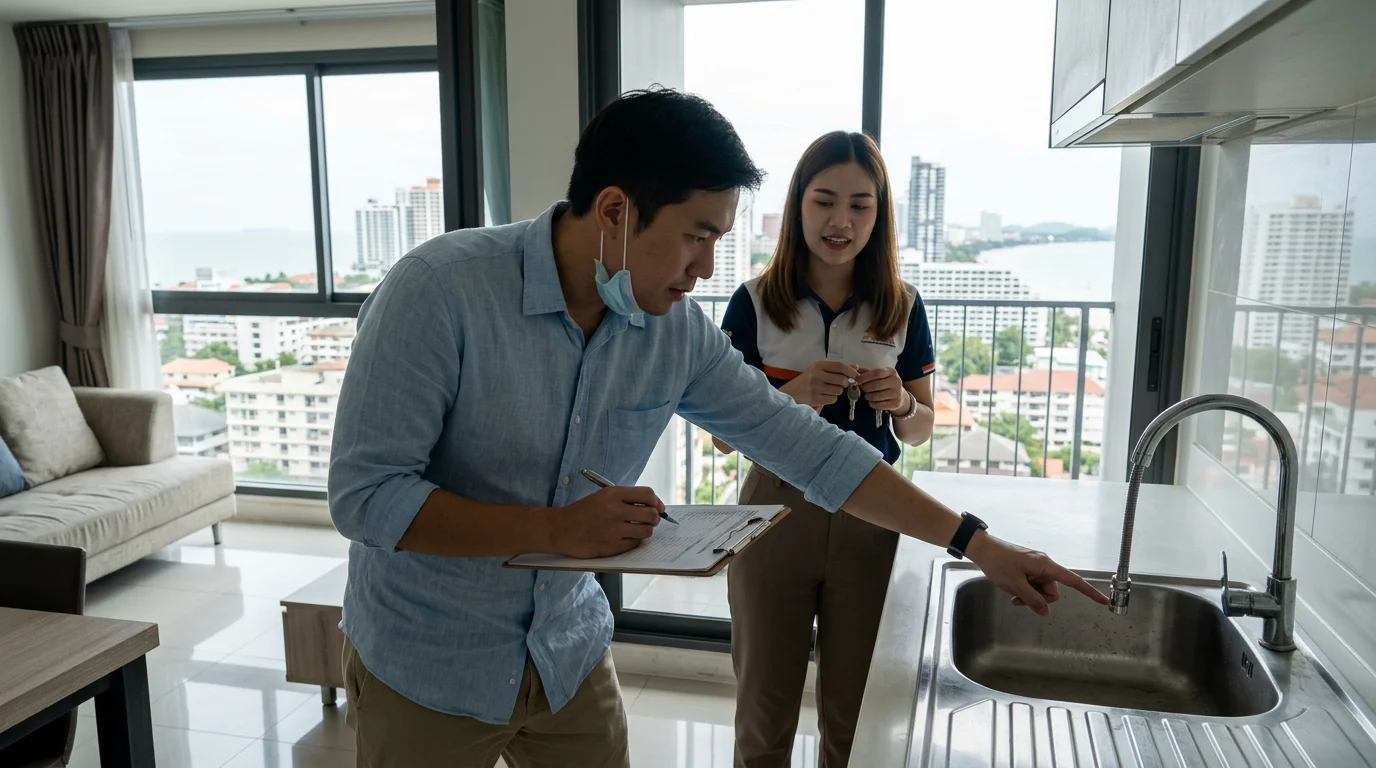

Why Pre-Signing Inspection is More Important Than the Deposit
Renting a condominium in Central Pattaya for a year is a typical choice for snowbirds, remote workers, and expats relocating to Thailand for the long term. The market offers thousands of options within a 2-kilometer radius of Central Beach Road: from 25 m² studios for 12,000 baht per month to 120 m² penthouses for 60,000 baht.
The problem is that 70% of tenants sign the contract after a single viewing, relying on photos and the owner's promises. A month later, it turns out: the air conditioner doesn't cool, the internet disconnects in the evenings, the management company demands extra payment for water, and the upstairs neighbor rents out the apartment daily to tourists.
A deposit of two months' rent (24,000-50,000 baht) is difficult to recover-even with photo documentation of defects. Thai landlords often withhold the deposit for "furniture wear" or "cleaning," which is impossible to dispute without a Thai lawyer. According to the Pattaya Expat Community Survey 2025, 38% of long-term tenants lost part or all of their deposit upon moving out.
This checklist systematizes 25 inspection points that need to be completed before paying the deposit and signing a year-long rental contract in Central Pattaya. Each point is based on real tenant cases and includes specific actions that can be completed in 2-3 days of inspections.
Building and Management Company Inspection
Legal Status of the Building
Before viewing the apartment, check the condominium itself. Request from the owner or agent a copy of the Condominium License-a document confirming the building's registration as a condominium with the Land Office. Without this license, the building has no legal status, and in case of a dispute, you won't be able to contact the management company or court.
In Central Pattaya, about 15% of buildings older than 20 years have documentation issues: the license hasn't been renewed, the building is registered as apartments (not a condominium), or the land ownership is registered through a nominee company that has been liquidated.
Financial Condition of the Management Company
The management company (Juristic Person) is responsible for maintaining common areas: pool, elevators, security, grounds cleaning. If it has accumulated debts to suppliers, this will affect you:
- Power outages in common areas
- Elevators not working for weeks
- Dirty pool without chemical treatment
- No security at night
Request from the management company a statement of the building's current debts. If the debt exceeds 500,000 baht-look for another property. Signs of problems: no security guard at reception, dirty corridors, notices about arrears on bulletin boards.
Service Fee Amount and Arrears
The service fee (Common Area Maintenance, CAM) in Central Pattaya ranges from 40 to 90 baht per m² per month. For a 30 m² studio, this is 1,200-2,700 baht monthly. Clarify:
- Who pays CAM-the owner or tenant? In 80% of cases, the tenant pays, but this must be specified in the contract.
- Does the owner have any CAM arrears? If yes, the management company may block your access to the pool and fitness until the debt is paid.
- What's included in CAM? Pool water, cleaning, security-yes. Electricity in the apartment, internet, cable TV-usually no.
Ask for the CAM payment receipt for the last 3 months. If the owner refuses-red flag.
Residence Rules and Restrictions
Each condominium has internal rules (Condominium Regulations) that can significantly limit your comfort:
- Ban on hosting guests for more than 3 consecutive days
- Ban on pets (even cats)
- Quiet hours from 22:00 to 07:00 with a 1,000 baht fine for violations
- Ban on using the balcony for drying laundry
- Restrictions on taxi and motorbike entry to the premises
Request a copy of the rules in English and read them before signing the contract. Especially relevant for buildings in the Walking Street and Soi Buakhao areas, where rules are stricter due to tourist flow.
Technical Apartment Inspection
Air Conditioners: Power, Age, Maintenance
An air conditioner in Pattaya operates 8-12 hours a day from March to October. Its condition directly affects your expenses: an old air conditioner consumes 40% more electricity and cools worse.
Check:
- Air conditioner age: look at the sticker on the indoor unit. If older than 7 years-ask the owner to replace it or reduce rent by 2,000-3,000 baht per month.
- Power: for a 15-20 m² room, you need a unit of at least 9,000 BTU. If it's 7,000 BTU-it won't handle the heat.
- Filter cleanliness: remove the front panel and inspect the filters. If they're black with dust-the air conditioner hasn't been cleaned for at least a year.
- Test run: turn on maximum and check the temperature after 15 minutes. If the room hasn't gotten colder-it needs a freon recharge (cost 1,500-2,500 baht).
Specify in the contract: air conditioner maintenance (filter cleaning and refilling) is the owner's responsibility, not the tenant's.
Electrical Wiring and Circuit Breakers
In old Central Pattaya buildings (built before 2010), wiring often isn't designed for modern loads: air conditioner, washing machine, electric stove, water heater simultaneously.
Check the electrical panel:
- Are there circuit breakers? If there are old fuse plugs-refuse the apartment.
- How many breakers? For a studio, minimum 2 (lighting + outlets), for 1-bedroom minimum 3 (+ separate line for air conditioner).
- Main breaker rating: for a 30-50 m² apartment, you need a 32-40 amp breaker. If it's 20 A-there will be constant outages.
Turn on the air conditioner, kettle, and hair dryer simultaneously. If the breaker tripped-the wiring can't handle the load.
Water Supply: Pressure, Water Heater, Leaks
In high-rise buildings (above 8 floors), upper floors often have low water pressure. Check:
- Open the bathroom tap to full power. If the stream is thin-the pressure is weak.
- Turn on the shower and flush the toilet simultaneously. If the shower pressure dropped-the system can't handle two points.
- Check the water heater: turn on hot water and time the heating. If after 5 minutes the water is still cold-the heater is faulty or too small (standard for studio-15 liters, for 1-bedroom-30 liters).
Inspect pipes under the sink and behind the toilet for leaks and rust. Ask the owner to show the last water bill-if consumption is more than 10 m³ per month for one person, there's a hidden leak somewhere.
Internet: Speed, Provider, Stability
For remote work and video calls, you need a speed of at least 50 Mbps. Central Pattaya has three main providers: True, AIS, 3BB. Quality depends on the building-in one house True provides 100 Mbps stably, in the neighboring one-20 Mbps with interruptions.
Check:
- Which provider is connected? Ask the owner to show the router and last bill.
- Tariff plan: speed and price. Standard for long-term rental-100 Mbps for 600-800 baht per month.
- Real speed: ask to run speedtest.net in your presence. If speed is 30% below stated-there's a problem with equipment or line.
- Stability: ask neighbors or in the building residents' chat if there are connection drops in the evenings (peak load).
If internet isn't connected or speed is low, agree with the owner to connect a new tariff before move-in. Installation cost 500-1,000 baht, usually paid by the owner.
Furniture and Appliances: Inventory and Condition
Most apartments in Pattaya are rented with furniture and appliances. Before signing the contract, compile a detailed inventory with photo documentation:
- Bed: check the mattress for stains, sagging, odor. If the mattress is more than 5 years old-request replacement.
- Wardrobe: open all doors, check hinges and drawer slides.
- Kitchen: stove (gas or electric), refrigerator, microwave. Turn on each appliance and check operation.
- Washing machine: run a test wash cycle. Check for leaks and excessive vibration.
- TV: turn on and check remote, availability of channels.
- Dishes and kitchenware: plates, pots, cutlery. Often owners take some dishes after the last tenant.
Photograph each item and all defects (scratches, chips, stains). Attach photos to the rental contract as an Annex. Without photo documentation, the owner will attribute all damage to you and withhold the deposit.
Rental Contract Inspection
Mandatory Contract Clauses
A rental contract (Lease Agreement) in Thailand can be in Thai or English. For long-term rental (from 6 months), a bilingual contract is recommended, where the Thai version has legal priority.
Mandatory clauses:
- Rental period: exact start and end dates (for example, from March 1, 2026 to February 28, 2027).
- Rent amount: amount in baht, date of monthly payment (usually 1st or 5th of the month).
- Deposit: amount (usually 2 months' rent), return conditions, return period after move-out (standard-30 days).
- Utilities: who pays for electricity, water, internet, CAM, garbage collection.
- Repairs and maintenance: who pays for minor repairs (changing light bulbs, unclogging drains), and who for major ones (replacing air conditioner, plumbing repairs).
- Early termination conditions: penalty for moving out early (usually loss of deposit or payment of 2 months' rent).
- Residence rules: whether guests can stay, keep pets, smoke in the apartment.
Red Flags in the Contract
Refuse rental if the contract:
- Doesn't have a clear deposit return deadline or says "by agreement."
- Owner demands payment for the entire year upfront (risk of money disappearing).
- Any guests are prohibited without notifying the owner 24 hours in advance.
- Tenant is obliged to pay for all repairs, including replacement of appliances and furniture.
- Owner reserves the right to enter the apartment at any time without notice.
- There's no force majeure clause (for example, if the building will be demolished or declared unsafe).
Contract Registration with Immigration
Under Thai law (Immigration Act Section 38), the owner must notify the immigration service of a foreigner's residence in their property within 24 hours. This is form TM.30.
For the tenant, this is important because without TM.30:
- You won't be able to extend your visa at the Pattaya immigration office.
- Upon leaving the country and returning, you may be denied a visa or the owner may be fined (fine up to 20,000 baht, which they may pass on to you).
Make sure the owner filed TM.30 within a week of your move-in. Request a copy of confirmation-this is a paper receipt or electronic notification from the system.
Financial Inspection and Hidden Costs
Electricity Rates: MEA vs. Owner Markup
In Central Pattaya, electricity is supplied by the Metropolitan Electricity Authority (MEA). The official rate for residential premises is 3.5-4.5 baht per kWh depending on consumption volume.
Problem: many owners resell electricity to tenants at an inflated rate-6-8 baht per kWh. This is legal if specified in the contract but increases your expenses by 50-100%.
Calculation example for a 30 m² studio with air conditioning:
- Average consumption: 300-500 kWh per month (high season, air conditioner runs 10 hours a day).
- At MEA rate (4 baht): 1,200-2,000 baht per month.
- At owner's rate (7 baht): 2,100-3,500 baht per month.
Before signing the contract, clarify the electricity rate and ask to see the last MEA bill. If the owner refuses to disclose the rate-negotiate for an official MEA meter in your name (possible in some buildings, requires management company consent).
Deposit: Amount, Return Conditions, Photo Documentation
The standard deposit in Pattaya is 2 months' rent. For an apartment at 20,000 baht, this is 40,000 baht. The deposit is returned within 30 days after move-out minus:
- Furniture and appliance damage beyond normal wear.
- Unpaid utility bills.
- Cleaning cost if the apartment is returned dirty.
Problem: the concept of "normal wear" is subjective. The owner may withhold 10,000 baht for "floor scratches" or "mattress stains" that were there before you.
Protection:
- Photograph the apartment on move-in day: each room, furniture, walls, floor, plumbing. Photograph all defects in close-up.
- Compile a written handover report (Inventory List) in English and Thai describing all defects. Sign together with the owner.
- Attach photos to the rental contract.
- Upon move-out, repeat the photo session and compile a return report.
If the owner refuses to return the deposit without justification, you'll have evidence for small claims court (Small Claims Court, limit 300,000 baht, review period 1-2 months).
Hidden Payments: Parking, Keys, Passes
In addition to rent and utilities, there may be additional expenses:
- Parking: in most Central Pattaya buildings, parking is paid-500-1,500 baht per month for a motorbike, 1,000-3,000 baht for a car. Clarify before signing the contract.
- Extra keys and access cards: if you lose a key or elevator card, replacement costs 500-2,000 baht.
- Registration fee: some management companies charge a one-time fee for registering a new resident-500-1,000 baht.
- Bulky waste removal: if you're disposing of old furniture or appliances, the management company may charge 500-1,000 baht for removal.
All these payments must be specified in the contract or building rules. If the owner or management company demands additional money without documentary basis-this is illegal.
Location and Infrastructure Inspection
Noise: Tourist Zones, Bars, Construction
Central Pattaya is the noisiest area of the city. Main noise sources:
- Walking Street and Soi 6-8: bars operate until 02:00-03:00, music is heard within a 300-meter radius.
- Beach Road: round-the-clock traffic, motorbikes without mufflers.
- Construction sites: new condominiums are constantly being built, work goes on from 08:00 to 18:00 six days a week.
Before renting, come for viewing at least twice: during the day and evening after 22:00. Stand on the balcony and listen for 10-15 minutes. If you hear music from bars or construction noise-look for another option or request an apartment on the opposite side of the building.
Buildings deep in sois (Soi 10, 12, 14) are quieter than on the Beach Road frontline. Price difference is 10-15%, but comfort is higher.
Transportation Accessibility
Central Pattaya is well connected by songthaew (route pickups, 10 baht per ride along Beach Road) and motorcycle taxis (20-60 baht depending on distance). But if the building is located deep in a soi, getting to main points (shopping centers, beach, hospital) may be inconvenient.
Check:
- Distance to the nearest songthaew stop: if more than 500 meters-you'll have to use motorcycle taxis (expenses 1,000-2,000 baht per month).
- Availability of pedestrian sidewalks: many sois don't have sidewalks, you have to walk on the road.
- Lighting: if the soi is dark in the evenings-it's unsafe to return late on foot.
For tenants without their own transport, buildings within 300 meters of Beach Road or Second Road are recommended.
Stores, Markets, Hospitals
For long-term living, proximity to infrastructure is important:
- Supermarkets: Big C, Tesco Lotus, Tops Market. Ideal distance-10 minutes walk (700 meters).
- Markets: night market on Thepprasit Road, day market on Soi Buakhao. Prices are 30-50% lower than supermarkets.
- Hospitals: Bangkok Hospital Pattaya (international, expensive), Pattaya Memorial Hospital (mid-range). For emergencies, distance to hospital should not exceed 15 minutes by taxi.
- Pharmacies: Boots chain and independent pharmacies on every corner.
Build a route from the building to the nearest supermarket and hospital via Google Maps. If travel time is more than 20 minutes on foot-you'll need a motorbike or frequent taxi rides