

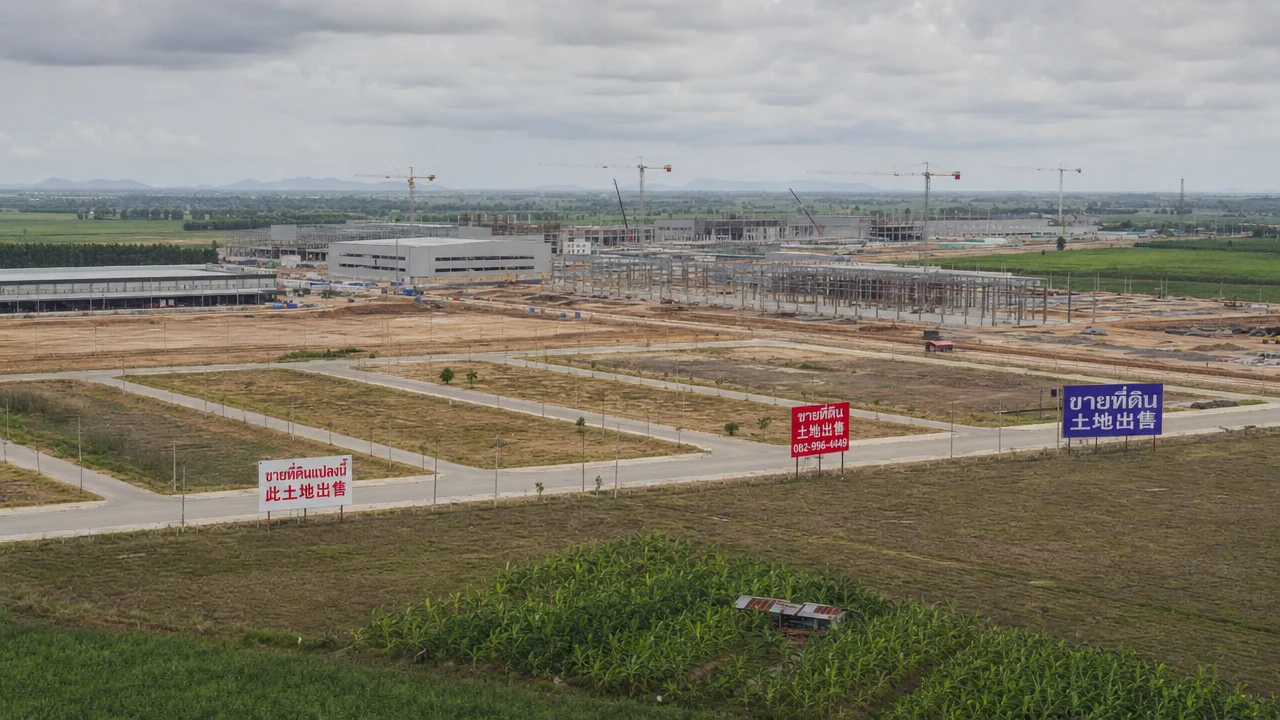

Land in EEC industrial zones rises to 7 million baht per rai - now the market is collapsing
Land in the Eastern Economic Corridor (EEC) - Chachoengsao, Chonburi, and Rayong - has increased in price by an average of 44% over the past 18 months. The peak occurred in early 2025 when plots of 500-1,000 rai were selling for 7 million baht per rai - a price unaffordable for local investors. However, by May 2026, this market faced mass sell-offs: owners are hastily disposing of assets due to a nationwide crackdown on nominee shareholders. Half of unfinished warehouses are listed for sale without buyers, and prices have crashed 20-30% in a quarter.
The reason for the spike was an influx of foreign capital, predominantly Chinese. Investors avoided official industrial zones managed by IEAT (Industrial Estate Authority of Thailand), where regulation is strict and costs are transparent. Instead, they bought agricultural land through Thai nominee shareholders, registered properties as "warehouses," and bypassed environmental licensing and Factory License (Ror.Ngor. 4) requirements. The Department of Business Development (DBD) is currently investigating over 20,000 suspicious companies, using artificial intelligence to track financial chains.
How foreign capital changed the land market structure
The strategy was simple: buy land through a Thai company with 51% Thai shareholders, register the property as a warehouse, actually use it for manufacturing. Building materials were imported from China, contractors were Chinese, labor was foreign. Local residents were not hired. Taxes weren't paid: companies understated revenue, and properties were listed as "warehouse facilities" rather than factories.
According to Pattaya Mail (May 2026), areas around these industrial zones have turned into closed enclaves with signs in foreign languages, shops for non-residents, and a complete absence of Thai staff. Local authorities call them "shadow Chinatowns." Residents of Chachoengsao and Rayong complain: Thailand gets nothing - no taxes, no jobs, no infrastructure.
Main provinces where price growth was recorded:
- Chonburi: Si Racha and East Pattaya industrial zones - land increased from 3.5 to 6.2 million baht per rai (77% growth)
- Rayong: Map Ta Phut industrial belt - from 2.8 to 5.9 million baht per rai (110% growth)
- Chachoengsao: plots along Highway 304 - from 1.9 to 4.3 million baht per rai (126% growth)
Figures are based on transactions registered with the Land Department from January 2025 to April 2026. However, actual deals often exceeded official prices: buyers paid cash supplements to reduce property transfer tax.
Nominee shareholder crackdown: how the state regained control
In May 2026, the Land Department issued an urgent circular (MT 0515.2/ว 10722), signed by Director-General Pornpot Penphas. The document requires land offices in eight provinces - Phuket, Surat Thani, Mae Hong Son, Chiang Mai, Krabi, Chonburi, Rayong, and Chanthaburi - to actively identify transactions where foreigners own land through nominee shareholders.
Main signs of a nominee scheme:
- Thai shareholders (51%) have low income but on paper invested millions of baht
- Foreigner is the sole director with signing authority
- Shareholders signed undated share transfer forms
- Company conducts no real business, pays no taxes, employs no staff
DBD has integrated databases with the Revenue Department and Land Office. The system automatically flags companies where shareholders' tax history doesn't match declared investments. Punishment is severe: the company is dissolved, the asset (land) must be sold within 180 days, and both the foreigner and nominee shareholders face criminal prosecution.
Panic began in March 2026. Owners who paid 7 million baht per rai a year ago are now listing plots at 4-5 million baht and finding no buyers. Legitimate investors avoid these assets due to "legal taint": illegal zoning, properties without permits, questionable origin of funds. The EEC industrial land market lost liquidity in three months.
How rising land prices affect villa costs in Pattaya
Pattaya is in the center of the EEC zone, and the spike in land prices directly impacted villa costs in East Pattaya, Na Jomtien, and adjacent areas. From January 2025 to March 2026, the average villa price in these areas increased 12-18%, although condominiums in the same region fell 1-2%.
Reasons for growth:
Shortage of development land. Villa developers compete with industrial buyers for plots. Land that previously cost 2-3 million baht per rai now sells for 5-6 million baht. Developers factor these costs into finished villa prices.
Rising infrastructure costs. Connection to electrical grids, water supply, and roads has increased 20-25% due to engineering network overload. Industrial facilities consume more resources than residential ones, and local authorities have raised tariffs for new connections.
Speculative demand. Some foreign investors who couldn't buy land directly switched to purchasing ready-made villas hoping for further growth. This pushed up secondary market prices by 8-10% annually.
Examples of specific projects:
- East Pattaya (Huai Yai area): 3-bedroom villas, 200-250 m², 200-300 m² plot. Price in January 2025: 8.5-10 million baht. Price in April 2026: 10-12 million baht (18% growth).
- Na Jomtien (Soi Najomtien 30-40): 2-3 bedroom villas, 150-200 m², 150-250 m² plot. Price in January 2025: 6-7.5 million baht. Price in April 2026: 7.2-8.8 million baht (15% growth).
However, since March 2026, the market has slowed. Buyers are waiting for industrial asset sell-offs to stabilize land prices. New villa offerings are stalled without deals; developers offer free furniture and appliances worth 150-300,000 baht to maintain nominal prices.
EEC condominiums declining for second consecutive quarter
While villas appreciate, condominiums in the EEC are losing value. The condominium price index in the three EEC provinces fell to 101.9 points in Q1 2026 - down 1% year-on-year and 0.3% quarter-on-quarter. This is the second consecutive decline after peaking in late 2024.
Breakdown by province:
- Chonburi: 101.7 points (down 1% year-on-year, down 0.3% quarter-on-quarter). Demand persists only near major industrial zones where expat managers and Thai engineers live.
- Rayong: 102.3 points (down 0.5% year-on-year). The most resilient market thanks to proximity to Map Ta Phut and stable petrochemical employment.
- Chachoengsao: 100.8 points (down 2.1% year-on-year). The sharpest decline due to distance from tourist zones and low local purchasing power.
Reasons for decline:
- High household debt levels. Thailand ranks among the highest in Southeast Asia for debt-to-GDP ratio. Banks reject more mortgage applications for properties under 3 million baht, though such units comprise the bulk of new EEC supply.
- Wage growth lags inflation. Thai purchasing power has declined for three consecutive years.
- Foreign buyers face additional requirements: banks demand larger down payments and proof of stable income from Thai sources.
Developers have switched to "hidden discount" tactics: instead of direct price cuts, they offer free furniture (56% of all promotions in Q1 2026 versus 52.4% in Q4 2025), air conditioners, washing machines. Savings for buyers - 150-300,000 baht per unit, but nominal prices remain level.
Contradiction: industrial land rising, housing falling
The EEC paradox is that industrial and residential real estate move in opposite directions. Land prices in Chonburi and Rayong industrial zones rose 20-30% over two years thanks to Chinese manufacturing relocation and Thailand's role as a logistics hub. Warehouse and factory construction continues at high rates supported by foreign direct investment.
However, the mass-market residential segment suffers. The problem isn't demand for housing per se, but financing accessibility. Thai families can't get mortgages; foreigners face tightening bank requirements. The result - a two-tier market:
- Premium segment in Bangkok (central business district) and Phuket is stable or growing. Buyers are affluent Thais and foreigners paying cash.
- Mass and suburban segment stagnates. EEC, Samui, and provincial city projects lose liquidity.
Phuket, for example, shows condominium price growth of 8-10% annually in 2026. Buyers are Europeans, Middle Easterners, and Asians seeking lifestyle investments, not speculative assets. Luxury villas on the island yield 5-8% annual rental returns - figures unattainable for the EEC market.
What this means for buyers in Pattaya
If you're planning to buy a villa in East Pattaya or Na Jomtien, this is a turning point. Land prices peaked and began correcting due to industrial asset sell-offs. Developers who purchased plots in 2024-2025 at 5-7 million baht per rai must now either freeze projects or sell villas with minimal margins.
Practical steps:
Wait until Q3 2026. Mass industrial plot sell-offs will stabilize the land market by August-September. Villa developers will access cheaper plots and reduce new project prices by 5-10%.
Verify land ownership structure. If buying a villa on leasehold land, ensure the developer owns the land directly, not through a company with nominee shareholders. Request a Land Office extract (Chanote, Nor Sor 4 Jor) and check transaction history. If land was purchased in 2024-2025 at over 5 million baht per rai, there's risk the transaction will be challenged.
Consider condominiums instead of villas. If your budget is under 10 million baht, a freehold condominium is legally safer. Prices have fallen for two consecutive quarters, and you can get a 10-15% discount plus 200-300,000 baht in free furniture. Na Jomtien and Pratumnak areas offer 50-70 m² units for 3.5-5 million baht - without land lease risks.
Avoid Thai company schemes. Despite many agents still offering villa purchases through Thai company registration with nominee shareholders, in 2026 this is a direct path to asset confiscation. DBD is investigating 20,000 companies, and audit probability is high. Legal alternatives - 30-year land lease with renewal option (registered at Land Office) or condominium purchase in foreign quota.
Monitor new visa programs. Thailand's government has expanded investment visas: purchasing a condominium from 3 million baht qualifies for long-term residence (LTR visa for retirees over 50 with additional income requirements, or Privilege Entry for any age). This is a legal way to stay in Thailand without nominee schemes.
The Pattaya villa market is undergoing correction after artificial land price spikes. Buyers who wait 3-6 months will access fairer prices and lower legal risks. Developers are already signaling willingness to negotiate: projects with "flexible payment terms" increased 40% since year-start.
Conclusion: market rebooting
EEC land price growth of 44% in a year resulted from speculative foreign capital influx through nominee schemes. The government crackdown ended this model. Industrial plots that cost 7 million baht per rai now sell for 4-5 million without buyers. Pattaya villas rose 12-18% due to land shortage, but correction has begun.
For buyers, this is a window of opportunity. The market is rebooting, developers are revising strategies, and legal property ownership instruments are becoming more accessible. The key is avoiding gray schemes and working with verified agencies that conduct full due diligence before purchase.