Market Paradox: Volume Growing, Average Purchase Price Falling
Foreign buyers registered 18% more condominium transactions in Thailand during the first quarter of 2026 compared to the same period in 2025. At the same time, the average cost per housing unit fell by 11%. Such data was published by Thailand's Department of Lands in April. Russians entered the top 5 buyers by number of transactions, but the average value of their purchases was only 3.2 million baht-15% lower than a year ago. Chinese maintained their leadership by volume, however their average purchase decreased from 5.8 to 4.9 million baht.
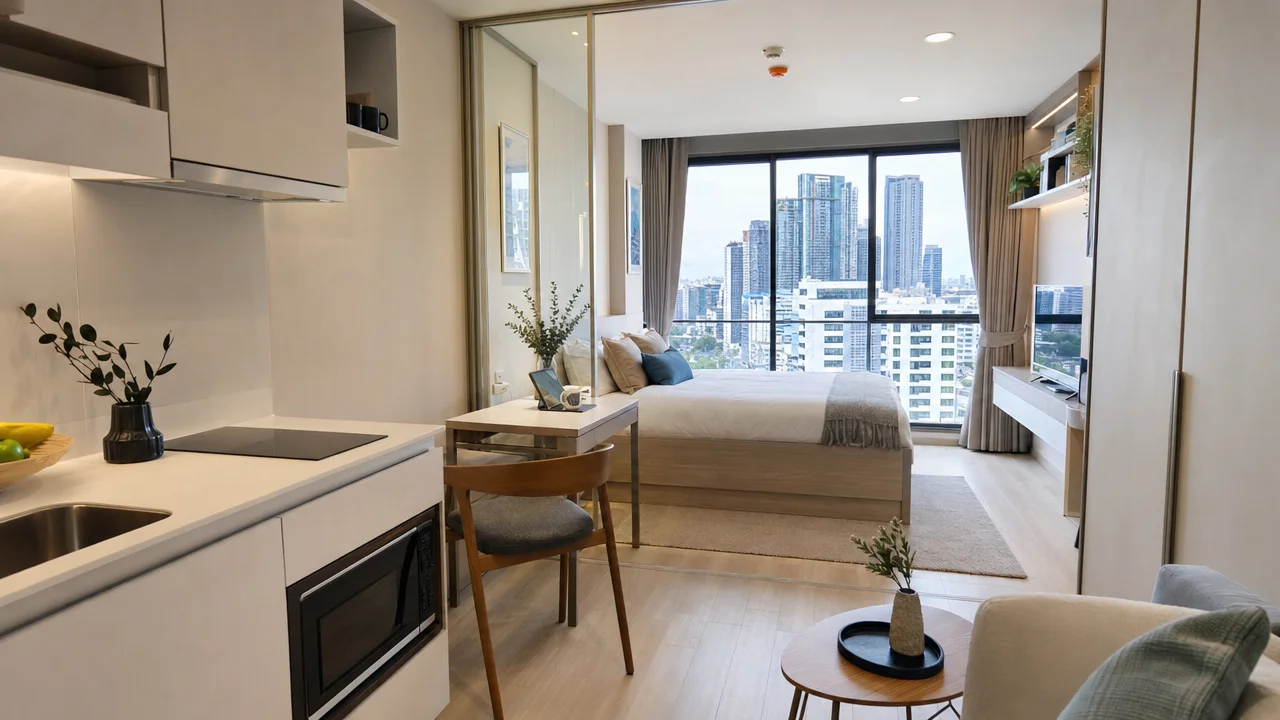
This trend is changing the structure of supply. Developers are reorienting towards compact studios and one-bedroom apartments of 25-35 m². Premium-class projects with sea views in Pattaya are facing prolonged sales, while budget complexes in Pratumnak and Jomtien areas are selling out at the foundation stage. Let's examine what's behind the numbers and how to use this shift for profitable investments.
Why Foreigners Are Switching to Budget Lots
Global economic uncertainty is forcing buyers to reduce risks. Geopolitical tensions in the Middle East are affecting energy prices: Brent crude oil jumped above $82 per barrel on July 13, 2026, after the Trump administration resumed Iran's maritime blockade. Rising transport costs and inflationary pressure are reducing free capital among private investors.
The Bank of Thailand in its June report recorded the strengthening of the baht to 33.2 per dollar-a two-year low. For foreigners, this means more expensive assets in dollar equivalent. A buyer from Russia who could purchase a studio for $90,000 a year ago will pay about $96,000 for a similar property today at the same price in baht.
Demand for liquidity is growing. Investors are choosing properties that can be quickly resold or rented out. A studio for 2.5-3.5 million baht within walking distance of Jomtien Beach brings 18-22 thousand baht in monthly rent and pays for itself in 10-12 years. A penthouse for 12 million baht can stand vacant for months, while its maintenance consumes up to 8 thousand baht monthly on utilities and sinking fund.
Demand Structure: Who's Buying and What Exactly
According to CBRE Thailand data published in May 2026, 62% of foreign transactions were for studios and one-bedroom apartments. Two-bedroom lots accounted for 28%, three-bedroom apartments and penthouses-only 10%. A year ago, the ratio was 54%, 32%, and 14% respectively.
Russian buyers prefer ready-to-move properties. The share of secondary market transactions increased from 41% to 57%. The reason is the desire to move in immediately and avoid construction delay risks. Chinese, on the contrary, are actively buying lots at the foundation stage, counting on discounts of up to 20% from the final price.
Geography has shifted from central Pattaya to the outskirts. Pratumnak, Jomtien, and Na Jomtien areas showed registration growth of 34%, 29%, and 41% respectively. Central Pattaya and Wongamat lost 8% and 12% of transactions. Buyers are seeking quiet, parking, and beach proximity, sacrificing walking distance to nightclubs.
Developer Response: Restructuring Product Lines
Major developers have already adjusted their plans. Sansiri launched the Base Central Pattaya project in February 2026-384 studios priced from 1.99 million baht. All lots sold out in 72 hours. Origin Property in March announced Origin Seaside Jomtien with 60% studios of 26-30 m² and a starting price of 2.3 million baht. Pre-sales closed at 78% in the first month.
Old premium-class projects are switching to aggressive marketing. Developers offer 48-month installments without interest, cover transfer fees (usually 2% of cost), and gift furniture packages worth up to 300 thousand baht. Some reduce prices by 10-15%, disguising this as "special promotions for foreigners."
Hybrid formats have appeared. Complexes like Arcadia Beach Resort offer studios with sliding partitions, transforming the space into something resembling a one-bedroom apartment. The area remains 32 m², but the layout allows for a separate sleeping zone. Price-3.6 million baht, which is 20% cheaper than a classic one-bedroom apartment of the same area.
Investment Arithmetic: Calculating Returns
Let's compare two scenarios for a buyer with a budget of 6 million baht.
Option A: one two-bedroom apartment of 52 m² in central Pattaya, price 5.8 million baht. Rent-25 thousand baht per month (70% occupancy due to high competition). Annual income: 210 thousand baht. Management, tax, and maintenance expenses: 65 thousand baht. Net profit: 145 thousand baht, yield 2.5%.
Option B: two studios of 28 m² in Jomtien area, priced at 2.9 million baht each. Rent-18 thousand baht per month each (85% occupancy thanks to affordable price). Annual income: 367 thousand baht. Expenses: 92 thousand baht. Net profit: 275 thousand baht, yield 4.7%.
The second option brings 90% more at the same investment amount. Liquidity is higher: selling two studios separately is easier than one expensive apartment. Risk is diversified-if one studio is vacant, the second continues to generate income.
Pitfalls of the Budget Segment
Low price doesn't always mean good value. Studios in remote areas like Bang Saray or Sattahip may cost 1.5-2 million baht, but their rental yield rarely exceeds 3% due to weak tourist flow. Reselling such a property is difficult: the secondary market there is virtually non-existent.
Construction quality in budget projects often suffers. Developers save on soundproofing, plumbing, and finishing. The owner of a studio in a 2 million baht complex may face leaks, wall cracks, and noisy neighbors within a year. Repair costs will eat up the purchase savings.
Sinking funds in cheap complexes are often underfunded. The management company charges 30-40 baht per m² per month, but this isn't enough to maintain the pool, elevators, and security. After 5-7 years, the building deteriorates, tenants leave, prices fall.
Legal Nuances for Foreigners in 2026
The foreign ownership quota in condominiums remains at 49%. However, in popular projects, this quota is exhausted at the construction stage. A buyer who comes to a completed property may discover that all lots for foreigners are sold. Only land lease (leasehold) for 30 years with renewal option remains.
Clean transaction verification is critical. The Land Office must confirm that the apartment is registered under Chanote title (Nor Sor 4), not an intermediate document. The seller must provide a certificate of no debts to the management company and sinking fund. Debt transfers to the new owner automatically.
Currency control has tightened. The Bank of Thailand requires documentary proof of the source of funds for transactions over $50,000. The buyer must provide a statement from a foreign account and a Foreign Exchange Transaction Form (FETF), issued by a Thai bank when crediting foreign currency. Without FETF, registering ownership to a foreigner is impossible.
Forecast for the Second Half of 2026
Knight Frank Thailand analysts expect further transaction growth of 12-15% by year-end while maintaining the downward trend in average purchase price. Developers plan to launch about 40 new projects in Pattaya, of which 70% target the budget segment.
Mortgage interest rates for foreigners remain high-6.5-7.5% per annum. Banks require a down payment of at least 40%, making lending unprofitable for most buyers. Cash transactions dominate.
The baht exchange rate may weaken in the second half of the year. The 2026-2027 tourist season is forecast to be weaker than the previous one due to rising jet fuel prices and reduced flights from China. Thailand's export revenues are declining amid a slowdown in the global economy. A weaker baht will make Thai real estate cheaper for foreigners, which could stimulate demand in the fourth quarter.
What This Means for Buyers in Pattaya
Russian investors should now look towards ready-to-move studios and one-bedroom apartments in the secondary market. Sellers who bought at the peak in 2023-2024 are ready to concede 10-15% from the original price for a quick sale. A property for 2.8 million baht in Pratumnak area that cost 3.2 million two years ago is a real opportunity.
Jomtien and Na Jomtien areas offer the best price-to-rental potential ratio. Beach proximity, developed infrastructure, and relative quiet attract long-term tenants-retirees and remote workers. Occupancy there is consistently higher than in the center.
Avoid projects at the foundation stage from little-known developers. The risk of construction freeze or developer bankruptcy has increased. If you want to buy at excavation stage-choose only top companies: Sansiri, Ananda, Origin, LPN. They have financial cushions and access to bank loans.
Diversification works. Two budget properties are better than one expensive one. You reduce vacancy risk, increase aggregate income, and maintain flexibility when selling. One lot can be kept for personal use, the second-rented year-round.
Currency risks require attention. Buying in baht with a strong currency can result in losses when the ruble weakens. Consider real estate as a long-term investment for 7-10 years, when currency fluctuations smooth out. Short-term speculation on exchange rate differences is currently unpredictable.
Practical Steps for Investors
Start with analyzing specific complexes. Request from the management company data on occupancy, average rental rate, and current resident debts. High debt is a red flag indicating management or property quality problems.
Visit the area at different times of day. A quiet soi during the day can turn into a noisy artery in the evening when bars and massage parlors open. Check parking availability, road conditions, and grocery stores within walking distance.
Hire an independent lawyer to verify documents. Service cost-15-25 thousand baht, but it protects against buying an apartment with encumbrances or in a complex with exhausted foreign quota. The lawyer will check title history, presence of legal disputes, and layout compliance with registered plans.
Calculate the full cost of ownership for 5 years ahead. Include transfer fees (2%), stamp duty (0.5%), annual property tax (0.02-0.1% of cadastral value), sinking fund contributions, utilities, and furniture expenses. Real returns often turn out 1-2 percentage points lower than calculated.
Prepare for negotiations. The market has shifted in favor of buyers. Sellers are ready to discuss price, assume part of the fees, and leave furniture. Don't hesitate to offer 5-10% below the asking price-in half the cases you'll meet halfway.
Conclusion: A Moment for Selective Purchases
Growing transaction numbers with falling average purchase price is not a sign of market weakness, but its restructuring to new realities. Foreigners are adapting to economic uncertainty, choosing liquid and profitable assets instead of prestigious but low-yield ones.
For investors in Pattaya, this is a window of opportunity. The budget segment offers returns 1.5-2 times higher than premium with comparable risks, if you carefully choose the property and area. The secondary market is saturated with offers from motivated sellers ready for concessions.
Key success factors-location in proven areas, ready-to-move property from a reliable developer, legal transaction purity, and realistic expense assessment. Emotional purchases and chasing illusory benefits will lead to losses. Cold calculation and patience will bring stable income in baht and dollars over a 7-10 year horizon.