
A 7.8 Million Baht Deal and an Unpleasant Surprise Five Months Later
In spring 2025, a buyer from Moscow purchased a 42 m² one-bedroom apartment in a new project in northern Wongamat for 7.8 million baht. The deal went through the Land Office, with a complete set of documents in hand, including a Chanote (Nor Sor 4) in his name. Five months later, his neighbor on the same floor attempted to transfer an adjacent unit - and was refused. The reason: the foreign quota in the building was exhausted. The Land Department refused registration, despite the seller assuring the buyer of available quota.
The problem isn't that the 49/51 rule suddenly changed. The Condominium Act B.E. 2522 has been in effect since 1979 and clearly establishes: foreigners can own no more than 49% of the saleable area of a condominium. The problem is that buyers rarely check the current quota balance before making a deposit - and discover the trap only at the Land Office registration stage, when getting money back is already difficult.
What is the Foreign Quota and Why Does It Run Out Early
By law, any condominium building in Thailand is divided into two parts: up to 49% of the area can be registered to foreign passports (foreign quota), the remaining 51% or more - only to Thai citizens or Thai legal entities (Thai quota). The type of ownership is the same - freehold (full ownership), only the owner's nationality differs.
The quota is calculated from the total saleable area of all units in the building. If a project has 100 apartments with a total area of 5,000 m², foreigners have access to a maximum of 2,450 m². Once this area is allocated, the next foreign buyer will be refused at the Land Office - even if the seller has already accepted their money.
Why the quota runs out earlier than buyers expect:
- Developers reserve part of the quota in early construction stages for investors who haven't yet completed the transfer. Formally, units appear as available, but are actually already occupied.
- The management company (Juristic Person) updates quota data only after registering the transaction at the Land Office. Between signing the contract and transfer takes 30-90 days - during this time, several buyers may simultaneously claim the last percentages.
- In old buildings, previous owners could transfer units from Thai quota to foreign (or vice versa) through complex schemes with nominee companies. This distorts the actual balance.
According to Thailand's Land Department, over 1,200 complaints were registered in 2024 from foreign buyers against condominium developers. Most conflicts are related precisely to quota exhaustion at the registration stage.
Five Documents to Request Before Making a Deposit
Checking the remaining quota isn't a request to an agent to "check with the developer." You need written confirmations from official persons who bear legal responsibility for data accuracy.
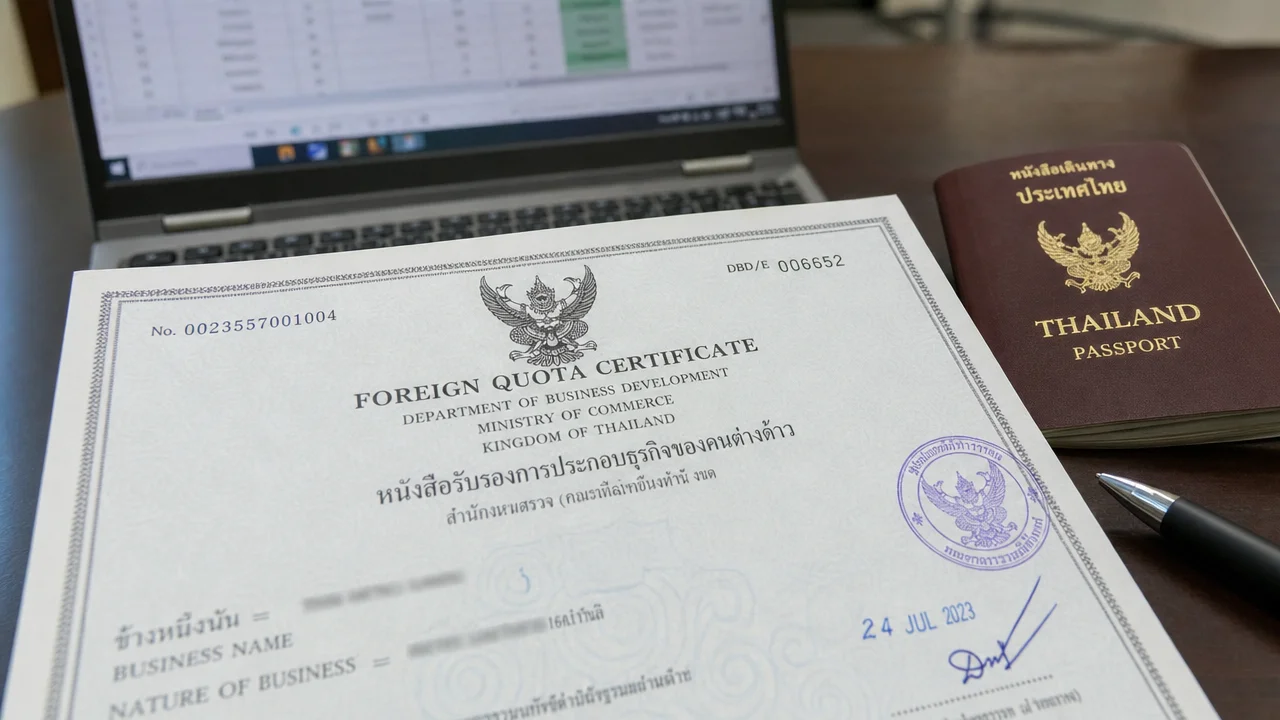
Foreign Quota Certificate
This is the main document. Requested from the condominium management company (Juristic Person) or from the developer (for new buildings where the Juristic hasn't yet been formed). The certificate must contain:
- The total saleable area of the building in square meters.
- The current percentage of foreign ownership (e.g., 45.2% of the allowed 49%).
- The number of the specific unit you're buying, with confirmation that it's included in the foreign quota.
- Date of certificate issuance (no older than 7-10 days).
- Signature and seal of the Juristic Person chairman or authorized person from the developer.
Without this certificate, the deal at the Land Office won't go through. If the seller refuses to provide it before making a deposit - this is a red flag.
Extract from the Juristic Person Registry
Requested directly from the condominium management company office. The document is in Thai, but key figures are clear: total number of units, number of foreign owners, remaining quota in percentages. Ask your lawyer to certify the translation of key points.
Copy of the Seller's Chanote (Nor Sor 4)
Verify that the current unit owner is the person specified in the sale and purchase agreement. If the Chanote is registered to a Thai company and the seller is an individual - demand a power of attorney and company formation documents. Fraudsters often sell units from Thai quota, promising to "transfer later" through a shell company - which is illegal and won't work at the Land Office.
Confirmation of No Encumbrances
Requested at the Land Office by Chanote number. The document shows whether there's a mortgage, seizure, or legal disputes on the unit. The check is paid (about 100 baht), takes 15-30 minutes. Without it, you risk buying an apartment that the bank will take in six months for the previous owner's debts.
Condominium Management Agreement (Condominium Act Regulations)
It specifies the rules for quota distribution, unit reservation procedure, penalties for violations. If the agreement has a clause that the developer can temporarily "freeze" quota for future sales - this is legal practice, but you should know about it in advance.
How to Check the Quota Yourself: Step-by-Step Instructions
If you don't want to rely on the seller's or agent's words, you can conduct the check yourself. It will take 1-2 days and basic English knowledge (or translator assistance).
Step 1. Get from the seller the unit's Chanote number and condominium name (full legal name in English and Thai).
Step 2. Visit the condominium management company office (Juristic Office). Usually located on the building's first floor or near the lobby. Request a Foreign Quota Confirmation Letter. If the Juristic hasn't yet been formed (new building) - contact the developer's office.
Step 3. If the management company refuses to issue the certificate (rare, but happens), go to the district Land Office (for Pattaya - Pattaya Land Office, Soi Siam Country Club). Present your passport, name the condominium address and Chanote number. The officer will check the registry and tell you the current foreign quota percentage. The service is free but may take 1-2 hours in queue.
Step 4. Ask your independent lawyer (not the one recommended by the seller) to double-check the data. The lawyer will request an extract from the Land Department database, showing all registered transactions for this building over the last 6 months. If the quota is close to 49% and 5-10 more units are queued for registration - your deal is at risk.
Step 5. Secure the verification result in the Sale & Purchase Agreement. Add a clause: "The seller guarantees that at the time of transaction registration at the Land Office, unit No. XXX is included in the condominium's foreign quota. In case of registration refusal due to quota exhaustion, the seller is obligated to return 100% of contributed funds within 14 days plus 2% monthly penalties." Without such a clause, getting money back through court will be long and expensive.
What to Do If the Quota Runs Out After Making a Deposit
The situation is unpleasant but solvable - if you act quickly.
First option: demand a unit replacement. If the same building has other apartments in the foreign quota (even on a different floor or with different layout), the developer is obligated to offer an alternative. The price difference can be compensated with additional payment or discount.
Second option: transfer through leasehold (30-year lease with renewal right). This isn't full ownership, and such a unit's resale liquidity is 20-30% lower. But if there's no alternative and money is already transferred, it's better than litigation.
Third option: contract termination and refund. Under Thai law, if the seller cannot fulfill obligations (provide a unit in foreign quota), the buyer has the right to a full deposit refund plus compensation for losses. But in practice, this only works if the corresponding clause is written in the contract. Without it, the developer may offer to return only 50-70% of the amount, withholding "administrative expenses."
Fourth option: registration through a Thai nominee company. Some lawyers offer this scheme as a "law bypass." Formally, you create a Thai legal entity where 51% of shares belong to Thai citizens (usually nominees), and 49% to you. The company buys a unit from Thai quota, you control it through a director's agreement. The scheme is legal on paper, but the Land Department has intensified checks of such structures since 2024. If it's revealed that Thai shareholders are nominees without real capital participation, the deal can be annulled, and you'll lose both the apartment and money.
Quota Check Specifics in Different Pattaya Districts
Pattaya's condominium market is heterogeneous. The remaining foreign quota and speed of its exhaustion depend on the district and project class.
Wongamat and Naklua (north). The most expensive segment: price per square meter in foreign quota starts from 130,000 baht and reaches 180,000+ baht. Entry threshold - from 7 million baht for a new one-bedroom apartment. Foreign quota here is exhausted quickly, often during pre-sales. If you're buying in an already completed project, definitely check the balance: in some buildings only 1-2% of the allowed 49% is available.
Pratamnak Hill. Medium price segment: 90,000-140,000 baht/m². Quota is exhausted slower than in Wongamat, but faster than in Jomtien. Many projects with sea views here, purchased by European and Russian investors. Quota check is mandatory, especially if the building is older than 5 years.
Jomtien. Mass segment: 70,000-110,000 baht/m². Quota is usually not exhausted even in 10-year-old buildings. But be careful: low price sometimes means units are sold from Thai quota, and the buyer is promised to "resolve the issue later" - which is illegal.
Central Pattaya (Beach Road, Second Road). Old housing stock, many buildings from the 1990-2000s. Foreign quota is often completely exhausted. If you're offered an apartment in foreign quota in such a building - demand a certificate from the Land Office, not from the management company. In old projects, Juristic Person data may be outdated.
What This Means for a Buyer in Pattaya
Foreign quota isn't an abstract legal formality. It directly affects entry price, deal speed, and resale possibility.
If you're buying an apartment for personal residence, quota check protects from a situation where in a year you decide to sell the unit, and a foreign buyer won't be able to transfer it. This reduces liquidity by 30-40%.
If you're an investor planning to rent out the apartment, quota affects the pool of potential buyers when exiting the deal. A unit in foreign quota can be sold to both a Thai and a foreigner. A unit in Thai quota - only to a Thai or through a leasehold scheme, which narrows the market.
If you're buying in a new building, demand from the developer written confirmation of your unit's reservation in foreign quota before making the first payment. Some developers accept deposits from 10-15 buyers for the last 5% of quota, expecting some deals to fall through. You shouldn't be the one left out.
If the management company or developer refuses to provide a Foreign Quota Certificate before signing the contract - walk away from the deal. Pattaya's market has hundreds of projects with transparent quota and honest sellers. Don't risk millions of baht for a "good deal" that could turn into litigation.
Quota Check Checklist: What Should Be in Hand Before Signing the Contract
Before making a deposit (usually 10% of the unit cost), you should have:
- Foreign Quota Certificate from Juristic Person or developer indicating your unit number and dated no older than 10 days.
- Copy of seller's Chanote (Nor Sor 4) with Land Office stamp.
- Confirmation of no encumbrances from Land Office (no older than 30 days).
- Sale & Purchase Agreement checked by your independent lawyer, with a clause about refund in case of registration refusal due to quota.
- Bank details for transferring funds from abroad and bank contacts for preparing FET-form (Foreign Exchange Transaction Form) - without it the Land Office won't register the deal, even if quota is available.
If at least one document is missing - don't sign the contract. The timeframe for checking all papers is 3-7 business days, this is normal practice. A seller who rushes you to "make a deposit today before the price rises" - is either unprofessional or a fraudster.
Foreign quota in Pattaya condominiums isn't an obstacle to purchase, but a filter that cuts off non-transparent deals. Buyers who check quota before making a deposit save months of stress and hundreds of thousands of baht on lawyers. Those who rely on an agent's words risk repeating the story of the neighbor from Wongamat, who learned about the problem only in the Land Office.