How Buyers Make Decisions in 8 Seconds and What It Means for the Condo Market
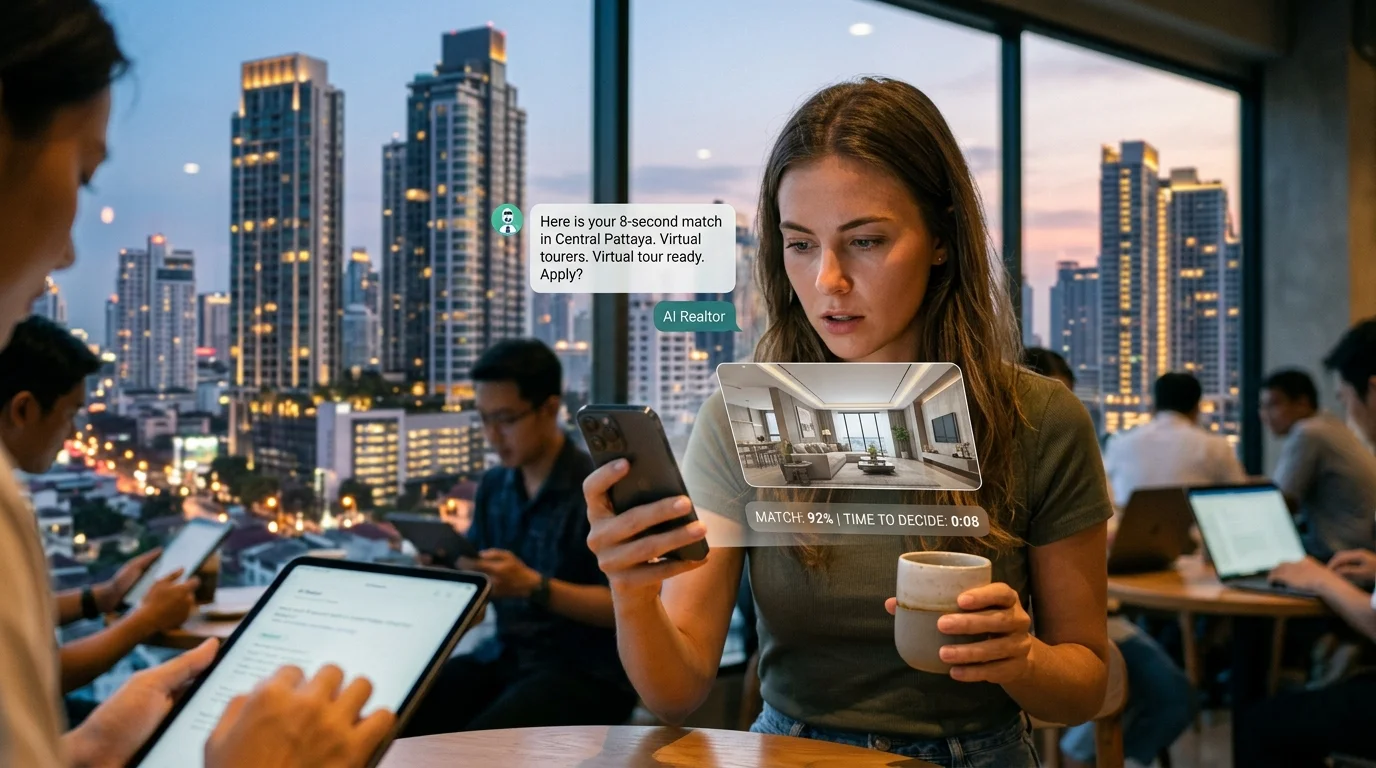
In 2026, buying a condominium in Central Pattaya is no longer the result of weeks of deliberation and dozens of viewings. According to a study of behavioral patterns of users on Thai property portals, the average decision-making time for requesting a viewing has decreased from 14 minutes in 2020 to 8 seconds in 2025. Virtual tours with artificial intelligence, instant mortgage calculations, and chatbots that respond in Thai, English, and Russian within 2 seconds have turned apartment selection into a process more akin to scrolling through an Instagram feed.
This is not just a technological trend. The very structure of demand has changed. Developers in Central Pattaya are recording a 23% year-on-year increase in impulse purchases: a client sees a listing at 9 AM, takes a virtual tour at 11 AM, and makes a reservation deposit by 2 PM. The old model-"I'll look at 10 options, compare Excel spreadsheets, consult with a realtor"-works for only 31% of buyers. The rest make decisions based on first impressions, enhanced by AI recommendations and personalized offers.
For investors and buyers from Russia, this means a need to reconsider their search strategy. The Central Pattaya market in 2026 requires not so much patience as speed of reaction and the ability to filter out noise.
Central Pattaya in Numbers: What's Happening with Prices and Supply
According to moregroupestate.ru, the average cost per square meter in new projects in Central Pattaya in April 2026 is 95,000-140,000 baht. This is 7% higher than at the beginning of 2025 and 18% higher than the 2023 level. The growth is driven by three factors: limited land in the center, recovery of tourist flow (according to the Thai Ministry of Tourism, 2.1 million foreigners visited Pattaya in the first quarter of 2026, 14% more than the same period in 2025), and the launch of infrastructure projects in the Eastern Economic Corridor.
The secondary market shows a different picture. Apartments in complexes built in 2018-2020 are sold at a 12-20% discount from the original developer price. The reason is oversupply in the 24-28 m² studio segment and aging infrastructure (pools requiring repairs, noisy elevators, air conditioning systems operating at their limit). Buyers in 2026 prefer to pay 15% more and get a new apartment with a developer's warranty than save on secondary properties with an unknown operating history.
The demand structure has changed. While in 2020-2022, 68% of purchases were studios, in 2026 the share of one-bedroom apartments has grown to 47%. Buyers are looking for space for remote work: a separate bedroom, an area for a desk, a balcony. The price of such an apartment in Central Pattaya starts from 2.8 million baht for 35 m² in mid-range projects and from 4.5 million baht for 42 m² in premium complexes near Beach Road.
How AI Is Changing the Buying Process: From Virtual Tours to Price Prediction
Artificial intelligence is integrated into every stage of the transaction. On portals like Hipflat, DDProperty, and international platforms, a buyer enters their budget, location and area preferences-the algorithm produces 12 options with an 87-94% probability match in 3 seconds. The system analyzes not only stated criteria but also behavior: how much time the user spent on similar property pages, which photos they enlarged, at what stage they closed the tab.
Virtual tours with AI guides allow users to "walk" through an apartment, ask questions by voice ("What's the ceiling height?", "How much are the utility bills?") and receive answers in Russian. The technology recognizes accents and adjusts to the speech pace. According to developer statistics, 61% of clients who complete an AI tour book an apartment without physically visiting Thailand.
Predictive analytics help assess investment potential. Platforms use data on new construction within a 500-meter radius, transport development plans, rental price dynamics, and tourist traffic. The algorithm produces a forecast: "Probability of 12% value growth over 3 years-78%". The accuracy of such forecasts, based on testing against historical data from 2020-2025, is 71%-not perfect, but better than the average buyer's intuition.
The Psychology of the 8-Second Decision: Why Buyers Have Stopped Comparing
Clip thinking is not a myth but a measurable reality. A study by Chulalongkorn University (Bangkok) showed that for 54% of real estate mobile app users, the decision-making threshold occurs within the first 8 seconds of viewing a listing. If the photo is poor quality, the description is long, or the price looks uncompetitive-the user leaves. Recapturing their attention is virtually impossible.
Developers have adapted. The main listing photo is now not the building facade but the view from the window or furnished interior. The price is stated not only in baht but also in dollars, euros, rubles-with automatic conversion at the CBR exchange rate for the current day. The description is shortened to 4 sentences, each with a specific benefit: "5 minutes walk to the beach", "0% installment for 2 years", "Furniture and appliances included".
The paradox of choice works against the buyer. When the search results show 47 similar studios priced at 2.5-2.9 million baht, the brain shuts down. AI solves this problem by narrowing the choice to 3-5 options based on hidden preferences. The buyer feels in control of the process, although the algorithm has actually done 80% of the work.
Risks of Impulse Buying: What Cannot Be Checked in 8 Seconds
Speed of decision-making has a downside. According to legal companies handling transactions in Pattaya, the number of disputes over property quality increased by 19% in 2025 compared to 2023. The reason-buyers skip the due diligence stage (checking transaction legitimacy and developer credentials), relying on beautiful renders and AI chatbot promises.
What cannot be checked in 8 seconds:
Developer reputation. AI will show the logo and year the company was founded but won't tell you that the developer has three unfinished projects and lawsuits from buyers. Checking through the Department of Business Development (DBD) takes 15 minutes-but only 22% of buyers do it.
Foreign quota. Thai law allows foreigners to own no more than 49% of a condominium's area. If the quota is exhausted, you'll be offered registration through a Thai company (30-year leasehold) or a nominee owner-both options carry risks. Quota information is in the project documents but not in the advertising listing.
Actual construction status. A virtual tour shows a finished interior, but the project may be at the excavation stage. The completion date "Q4 2027" easily becomes "Q2 2029"-delays of 12-18 months are not uncommon in Thailand. Developer penalties for delays are usually symbolic: 0.01-0.05% of the value per day, which over a year gives 3.6-18% compensation-less than inflation and lost rental income.
Hidden fees. The listing states "2.8 million baht", but upon signing the contract, the following appear: 2% transfer fee (56,000 baht), 20,000 baht utility deposit, 150,000 baht furniture package fee, 18,000 baht service charge for the first year. Total 3.044 million baht-8.7% more than advertised.
Case Study: How a Buyer from Moscow Lost 340,000 Baht on an Impulse Deal
An agency client (name changed) in February 2025 saw a listing for a 28 m² studio in Central Pattaya for 2.65 million baht. The virtual tour impressed: panoramic windows, modern kitchen, city view. The AI system showed a 10% price growth forecast over 2 years. The client made a 100,000 baht reservation deposit remotely without visiting Thailand.
When attempting to register the transaction at the Land Office, it emerged that:
- The foreign quota was exhausted. The developer offered registration through a Thai company for an additional 80,000 baht.
- The project did not have a Condominium License-a document without which property registration is impossible. They promised to obtain it "within 3 months".
- The actual apartment area measured by internal walls (net area) was 24.7 m², not 28 m² as stated in the listing (which was gross area including walls and share of common areas).
The client attempted to terminate the contract. According to the Reservation Agreement terms, the deposit was non-refundable. Through a lawyer, they managed to recover 60,000 baht out of 100,000-a loss of 40,000 baht plus 300,000 baht for lawyer and translator services. Total 340,000 baht (about 850,000 rubles at the exchange rate at the beginning of 2025) for a decision made in 8 seconds.
How to Buy Quickly but Safely: A 15-Minute Checklist
Speed and security are compatible if you automate verification. Here's an algorithm that takes 15 minutes and filters out 90% of problematic properties:
Minutes 1-3: Developer verification. Enter the company name in the Department of Business Development database (dbd.go.th). Look for registration year (less than 5 years-risk), registered capital (less than 10 million baht for a developer-warning sign), list of directors. If the DBD site doesn't open or is in Thai-ask the agent to provide an extract.
Minutes 4-6: Foreign quota. Request written confirmation from the developer of available quota for your unit. The wording should be: "Unit № XXX is available under foreign quota (freehold)". If the answer is evasive ("we'll check", "usually available")-this is a red flag.
Minutes 7-10: Project documents. Request copies of: EIA (Environmental Impact Assessment), construction license, Condominium License (if project is completed) or letter from the Land Office regarding its processing (if construction is ongoing). Absence of EIA for a project with 80+ units is a legal violation; such a property can be demolished.
Minutes 11-13: Actual cost calculation. Add up: unit price + 2% transfer fee + furniture (if not included) + annual service charge + utility deposit. If the total is 10%+ above budget-look for another option.
Minutes 14-15: Location verification. Open Google Maps, enable "Traffic" mode, and see what the area looks like during rush hour. If red lines (traffic jams) surround the building on all sides-life there will be hell, despite "5 minutes to the beach". Check reviews of the complex on expat forums (Thaivisa, Pattaya Addicts)-they write the truth about noise, management quality, water problems.
This checklist can be automated. Some agencies in Pattaya already offer AI assistants that run a property through all points in 5 minutes and produce a report with risk assessment: "Low", "Medium", "High". The service costs 5,000-10,000 baht, which is 34 times cheaper than the losses of the client in the above example.
Alternatives to Central Pattaya: Where to Look in 2026
Central Pattaya is not the only option. The 2026 market offers three alternatives with better price/quality ratios:
Pratumnak (Pratumnak Hill). The hill between the center and Jomtien. Quieter, greener, more prestigious. Average price per square meter-110,000-160,000 baht, but liquidity is higher: apartments here sell 18% faster than in the center (data from realting.com). Rental income is more stable: long-term tenants (expats, families) prefer Pratumnak to the noisy center.
Jomtien. South of the center, wide beach, fewer tourists. Price per square meter-75,000-105,000 baht, which is 20-30% lower than the center with comparable infrastructure. New projects (interthai.ru) start from 1.8 million baht for a studio-the entry threshold for an investor is almost half as low. Downside: farther from nightlife and shopping centers, which for some is a plus, for others-a disadvantage.
Na Jomtien and Bang Saray. Even further south, almost suburban. Villas and low-rise complexes are being built here. According to a forecast by pattayahome.ru, price growth in these areas by 2027 will be 12-15%-higher than in the center. The reason: development of U-Tapao Airport and construction of the Bangkok-Pattaya high-speed railway (launch in 2028 will reduce travel time to 50 minutes). Downside: weak infrastructure so far, car needed.
What This Means for the Russian Buyer in 2026
For the Russian-speaking investor or second-home buyer, Central Pattaya in 2026 is a market where decision-making speed has become a competitive advantage, but only with automated risk verification. Impulse buying without due diligence is a direct path to losing 10-15% of the budget on hidden fees and legal problems.
Three practical steps:
Use AI, but verify manually. Algorithms are good for initial selection, but make the final decision after verifying the developer, quota, and documents. Hire a local lawyer (cost 25,000-60,000 baht)-that's 2% of the budget for buying an apartment for 3 million baht, but protection against losing 100% of the investment.
Consider alternatives to the center. If the goal is investment, Jomtien and Pratumnak offer comparable returns (5-8% annual rental yield) with lower risks of market oversaturation. If the goal is personal residence, Na Jomtien offers more space and tranquility for the same money.
Plan a 5+ year horizon. Short-term speculation (buy, sell higher in a year) in Central Pattaya works only in the top 5% of projects from well-known developers. The remaining 95% yield profits over 5-7 years through capital appreciation and accumulated rental income. According to calculations by moregroupestate.ru, an apartment for 3.2 million baht with a rental of 18,000 baht/month and 8% annual price growth will give a total return of 12-13% annually after 5 years-this is higher than deposits in Thai banks (2.5-3.5%) and comparable to the stock market with lower volatility.
The Central Pattaya condominium market in 2026 requires a new approach: speed of reaction plus verification discipline. AI has changed the rules of the game but has not eliminated the need to think. Buyers who have learned to combine technology and common sense get access to properties 10-15% more advantageous than the market. The rest pay for impulsiveness.