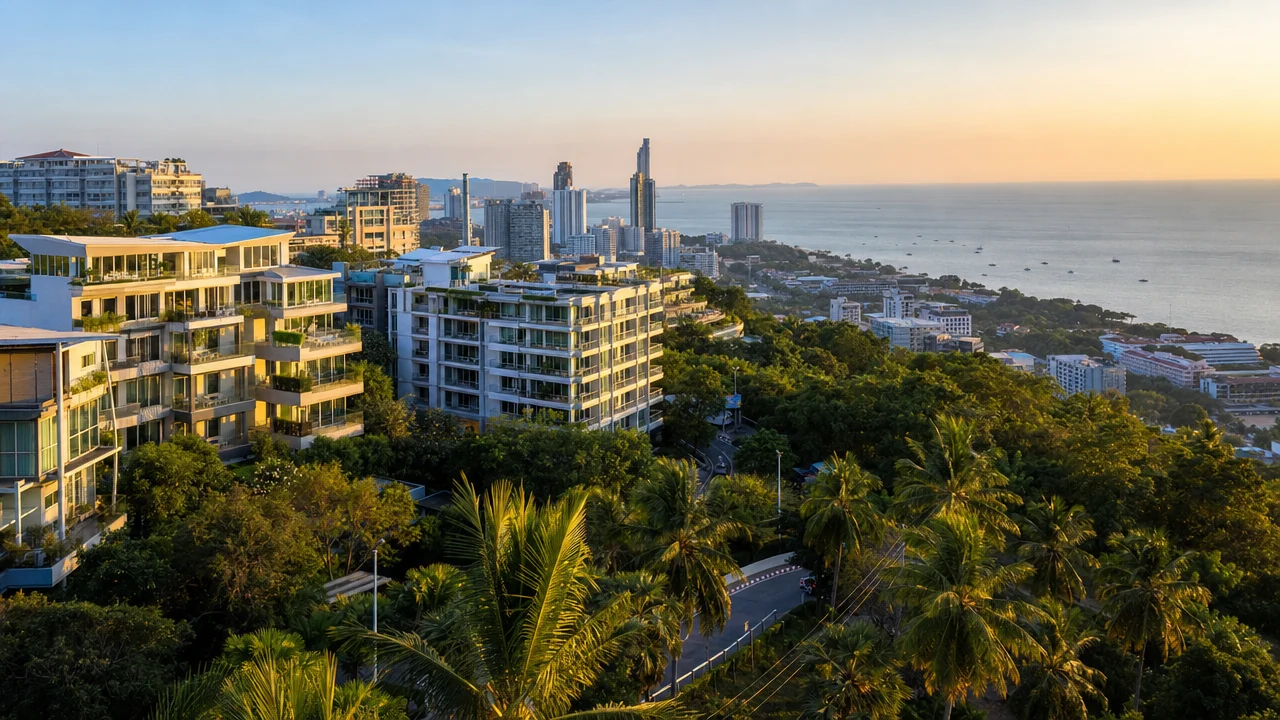

Six months ago, I closed a deal on a 35 m² studio in a project on Pratumnak Hill for 8.9 million baht. It seemed like a good price - 254,000 baht per square meter, sea view, quiet area. Now it's July 2026, and I realize: I entered the market right before a wave of Middle Eastern capital flooded into Thailand, reshaping the entire luxury real estate map. Phuket received 14 billion baht in ultra-premium segment investments in half a year, and Pattaya became a backup destination for Arab buyers who can no longer live peacefully in a conflict zone.
What's happening with Middle Eastern buyers in 2026
According to Bangkok Post, Thailand is recording a massive shift in the structure of international luxury real estate buyers. This isn't about tourists - it's about families moving capital out of the Persian Gulf region amid escalating conflicts. Israeli strikes on Gaza continue even after the formal ceasefire in October 2025: in July 2026 alone, 14 people were killed, including participants in a funeral procession. The ACLED research group recorded more than 40 strikes in May - the highest number since the "ceasefire" began. One child dies every day.
For wealthy families from Saudi Arabia, UAE, Kuwait, this is a signal: it's time to diversify assets geographically. Thailand is a logical choice: no inheritance tax for foreigners owning condominiums, visa concessions for investors, direct flights from Dubai and Doha. The Chinese AI boom (Kimi company released the K3 model, surpassing American analogues) created additional capital inflow from Asia, but the Arab segment is growing faster.
I didn't account for this when I bought in January. I looked at historical data - Chinese, Russians, Europeans. Arabs were in the statistics but didn't dominate. Now they're changing the rules of the game.
Phuket received 14 billion - figures and projects
In the first half of 2026, seven ultra-luxury segment projects worth a total of 14 billion baht were launched in Phuket. The average price per square meter in these complexes is 420,000-650,000 baht. For comparison: I bought at 254,000 baht/m². A 2.5-fold difference.
Why Phuket? The island has historically attracted Europeans and Arabs - beaches, infrastructure, international schools. Developers are building villas with private pools, concierge service, yacht berths. Buyers from the Persian Gulf are willing to pay a premium for gated communities where they can live with their families year-round, not just vacation.
One of the largest projects is a complex on Cape Panwa worth 3.2 billion baht. Villas from 18 million baht, plots up to 800 m². The developer announced that 40% of lots were bought by purchasers from UAE and Saudi Arabia at the foundation stage. Average transaction amount - 22 million baht.
I looked at Phuket in December 2025 but was scared off by the prices. Thought I'd overpay. Now those same lots cost 18-25% more.
Pattaya as a backup option - and why it's changing the market
Arab buyers who aren't ready to pay Phuket prices are looking at Pattaya. The city is closer to Bangkok (1.5 hours by car versus a domestic flight), 30-40% cheaper in comparable locations, and infrastructure is growing faster.
Pratumnak area is the main beneficiary. A hill between Jomtien and central Pattaya, quiet, with viewpoints. Russians and Scandinavians used to dominate here. In 2026, Arab families started buying penthouses and duplexes. Agents report: requests are coming for three- and four-bedroom apartments from 12 million baht, necessarily with gated territory, playground, halal restaurant nearby.
My project - a 35 m² studio - doesn't fit this profile at all. I bought for tourist rental, counted on 6-7% annual yield. Now I see: the neighboring building with three-bedroom units for 15-18 million sells twice as fast. Buyers are families from Kuwait and Bahrain, paying cash, closing deals in 3-4 weeks.
What I missed - analysis of mistakes
First mistake: didn't account for the geopolitical factor. I looked at price charts for 2020-2025, read CBRE and Colliers reports. All forecasts were based on post-COVID tourism recovery and the return of Chinese buyers. Nobody factored in a sharp increase in Middle East tensions and capital outflow to Asia.
Second mistake: chose the wrong format. A 35 m² studio is short-term rental, tourists, high turnover. Arab buyers are looking for housing for long-term family residence. I should have bought at least a 65 m² two-bedroom or a 90+ m² three-bedroom. Yes, the 12-15 million baht price tag was scary, but this is exactly the segment now growing 20-30% annually.
Third mistake: ignored Phuket. I considered the island overvalued and decided Pattaya was a safer bet. Didn't account for Phuket becoming the epicenter of the investment boom. If I had bought a villa plot there for 8-10 million at the beginning of the year, I could now sell it for 12-14 million. The difference - 4 million baht pure profit in half a year.
Fourth mistake: didn't diversify. All 8.9 million baht went into one studio. It would have been better to buy two apartments in different projects or one in Pattaya, another in Phuket. Risks would have been diluted, growth potential doubled.
Figures I should have known
According to the Land Office (Land Department of Thailand), in the first quarter of 2026, the number of transactions involving buyers from Persian Gulf countries increased by 340% compared to the same period in 2025. Average transaction amount - 9.7 million baht (was 5.2 million a year earlier).
In Pattaya, the average price per square meter in luxury segment new builds (from 250,000 baht/m²) grew from January to July 2026 by 14%. In Pratumnak the growth was 18%. In Phuket - 22%.
The number of requests for three- and four-bedroom apartments from foreigners increased by 67%. Studios and one-bedrooms - minus 12%.
The share of deals closed entirely in cash (without mortgage) rose to 58%. A year ago it was 41%. This is a sign of "hot money" arrival - capital that needs to be quickly placed outside the risk zone.
How Arab buyers are changing the rental market
I planned to rent the studio to tourists through Airbnb for 1,800-2,200 baht per night. The summer season of 2026 showed: demand for short-term rental has fallen. Tourists from Russia are coming less (ruble weakened, sanctions complicated transfers), Chinese are just starting to return, Europeans prefer Bali and Vietnam.
But demand for long-term rental from Arab families has soared. A three-bedroom in Pratumnak rents for 60-80 thousand baht per month for a year in advance. Yield - 5-6% annually, but stable, without seasonal dips. Plus tenants pay utilities themselves, don't throw parties, extend contracts.
My studio doesn't work in this model. A family of four needs at least two bedrooms. I'm stuck in a dying segment of short-term tourist rental.
What's happening with prices right now
In July 2026, several major developers raised prices in under-construction projects. Sansiri increased prices in two Pratumnak towers by 8% in a month. Origin Property raised prices in a Jomtien project by 12%. One motivation: demand exceeds supply in the large apartment segment.
Studios and one-bedrooms are selling slowly. Developers offer 5-7% discounts, two-year installments, free furniture. I see this in my project: a neighboring studio listed at 8.6 million (I bought for 8.9 million), been on market three months, not one viewing.
Three- and four-bedroom units fly off the shelves in weeks. In one complex on the hill, two penthouses at 24 million remain - both reserved by Saudi Arabian buyers. Deals will close in August.
Ukrainian and Russian factors
The conflict in Ukraine continues. On July 18, 2026, Ukrainian drones attacked targets in Russia, eight people died, dozens wounded. Russia launched a missile strike on Kharkiv - one dead, nine wounded, including children. This affects the Thai real estate market in two ways.
On one hand, Russians and Ukrainians who previously actively bought in Pattaya are now either losing purchasing power (currency devaluation, sanctions) or leaving Thailand. Demand from them is falling.
On the other hand, those who stayed are looking for long-term family housing. They compete with Arabs for the same three- and four-bedroom units but lose in speed and transaction amount. An Arab will pay 15 million cash in a week. A Russian will bargain, ask for installments, check documents for a month.
I've seen this dynamic on expat forums. Russian-speaking buyers complain: "Came to view an apartment, called the next day - already sold to an Arab." The market has accelerated, and those who hesitate lose.
What this means for a Pattaya buyer
If you're planning to buy a condo in Pattaya in 2026, consider three factors.
First: apartment format. Studios and one-bedrooms are a bad investment right now. The short-term rental market has slumped, resale is difficult, prices are stagnant or falling. If your budget is limited to 5-7 million baht, it's better to buy a 50-60 m² two-bedroom in a simpler project than a studio in a premium tower. You'll rent the two-bedroom to a family long-term, the studio - you'll wait for tourists who are fewer and fewer.
Second: location. Pratumnak is at peak demand now. Prices are growing faster than in other Pattaya areas. If buying for resale in 1-2 years, buy here. If for living and rental - look at Jomtien (quieter, cheaper, also popular with Arabs) or areas along Sukhumvit closer to Sriracha (new infrastructure, international schools, Eastern Economic Corridor attracts expats with families).
Third: transaction speed. The market has accelerated. Good lots go in days, not weeks. If you found a suitable option - verify documents quickly (Chanote, absence of encumbrances at the Land Office), make a deposit, close the deal. You can negotiate, but not for a month. The seller will find another buyer who will pay full price.
Fourth: diversification. Don't invest all money in one apartment if the amount allows buying two. One in Pattaya, second in Phuket or Samui - this is insurance against a local downturn. Phuket is expensive but growing faster. Pattaya is cheaper but more volatile.
Fifth: monitor geopolitics. The influx of Arab capital is a direct consequence of Middle East instability. If the situation worsens (new escalation in Gaza, conflict in Yemen, tension around Iran), the flow will intensify. If real ceasefire comes and the region stabilizes - some buyers will return home, demand will fall. Read news, analyze trends, adjust strategy.
Could I have predicted this boom
Honestly - no. Geopolitical shocks are hard to forecast. I'm not a Middle East conflict analyst, I'm a real estate buyer. But there were signals.
In December 2025, several major agencies published reports on growing interest in Thai real estate from Persian Gulf buyers. Growth was 30-40% year-on-year. I read it but didn't pay attention. Thought: statistical error, small sample.
In January 2026, a thread "Arabs buying up Pratumnak" appeared on an expat forum. Several agents wrote they were getting unusually many requests from UAE and Saudi Arabia. I considered this a local spike.
In March, Bangkok Post published an article about 14 billion in Phuket investments. I read it but decided: Phuket is Phuket, Pattaya is a different market. Didn't connect the dots.
Now I understand: all signals were in plain sight. I just didn't want to see them because I had already decided to buy a studio in Pratumnak. Confirmation bias - you look for information that supports your choice, ignore what contradicts it.
What to do with my studio now
Three options. First - hold and rent. Short-term rental brings 40-50 thousand baht per month in summer, 20-30 thousand in winter (low season). Annual yield - 4-5%. Not brilliant, but better than a bank deposit.
Second - sell now. The studio market is weak, but the apartment is in good condition, furniture new, sea view. Realistically can get 8.5-8.7 million baht (minus 200-400 thousand from purchase price). Small loss, but I'll free up capital and buy a two- or three-bedroom before prices fly even higher.
Third - wait. The market is cyclical. The Arab boom may exhaust itself in a year or two, the tourist segment will recover, studios will become liquid again. Risk: while waiting, I'll miss the opportunity to buy a growing asset.
I'm leaning toward the second option. Sell the studio, add 4-5 million baht, buy a three-bedroom in Jomtien for 13-14 million. Rent to an Arab family for a year at 65 thousand per month. In two years, if prices grow another 20%, sell for 16-17 million. Net profit - 3-4 million baht. This is better than sitting in a stagnant studio.
Conclusions
Buying real estate in Thailand in 2026 is not only about analyzing local trends but understanding global processes. The Middle Eastern crisis, Chinese AI boom, Ukrainian conflict - all this affects who, where, and for how much buys a condo in Pattaya.
I bought a studio for 8.9 million baht in January and missed the wave of Arab capital that raised prices on large apartments by 15-20% in half a year. Phuket received 14 billion in investments, Pratumnak became a hotspot for Persian Gulf families, and I'm left with an asset that isn't growing.
Mistakes: wrong format (studio instead of three-bedroom), ignoring geopolitics, lack of diversification. Lessons: follow news, buy what new buyers need, act quickly, don't be afraid to pay a premium for a growing segment.
If you're buying a condo in Pattaya now - get two- and three-bedrooms in Pratumnak or Jomtien, close deals quickly, account for demand from Arab families. The market has changed, and whoever adapts first wins.