
Installment Plans Disappearing: What's Happening in Pattaya's New Construction Market
In 2024-2025, interest-free installment plans for the construction period were standard for off-plan projects in Pattaya. Developers offered 30/70, 40/60 schemes, sometimes stretching payments over 3-4 years. In 2026, the picture is changing. Increasingly, developers are requiring 100% cash payment within 30-60 days after signing the sales and purchase agreement. And we're not talking about individual premium-class projects, but the mass segment - studios and one-bedroom apartments from 3 to 6 million baht.
The reason isn't developer greed. Thai banks tightened lending conditions for developers after a series of bankruptcies in 2023-2024. Project financing became more expensive, collateral requirements increased. Developers are now forced to close cash gaps through accelerated payments from buyers. At the same time, the share of Chinese and Indian investors willing to pay in full immediately is growing - this is changing the competitive environment.
Numbers: How Many Projects Abandoned Installment Plans
According to CBRE Thailand, in the first quarter of 2026, 62% of new condominium launches in Pattaya offered only full payment or minimal installment plans up to 90 days. A year ago, this figure was 28%. The average down payment increased from 30% to 70-80% of the unit cost.
Concrete example: the Copacabana Coral Reef Jomtien project (second phase of the popular high-rise in Jomtien) launched sales with a 4-year interest-free installment plan. The schedule looked like this: 100,000 baht reservation, 40% contract payment, 30% installment over three years, 30% final payment upon handover. Construction completion is scheduled for early 2028. This is a rare exception - most developers can no longer afford this model.
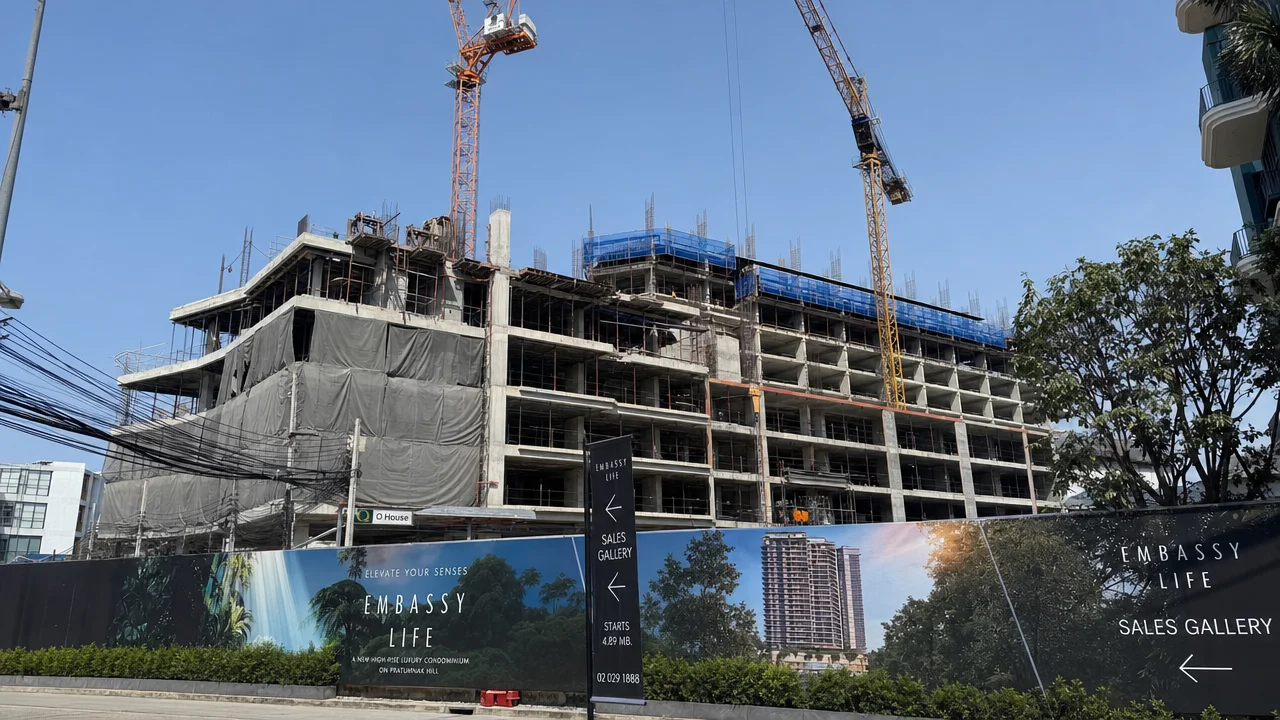
Another developer in the Pratumnak area offered 32 m² studios at 3.1 million baht but required 100% payment within 45 days. The alternative - two payments: 60% immediately, 40% after three months. No connection to construction stages.
Why Banks Stopped Lending to Developers on Previous Terms
In 2023, Thailand's Department of Special Investigation recorded 47 criminal cases of real estate fraud. Some involved frozen construction sites where developers couldn't complete projects due to lack of financing. Banks suffered losses when collateral property (unfinished towers) proved impossible to sell without additional investments.
The Bank of Thailand tightened requirements for issuing project loans. Now developers must confirm pre-sales of at least 40% of total units before receiving the main financing tranche. Rates increased from 4.5-5% to 6.5-7.5% annually. Application review time increased from two to four months.
Developers faced a choice: either freeze launches until accumulating sufficient capital, or transfer the financial burden to buyers. The second option proved easier.
How Demand Structure Changed: Chinese and Indian Buyers
Russian buyers are accustomed to installment plans. Chinese and Indian investors prefer to pay immediately - this is a cultural feature and consequence of capital export restrictions from their countries. They try to place money quickly while the window of opportunity is open.
According to Knight Frank, the share of Chinese buyers in Pattaya new construction grew from 18% in 2023 to 31% in 2025. Indian investors increased their presence from 9% to 14%. Russian buyers decreased from 22% to 16%. Developers are adapting terms to the solvent audience.
Chinese investors often buy in blocks - 5-10 units in one project. They're willing to pay in full in exchange for a 3-5% discount. It's more profitable for developers to close cash gaps with one large client than wait for stretched payments from ten small ones.
Buyer Risks: What Changes with 100% Advance Payment
When you pay the full amount for an off-plan project, risks increase sharply. If the developer goes bankrupt or freezes construction, recovering money will be practically impossible. Thai legislation doesn't require mandatory escrow accounts for developers. Your funds go to the company's operating account and can be spent on anything - from purchasing materials to repaying bank debts.
Standard practice with installment plans - payment by construction stages: foundation, framework, finishing, handover. This gave buyers leverage. If the developer delayed deadlines, the next payment could be withheld. With full prepayment, this leverage disappears.
Example from practice: in 2024, a developer in Naklua area froze a project at 60% completion. Buyers who paid 100% in advance (23 units out of 180) couldn't recover funds. Those paying according to installment schedule only lost the down payment - 30-40% of cost.
How to Protect Yourself When Full Payment Required
First: verify the EIA (Environmental Impact Assessment) permit exists. This is a government construction permit issued after environmental review. Without EIA, the project can't begin pile driving. If the developer requires 100% payment and there's no EIA yet - run.
Second: request the developer's financial statements for the last two years. Pay attention to debt burden (debt-to-equity ratio). If the indicator is above 2.5 - the company is over-leveraged and may not survive a cash gap.
Third: check the land plot status. The document should be Chanote type (Nor Sor 4 Jor) - this is the only title giving full land ownership rights. Request an extract from the district Land Office (Title Search). Make sure there are no mortgages, arrests, or easements on the plot.
Fourth: demand inclusion of penalty sanctions for delayed handover in the sales and purchase agreement (SPA). Standard wording - penalty of 0.01-0.05% of unit cost for each day of delay. If the developer refuses to include this clause - it's a red flag.
Alternatives: When Installment Plans Are Still Available
Installment plans haven't disappeared completely. Large developers with their own capital (Sansiri, Ananda Development, Origin Property) still offer interest-free installment plans for the construction period. Their projects cost more - from 120,000 to 160,000 baht per square meter versus 70,000-90,000 for small developers.
Example: a Sansiri project in Pratumnak area offers 35 m² studios at 4.2 million baht with 30/70 installment plan. Down payment 1.26 million, remainder upon handover in 24 months. The company has an A- credit rating from Fitch Ratings and doesn't depend on bank financing.
Second option - buying a completed property on the secondary market. There's no installment plan here, but you're paying for a real asset, not a promise. The price is usually 10-15% lower compared to off-plan if the seller is in a hurry. Risk of construction freeze is absent.
How to Work with FET Requirement for Full Payment
A foreigner must transfer funds from abroad through bank SWIFT transfer. This isn't a whim - it's a legal requirement. Upon transfer, the receiving bank issues an FET certificate (Foreign Exchange Transaction Form) necessary for registering property rights at the Land Office.
The transfer must be in foreign currency - USD, EUR, GBP. Conversion occurs on the Thai bank's side. Minimum amount for receiving FET - equivalent to 50,000 US dollars. If the unit costs less, FET won't be issued, and registering the condominium to a foreigner will be impossible.
With 100% advance payment, it's important that FET is issued immediately. Some developers offer depositing cash in baht, then "completing" FET later. This is a trap. Without FET for the full amount, the Land Office will refuse transfer to foreign quota.
Check the payment purpose in the SWIFT instruction. It should state: "For purchase of condominium unit". If it simply says "payment" or "investment" - the bank may not issue FET or issue it with incorrect purpose code.
What This Means for Buyers in Pattaya
For Russian investors, cancellation of installment plans changes the entry strategy. If previously you could buy a studio for 3 million baht by paying 900,000 down payment and stretching the remainder over two years, now you need the entire amount immediately. This cuts off a significant portion of buyers with average budgets.
Alternative - shift focus to the secondary market. Competition is lower here, sellers are willing to negotiate, and risk of construction freeze is absent. Price per square meter in liquid projects built in 2020-2022 is 70,000-110,000 baht - comparable to off-plan, but without risks.
Second option - pooling capital with a partner. Two buyers pool together for one unit, register it to one person, the second receives a share through notarized agreement. This works if the partner is verified. Legally the scheme is legal, but requires competent documentation.
Third path - focus on projects by large developers who retained installment plans. Overpaying 15-20% for the brand pays off with reduced risks. Companies like Sansiri or Origin don't abandon construction sites - their reputational losses would be too great.
If a developer requires 100% payment and you're not confident in their reliability - better refuse. The Pattaya market is saturated with offerings. There's always an alternative project with safer conditions. Losing time searching is better than losing money on a frozen construction site.
Forecast: Will Installment Plans Return in 2027
Return to mass installment plans is only possible if banks soften credit policy. As long as the Bank of Thailand keeps the base rate at 2.5% (data as of April 2026), project financing conditions will remain strict. Inflation in the country is 1.8%, the economy is growing slowly - the regulator has no reason to lower the rate.
Second factor - demand structure. As long as Chinese and Indian investors are willing to pay in full, developers won't voluntarily return to installment plans. Competition for this audience segment is high.
Likely scenario: installment plans will remain only with large developers and premium-class projects where profitability allows bearing the financial burden. The mass segment (studios and one-bedrooms up to 5 million baht) will remain on the full prepayment model or short installment plans up to 90 days.
For buyers, this means the need to adapt. Either increase initial capital, or shift focus to the secondary market, or choose more expensive projects with retained installment plans. The market is changing, and purchasing strategy must change with it.