
Why Pratumnak villas cost 18 million baht when Huay Yai townhouses sell for 5.5 million
In the first quarter of 2026, the average price of a villa in low-density Pratumnak complexes reached 17.8 million baht - 35% higher than in standard-density projects in Thepprasit Huay Yai. At the same time, sales velocity in boutique complexes is 22% higher. Saturdays Villas, launched in December 2025 by developer Raimon Land, sold out the first phase of 14 villas in 47 days at an average price of 19.2 million baht.
Buyers pay a premium not for the brand, but for development density: 8-12 units per hectare versus 25-30 in mass-market projects. We analyze the economics of low-density development and show why investors are returning to this format after five years of enthusiasm for compact townhouses.
What is low-density development and why it returned in 2025-2026
Low-density development refers to projects where no more than 12-15 residential units occupy 1 hectare of land. For comparison: a typical townhouse complex fits 28-32 homes on the same area. The format almost disappeared in Pattaya in 2020-2023, when developers chased sales volumes and focused on compact lots priced at 3-6 million baht.
The turning point came at the end of 2024. Colliers Thailand recorded an 18% year-on-year drop in sales velocity in the 4-7 million baht townhouse segment. Buyers with budgets above 12 million baht began seeking projects with larger plots and fewer neighbors. Developers responded by launching boutique complexes: Saturdays Villas on Pratumnak, The Retreat by Habitat on Soi Korphai, Eden Reserve in the Huay Yai area.
The key parameter is the distance between villas. In low-density projects, there's a minimum of 8-10 meters to the neighboring house, in standard ones - 4-5 meters. The difference is physically noticeable: noise levels are 12-15 decibels lower, privacy is higher, infrastructure is not overloaded.
Saturdays Villas: a case of rapid sales in a premium project
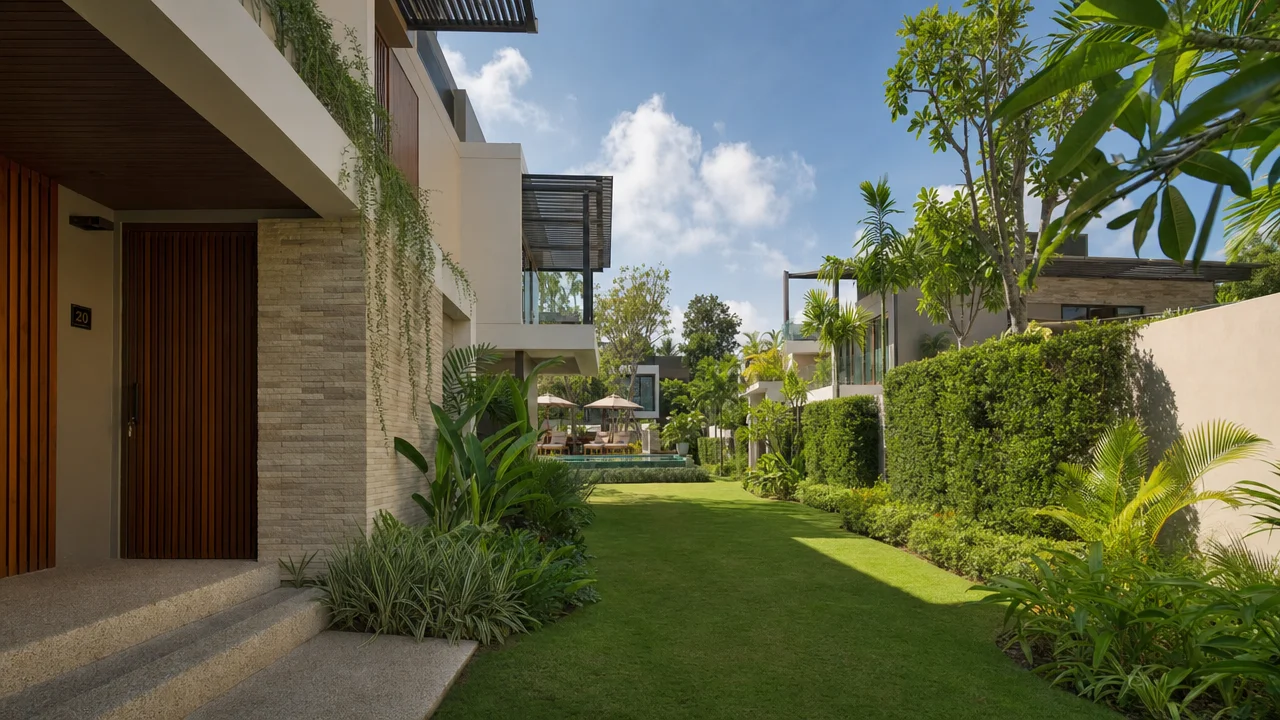
Saturdays Villas is built by Raimon Land on a 2.1-hectare plot in the northern part of Pratumnak, 850 meters from the viewpoint. Development density is 6.7 units per hectare, making it the most spacious village in the area. Just 14 villas ranging from 280 to 420 m² on plots of 400-650 m².
Prices started from 16.5 million baht for a 3+1 bedroom model. The top villa with panoramic bay views sold for 24.3 million baht. Average price - 19.2 million baht. For comparison: the neighboring Botanica Villas project with a density of 18 units per hectare sells for 12-14 million baht.
The first phase sold out in 47 days. The second phase of 12 villas launches in August 2026 with an 8% price increase. The developer explains the demand with three factors: minimal neighbors, private access to a 4,200 m² public park, and Chanote title (full ownership) on land without restrictions.
Buyers are 60% Thais from Bangkok, 25% Europeans, 15% Russians and Chinese. Average age 48 years, 70% buy for permanent residence, only 30% for rental income.
Economics of low-density development: why developers accept lower revenue
At first glance, the low-density format is unprofitable for developers. A 2-hectare plot can be built with 50 townhouses at 6 million baht (revenue 300 million baht) or 16 villas at 18 million baht (revenue 288 million baht). But the real economics are more complex.
Sales velocity in boutique projects is 20-25% higher. Saturdays Villas sold 14 units in 47 days - that's 3.6 months for capital turnover cycle. A typical townhouse project of 50 units sells over 14-18 months. The difference in financing costs and frozen capital eats up 12-15% of margin.
The second factor is land price. Plots for low-density development can be purchased on second line or away from main roads. Land on Pratumnak Soi 6 costs 35-40 thousand baht per square wah, on Pratumnak 4 - 65-70 thousand baht. Savings on land compensate for fewer units.
The third factor is marketing. A boutique project doesn't require mass advertising. Saturdays Villas didn't launch billboards and didn't work with agencies. Sales went through Raimon Land's client base and word of mouth. Marketing savings - 4-6% of revenue.
Pratumnak versus other areas: where low-density development works best
Pratumnak holds 65% of the low-density villa market in Pattaya. The reason is a combination of prestige, proximity to Cozy Beach, and limited land supply. Plots of 1-2 hectares are rare, which naturally limits density.
The second most popular area is Huay Yai, especially the zone around Phoenix Golf Course. There they build complexes of 10-16 villas with plots from 500 m². Prices are lower: 10-14 million baht versus 16-24 million on Pratumnak. Buyers are families with children who value peace and proximity to international schools.
In Jomtien, the low-density format hasn't caught on. Land is too expensive, demand is shifted toward condominiums. The only example is The Clouds on Soi 1, but there are only 8 villas, and the project is rather an exception.
In the Bang Saray and Sattahip areas, low-density development is just beginning. Developers are eyeing plots along Sukhumvit Road after the opening of the new U-Tapao airport terminal. Prices are forecast at 8-12 million baht for a 250-300 m² villa.
Infrastructure and management: why boutique complexes are more expensive to maintain
Low-density projects require higher maintenance costs. In Saturdays Villas, the monthly fee is 18 baht per m² versus 12-14 baht in standard villages. For a 300 m² villa, that's 5,400 baht per month. The difference goes to maintaining the common park, water treatment system, and 24-hour security.
Management companies in boutique projects usually work directly from the developer. In Saturdays Villas, management is handled by Raimon Land Property Management with a team of 6 people for 14 villas - a ratio of 1:2.3. In mass-market projects, one employee serves 8-10 houses.
Common infrastructure includes a fitness room, 15×6 meter pool, children's playground, and co-working space. All facilities are designed for a small number of users: the pool accommodates a maximum of 8 people at once, the fitness room - 4. No queues or overcrowding.
The security system is stricter. Two checkpoints with biometric access, 24 cameras for 14 villas, territory patrol every 2 hours. In standard projects, security usually sits at one post and responds only to calls.
Legal details: how land is registered in low-density projects
Most boutique complexes on Pratumnak are built on land with Chanote title (Nor Sor 4 Jor) - full ownership without restrictions. The buyer receives a separate Chanote for their plot and house, not a share in a condominium. This is important for resale and inheritance.
Foreigners buy villas through a Thai company or in the name of a Thai spouse. The company scheme costs 45-60 thousand baht for registration plus 25-30 thousand baht annually for maintenance. The company owns the land, the foreigner owns the house under a superficies agreement for 30 years with the right to extend.
In projects on leased land (leasehold), the lease term is usually 90 years. Saturdays Villas and most complexes on Pratumnak only work with freehold, which increases liquidity. The resale price difference between freehold and leasehold is 15-20%.
When buying, it's important to check that the plot doesn't fall into protected zones (setback from road, green zones, height restrictions). On Pratumnak, restrictions apply: no higher than 12 meters, minimum 3 meters from plot boundary to building. Checking at the Land Office takes one day.
Rental income: real numbers from Pratumnak
Rental yield from villas in low-density complexes is lower than condominiums, but more stable. A 300 m² villa in Saturdays Villas rents for 120-140 thousand baht per month on a long-term basis. At a purchase price of 19 million baht, annual yield is 7.6-8.8% before expenses.
Short-term rental through Airbnb brings 15-20 thousand baht per night in high season (November-March) and 8-10 thousand baht in low season. Average occupancy is 55% per year. Annual income 2.1-2.4 million baht, net yield after management and cleaning expenses - 9-10%.
For comparison: a 28 m² studio in Sea Saran Condominium costs 2.8 million baht and rents for 12 thousand baht per month (5.1% yield). But a villa offers more opportunities for capital growth. Over the past three years, prices for low-density villas on Pratumnak have grown 18%, for condominiums - 7%.
The risk is seasonality and dependence on tourist flow. In 2023, when tourist flow dropped 22%, villa yields fell to 4-5%. Long-term rental is more stable: annual contracts with expat families working in Bangkok or Rayong.
What this means for a buyer in Pattaya
Low-density development is no longer a niche. If your budget is above 15 million baht and you're buying for living, not just investment, boutique complexes offer the best ratio of comfort and liquidity. A 30-35% price premium pays off in resale speed and quality of life.
For investors, the key parameter is location. Pratumnak and northern Huay Yai show price growth of 5-7% per year, southern areas stagnate. Check the land title: only Chanote provides full protection and ease of resale. A 90-year leasehold is acceptable if the price is 20% below market.
Pay attention to the developer. Raimon Land, Habitat Group, Orchid Palm Homes - companies with history and completed projects. Market newcomers often offer low prices, but the risk of construction freeze is higher. Demand a bank guarantee for deposit return.
Buying a villa in a low-density complex is a long-term strategy. Investment horizon minimum 5-7 years. Over this period, Pratumnak prices historically grow 25-40%, and liquidity remains high due to limited supply.
Forecast for 2026-2027: which areas will grow
The second half of 2026 will see the launch of at least three new boutique projects on Pratumnak. Developers are buying out the last large plots in the Soi 5 and 6 area. Prices for new projects are forecast from 20 million baht for a 300 m² villa, 12-15% higher than current.
Huay Yai will become an alternative for buyers with a budget of 10-14 million baht. The area is getting infrastructure: the new Rugby School international school opens in September 2026, Central Huay Yai shopping center is planned for 2027. Demand for family villas will grow 20-25%.
Bang Saray and Sattahip remain a risk zone for now. U-Tapao airport is expanding slower than plans, infrastructure lags. Purchase there is justified only at prices below 8 million baht and willingness to wait 7-10 years for the area to mature.
The overall trend is a reduction in land supply for low-density development. In 3-5 years, buying a 1-2 hectare plot on Pratumnak will be virtually impossible. Buyers entering the market now get the last window of opportunity before the format becomes exclusive.