
Department of Lands Launches Mass Inspections: 46,918 Companies Under Investigation
In May 2026, Thailand's Department of Lands (DOL) launched the most extensive campaign to identify nominee ownership structures in real estate in the past two decades. Urgent Circular No. 0515.2/W 10722 dated May 15, 2026, signed by Director-General Pornpot Penpas, introduces unified inspection standards for all 77 provinces of Thailand. Eight regions have been declared priority control zones: Phuket, Surat Thani, Mae Hong Son, Chiang Mai, Krabi, Chonburi, Rayong, and Chanthaburi. Chonburi-the province that includes Pattaya and the entire Eastern Economic Corridor (EEC)-is at the center of authorities' attention.
According to the Department of Business Development (DBD), by the end of 2025, more than 29,000 cases had been initiated, 852 companies are under criminal prosecution, and the total value of confiscated assets exceeded 15.1 billion baht (approximately 430 million USD). In Phuket alone in 2024, 231 individuals were arrested, including 98 foreigners, and property worth over 1.5 billion baht was seized. Currently, 46,918 companies in six high-risk sectors, including real estate and land ownership, are under scheduled inspection.
What is a Nominee Structure and Why is it Illegal
Foreigners cannot own land in Thailand-this is the basic rule of the Land Code (Land Code B.E. 2497). Exceptions are extremely narrow: investments through the Board of Investment (BOI), inheritance in rare cases, special visa programs. To circumvent the prohibition, two schemes have been used for decades.
The first is an individual nominee. A foreigner provides the money, a Thai citizen registers the land in their name. On paper the owner is Thai, in reality-a foreigner.
The second is a company nominee. A Thai company is created where 51% of shares formally belong to Thai citizens, but the capital is contributed by a foreigner, who is also the sole director with signing authority, and who receives the economic benefit. Thai shareholders sign blank share transfer forms, do not participate in management, and do not contribute real funds.
Both schemes violate Articles 97 and 98 of the Land Code. Punishment is provided under Articles 111-113: up to two years imprisonment and a fine of up to 20,000 baht for the foreigner (Article 111), a fine of up to 50,000 baht for the company (Article 112), up to two years imprisonment for the Thai nominee (Article 113). Plus mandatory sale of the land within 180 days to one year (Article 99 in conjunction with Article 94).
New: Confiscation Without Court and Loss of All Funds
Previously, the owner was given time to sell the land and keep the proceeds. On February 24, 2026, the Cabinet of Ministers approved the Ombudsman's report and instructed the Department of Lands to prepare an amendment to Article 94. The essence: land transfers to the state without compensation (ตกเป็นของแผ่นดิน). The law has not yet been adopted, but the direction is clear. If the amendment comes into force, the owner of a nominee structure loses not only the land but all invested funds.
Simultaneously, the DBD and the Anti-Money Laundering Office (AMLO) are preparing amendments classifying nominee ownership as a predicate offense for money laundering. This grants the right to seize assets before a verdict is rendered-at the investigation stage.
How the New DOL Inspection System Works
The circular dated May 15, 2026 introduces a ten-step inspection algorithm: detection → screening → individual verification → company verification → risk group marking → in-depth investigation → evidence collection → inter-agency coordination → reporting → legal action. Each step is documented.
Since October 2025, the IBAS AI artificial intelligence system has been operating, automatically flagging suspicious transactions. Land Offices are required to report to DOL quarterly-January 10, April 10, July 10, October 10-through Google Forms. If a company becomes a foreign legal entity under Articles 97 or 98, a report must be submitted immediately, without waiting for the quarterly cycle.
National Registry of Corporate Land Owners
Land Offices across the country are compiling a database of all companies owning land. Companies with foreign shareholders, unusual capital structures, capital increases, and suspicious transactions are flagged. The registry covers the complete history: from initial acquisition to current status.
Mandatory Beneficial Owner Verification
Officers can no longer accept formal ownership at face value. Each high-risk case requires verification of the complete chain:
- Shareholder structure (direct and indirect)
- Directors and authorized signatories
- Capital increases and shareholder changes
- Source of funds
- Actual land users and ultimate beneficial owners (UBO)
- On-site circumstances
Automatic Inspection Thresholds
Two amounts trigger mandatory investigation:
- Transactions of 5 million baht and above
- Cash payments from 2 million baht
When either threshold is reached, officers verify the buyer's source of funds, income, and professional history.
Mixed Marriages Under Special Control
If a Thai buyer is married to a foreigner, they must confirm in writing that the purchase funds are personal property (sin suan tua), not joint marital property (sin somros). Mortgages, leases, and arrangements beneficial to the foreign spouse are also scrutinized.
Companies with Foreign Participation
If a company's land purchase price exceeds its registered capital and there is no mortgage, officers verify the source of funds and confirm that Thai shareholders are genuine investors, not nominees. Share percentages are no longer sufficient. Two types of companies are specially flagged:
Restructured companies: legal entities that increased capital or changed shareholder proportions specifically to meet the 51% threshold under Articles 97/98, where the purpose is nominee land ownership.
Shareholder rotation schemes: legal entities that repeatedly increased capital or changed shareholders back and forth-even if the current structure formally does not fall under Articles 97/98. The restructuring pattern itself is sufficient for investigation and prosecution.
Provincial Monitoring Committees
Permanent inter-agency committees have been established in each province: Land Offices, civil administration, local government, provincial commerce offices. Committees conduct continuous monitoring after registration-not just checks at the time of transaction.
Long-term leases or usufruct rights held by foreign companies are verified for compliance with the Foreign Business Act B.E. 2542 (1999): land use must correspond to permitted business activities.
2026 DBD Orders: Source of Funds Verification During Company Registration
DBD Order No. 2/2568, effective January 1, 2026, requires the registrar to verify bank statements and source of funds documents when registering any new Thai company. The order targets the practice of creating shell companies with nominal paid-up capital contributed by Thai "investors" who have no genuine financial interest.
DBD Order No. 1/2569, effective April 1, 2026, extends inspections to filing amendments, share transfers, capital increases, and director changes. Companies must provide a signed Investment Confirmation Letter using the DBD-approved template along with banking evidence. The template, published on the DBD website, requires each Thai shareholder to confirm the origin of funds used to acquire shares.
Specific Risks for Villa Buyers in Pattaya and EEC
The Eastern Economic Corridor-Rayong, Chonburi, Chachoengsao-is the center of Thailand's industrial and infrastructure development. High-speed rail, Utapao airport expansion, new industrial zones attract foreign investors. Demand for villas with land in Pattaya, Bang Saray, Sriracha, Na Jomtien is growing.
Most villas on the Pattaya market are sold with land. Foreigners are offered two options: 30-year land lease with renewal option or Thai company registration. The second option has been considered a "gray zone" for decades-technically illegal but not prosecuted. Now it's a red zone.
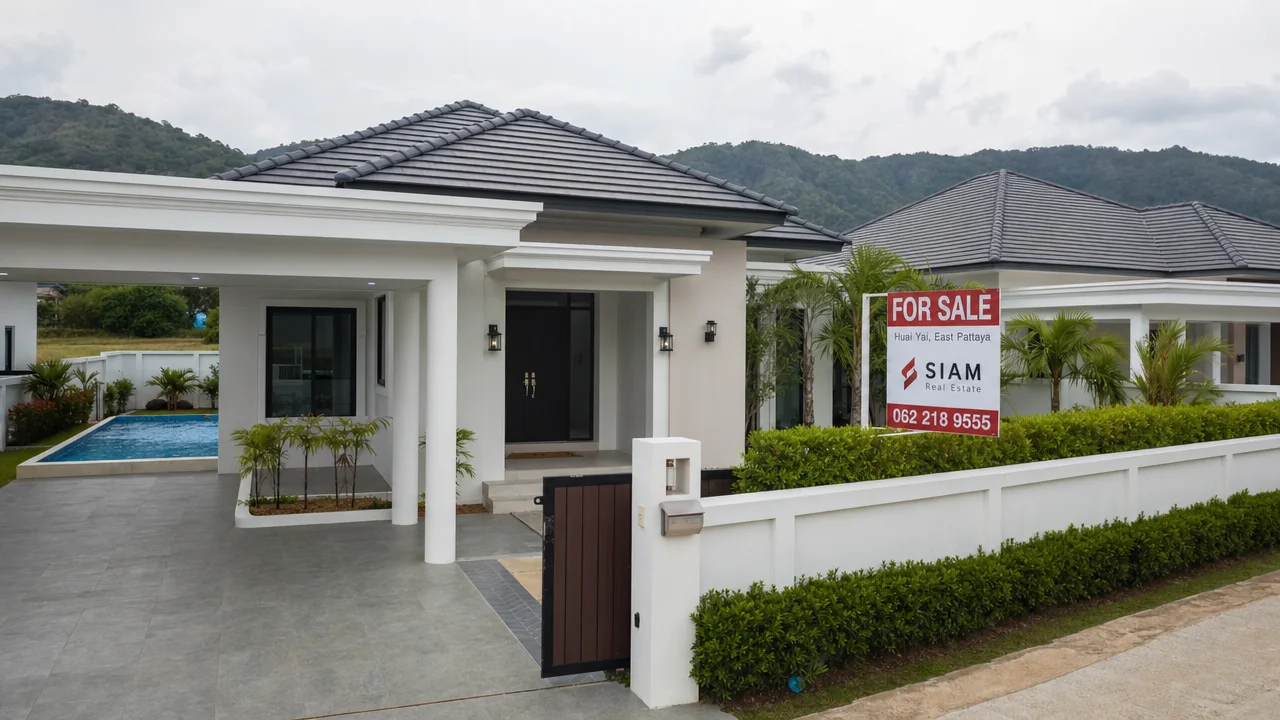
Example: A Russian buyer in 2023 purchased a 180 m² villa with a 400 m² plot in the Huay Yai area for 8.5 million baht through a Thai company. Registered capital 2 million baht, 51% of shares belong to three Thai citizens-acquaintances of the developer who signed blank share transfer forms. The buyer is the sole director, the only one who contributed money. In 2026, the company comes under scheduled inspection. Thai shareholders cannot explain the source of their "investments," tax history does not confirm financial capacity. The company is declared a nominee. The buyer loses the villa, may be deported, and blacklisted from entering Thailand.
Why Inspections in Chonburi are Particularly Strict
Chonburi's inclusion in the list of eight priority provinces is not accidental. High concentration of foreign buyers, large number of companies with zero income owning expensive real estate, complaints from locals about foreigners buying up land-all this made the region a target for the first wave of inspections.
Monitoring committees in Chonburi operate more actively than in most other provinces. Land Offices in Pattaya, Banglamung, Sriracha are already rejecting registration of transactions where shareholder structure raises doubts. Transactions registered 5-10 years ago are now being reviewed.
Legal Alternatives to Nominee Structures
Condominium: Full Ownership for Foreigners
Purchasing a condominium in your own name within the foreign quota (up to 49% of the project's total area) is completely legal and unaffected by the current campaign. This is the only form of direct freehold property ownership available to foreigners in Thailand. Foreign exchange transfer confirmation (Tor Tor 3 form from bank) is required.
30-Year Land Lease: Safe Alternative
A land lease for up to 30 years with contractual renewal conditions is a legally sound alternative to nominee land ownership. This structure carries no nominee ownership risks and is outside the current inspection campaign. Leasehold rights are weaker than ownership title, but the legal foundation is solid, the risk profile completely different. The lease is registered at the Land Office on the Chanote document, binding on successors.
Usufruct (right of use and benefit extraction) is also registered for up to 30 years or for life, offering stronger protection in some scenarios.
Company with BOI License: Legal Land Ownership for Business
Companies receiving Board of Investment (BOI) certification can own land on 100% foreign capital in promoted sectors, receive corporate tax benefits, simplified work visa procedures. This is the correct path for investors seeking to conduct real business in Thailand. The scheme is not suitable for buying a villa for personal residence.
What to Do if You Already Own Property Through a Nominee Company
First step-freeze all corporate changes. Do not file applications for capital increase, director changes, share transfers before consulting a lawyer. Any filing after April 1, 2026 triggers source of funds verification.
Second step-audit the ownership structure. Gather all documents: company charter, shareholder list, meeting minutes, bank statements, transfer confirmations, Thai shareholders' tax returns for the past three years. Verify whether Thai shareholders can prove they contributed capital from their own funds.
Third step-consultation with a licensed Thai lawyer. Do not rely on real estate agents or "consultants" who sold you the company. A lawyer will assess whether the structure can be made compliant or whether conversion to lease, usufruct, or sale is necessary.
Fourth step-voluntary regularization. If the structure can be corrected (for example, Thai shareholders actually have funds and are willing to officially confirm investments), submit corrected Investment Confirmation Letters through a lawyer. Voluntary disclosure before an investigation begins reduces the risk of criminal prosecution.
Fifth step-exit plan. If the structure cannot be corrected, develop an exit strategy: conversion to lease (if seller agrees), villa sale, transfer to Thai spouse (if marriage is registered and funds can be proven as spouse's personal property). Act before an investigation begins.
What This Means for Buyers in Pattaya
The villa market in Pattaya and the Eastern Economic Corridor is undergoing structural restructuring. For decades, developers sold villas to foreigners through nominee companies, knowing the scheme was illegal but counting on the absence of inspections. That era has ended.
For buyers, this means three things. First: if you plan to buy a villa with land, refuse offers to register a Thai company. The risk of losing all funds and deportation is real. Consider only 30-year land lease with Land Office registration or usufruct.
Second: if you already own a villa through a nominee company, act now. The probability of inspection grows each quarter. The longer you wait, the fewer options remain. Voluntary regularization or conversion to lease are the only ways to avoid confiscation.
Third: the condominium market in Pattaya is becoming more attractive to foreign buyers who previously preferred villas. Full ownership of an apartment within the foreign quota carries no legal risks, prices for quality projects in central Pattaya and Na Jomtien remain competitive (from 2.5 million baht for a 28-30 m² studio, from 4.5 million for a 35-40 m² one-bedroom). For investors focused on rental yield, condominiums are now safer than villas.
The temporary reduction in transfer fee to 0.01% for Thai citizens (valid until June 30, 2026 for properties up to 7 million baht) does not apply directly to foreigners but may stimulate the secondary market where foreigners buy from Thai owners.
Main conclusion: the legal environment has changed irreversibly. The Department of Lands, DBD, and AMLO work coordinately, using inter-agency databases and artificial intelligence. Nominee structures are no longer a "gray zone"-this is a criminal offense with real consequences. Buyers who ignore the new reality risk not only money but also the right to be in Thailand.