
Why Thai Developers Are Abandoning Installment Plans
In spring 2026, Thailand's condominium market is experiencing an unprecedented liquidity crisis. The volume of new launches has fallen to 17,000 units - the lowest in twenty years, and developers are massively curtailing installment programs and demanding full cash prepayment. The reason isn't greed, but a structural collapse of the industry's financial model: when 40-50% of mortgage applications are rejected by banks, developers are forced to protect their own liquidity at any cost.
According to industry analysts, unsold units are now taxed under the "other" category, which sharply increases operational costs. Developers have switched to a survival strategy: reducing their project portfolio, freezing launches, and preferring buyers with ready cash over those counting on extended payments. For investors from Russia, this means a fundamental change in the rules of the game.
Three Causes of Developers' Liquidity Crisis
The first cause is rising construction costs. Material and labor costs have increased by 15-20% over the past two years, but prices for finished apartments haven't kept pace with this dynamic. Developers found themselves trapped: raising prices is risky due to weak demand, keeping old ones means operating at a loss.
The second cause is strict bank lending policies. The mortgage application rejection rate has reached 40-50%, even creditworthy buyers cannot obtain financing. Banks have tightened loan-to-value (LTV) ratio requirements, increased down payments, and shortened lending terms. For developers, this means a client who signed an installment contract may not complete the purchase at the final stage.
The third cause is tax pressure. Unsold units are now subject to increased taxation, turning protracted projects into financial sinkholes. Developers are forced to either sell off remainders with 10-15% discounts or demand full prepayment from new buyers to close cash gaps.
How Purchase Terms Have Changed in Pattaya New Developments
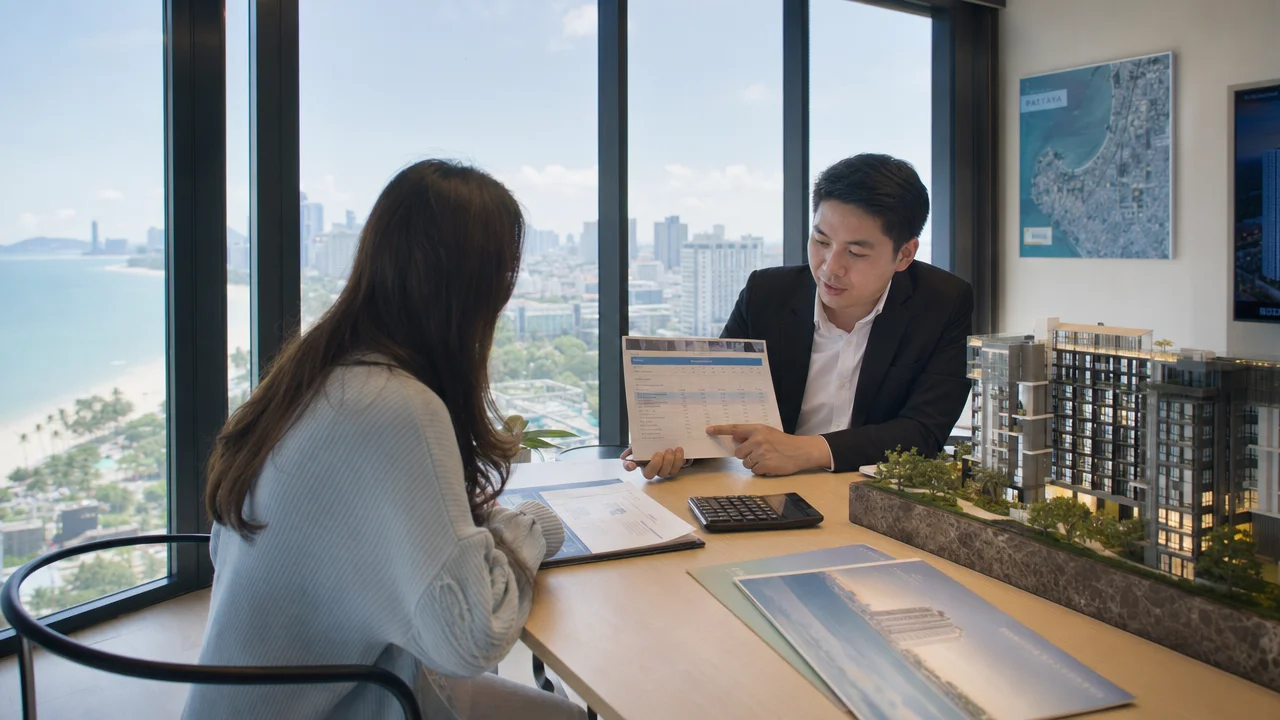
Back in 2024, the standard payment scheme looked like this: 20-30% upon booking, the rest - interest-free installments for the construction period, final payment after key handover. In 2026, this model has virtually disappeared from major developers' offers.
Today's typical terms: 50% upon contract signing, 30% within three months, remainder - upon ownership registration. Some developers require 100% prepayment at the foundation stage in exchange for a 5-7% discount. Installments have survived only with companies having strong balance sheets or in projects where more than 70% of units are already sold.
For buyers from Russia, this creates an additional barrier: the need to transfer a large sum at once via SWIFT in yuan with a 2-6% commission and pass bank compliance. Alternative schemes - exchanging rubles for baht in Pattaya through local exchangers - work only for small amounts and operational expenses, but not for purchasing freehold quota property, which requires confirmation of international transfer (FET).
Why Foreign Buyers Remain in the Game
Despite tighter conditions, foreign demand hasn't disappeared. Buyers from Russia, Taiwan, and Myanmar continue purchasing property in Pattaya, but motivation has changed. If speculative investments for resale previously dominated, now the share of those buying for long-term residence or rental to expats is growing.
Development of the Eastern Economic Corridor (EEC) creates sustainable demand for long-term rentals. International corporation employees rent apartments for 6-12 months, reducing dependence on seasonal tourist flow fluctuations. Rental yield from such rentals is 6-8% annually - a realistic figure after deducting all expenses, including taxes, utilities, and depreciation.
Cash buyers gain negotiating advantages. Developers are willing to provide 5-10% discounts to those who pay fully and quickly, because this closes cash gaps and allows construction to continue without borrowing. In Na Jomtien and Bang Saray areas, where construction is actively ongoing, such deals are becoming the norm.
Risks of Purchasing at Foundation Stage in 2026
Full prepayment at an early construction stage carries increased risks. The first risk is developer bankruptcy. If the developer cannot complete the project due to lack of financing, the buyer risks losing the entire amount. Insurance for such risks in Thailand is poorly developed, shareholder protection mechanisms are not comparable to European standards.
The second risk is project delivery delays. Developers include in contracts the right to postpone key handover by 6-12 months without penalties. For an investor counting on rental income from a specific date, this means direct financial losses.
The third risk is the finished property not matching promises. When a developer experiences financial difficulties, they may cut finishing costs, replace materials with cheaper ones, or reduce common infrastructure. The buyer learns about this only upon receiving keys, when getting money back is impossible.
Developer Verification Before Payment: Checklist
Before transferring a large sum, thorough developer verification is necessary. The first step is to ensure the construction license and environmental impact assessment (EIA) permit exist. EIA approval in Thailand takes one to two years, accelerating this process to 3-5 months is discussed as a government support measure but not yet implemented.
The second step is to study the company's financial history. How many projects has it completed over the past five years, were there delivery delays, what do buyer reviews look like. Information can be found in Thai Land Department databases and specialized expat forums.
The third step is to check the current project's sales structure. If the developer demands full prepayment but less than 30% of units are sold, this is a warning sign: the company is trying to close a budget hole at new buyers' expense. A healthy project has 50-70% of units sold before the active construction phase begins.
The fourth step is to verify the payment protocol. For freehold quota purchases, money must arrive from abroad in foreign currency with FET (Foreign Exchange Transaction) certificate issuance. If the developer offers alternative schemes or is willing to accept payment in baht without source confirmation, this is a law violation that will deprive you of full ownership rights.
Alternative: Secondary Market and Leasehold
Secondary property in Pattaya remains attractive for those wanting to avoid under-construction risks. Ready apartments can be inspected, the condition and complex infrastructure evaluated, real rental occupancy verified. Secondary market prices are 10-15% lower than comparable new developments, and transactions close in two to three weeks.
Leasehold (long-term rental for 30+30+30 years) is another option for lowering the entry threshold. Such properties cost 10-15% less than freehold, while ownership rights are protected by contract and Land Office registration. For investors planning a 10-15 year horizon, the difference between leasehold and freehold isn't critical, while savings are substantial.
Important point: in the secondary market, the developer no longer participates in the transaction, the seller is an individual. This eliminates developer bankruptcy risks but requires verification of clean title through the Land Department. Ensure the property has no encumbrances, utility payment debts, or legal disputes.
Government Support: What to Expect from Authorities
Thailand's real estate industry expects a package of support measures from the government. Developers are lobbying for relaxed LTV requirements, reduced registration and mortgage fees, extending leasehold term from 30 to 60 years, and accelerated environmental impact assessment approval.
Introduction of soft loan programs for buyers and debt consolidation mechanisms to increase creditworthiness is being discussed. If these measures are adopted in the second half of 2026, the market may begin recovery by 2027, but the process will be slow.
For foreign buyers, the key question is maintaining the freehold quota at 49% in condominiums. So far, the government doesn't plan to revise it, but pressure from nationalist groups is intensifying. Any quota reduction would sharply decrease foreign property liquidity and complicate resale.
What This Means for Pattaya Buyers
For Russian-speaking investors considering a Pattaya purchase in 2026, the situation requires strategy revision. Installments are no longer a standard option, you need to have the full amount on hand or be ready for an aggressive payment schedule.
Buyers with liquid capital capable of quickly closing deals gain advantages. They can negotiate 5-10% discounts and choose the best units in promising projects while competition is reduced. Na Jomtien and Bang Saray areas, where 12-15% price growth to 2028 is forecast thanks to EEC development, remain attractive for long-term investments.
It's important to soberly assess risks. Foundation-stage purchases with full prepayment are justified only with developers having impeccable reputations and high pre-sales levels. For other cases, it's safer to consider the secondary market or projects at final construction stages, where developer bankruptcy risk is minimal.
Rental yields in Pattaya remain at 6-8% annually with competent property management and orientation toward long-term tenants. The short-term model works in central beachfront areas, but competition among old stock is high, and operational expenses eat up a significant portion of profit.
Practical Steps for Safe Purchase
The first step is to determine budget accounting for all associated costs: international transfer fees (2-6%), registration fees (about 2% of value), transaction taxes, reserve for unforeseen expenses. The real amount needed to purchase an apartment for 3 million baht will be about 3.3 million baht.
The second step is to choose an area considering investment goals. For long-term rentals, Na Jomtien and areas near EEC industrial zones are suitable. For short-term tourist rentals - central Pattaya and Jomtien Beach. For personal residence - quiet Pratumnak and Bang Saray areas.
The third step is to conduct legal verification of the developer and project. Hire an independent lawyer specializing in real estate to verify licenses, permits, and contracts. Service cost is 15,000-25,000 baht, but this protects against losing millions.
The fourth step is to organize an international transfer with proper documentation. Money must arrive in foreign currency (dollars, euros, yuan) with the purpose indicated as "property purchase". The bank will issue an FET certificate, without which freehold registration for foreigners is impossible.
The fifth step is not to rush contract signing. Study all conditions, especially clauses about delivery deadlines, delay penalties, refund procedures in force majeure cases. If the developer pressures urgency - this is cause for concern.
Forecast: When Will Installments Return
Thailand's real estate market recovery will be slow and require coordinated actions by government, banks, and developers. Analysts forecast flexible payment schemes may return no earlier than 2027-2028, when bank lending policies stabilize and tax pressure on unsold properties decreases.
Until then, the market will remain a cash buyers' market. Developers will prioritize those who can pay quickly and fully, while other offers will close or freeze.
For Russian investors, this means a window of opportunity: with liquid capital available, you can enter the market on favorable terms, receive discounts, and choose the best units. But the price of this opportunity is increased risks and the need for thorough verification of every transaction aspect.