
Pattaya Real Estate Market Demonstrates Steady Growth Amid Tourism Recovery
According to CBRE Thailand, residential property prices in Pattaya are growing at 5-8% annually since 2023. This rate exceeds the national average growth (3-5%) and reflects fundamental changes in demand structure. Tourism recovery to 12 million visitors in 2024 has created a sustainable base for short-term rentals, while Eastern Economic Corridor infrastructure projects have attracted long-term investors from China, Russia, and European countries.
Price growth is uneven across segments. Condominiums in coastal areas of Wongamat and Pratumnak Hill show 7-8% annual growth, while suburban houses in East Pattaya and Na Jomtien grow slower at 4-6%. The market responds to foreign buyer preferences, for whom freehold condominium ownership remains the only legal way to own property in Thailand without using land leases or corporate structures.
Tourism as the Main Driver of Housing Demand
Pattaya received over 12 million tourists in 2024, matching the pre-pandemic level of 2019. Recovery occurred faster than in Bangkok or Phuket, thanks to proximity to the capital (147 km) and diverse entertainment options for all traveler categories.
The tourism boom directly impacts short-term rental yields. Studios in central Pattaya generate 6-8% annually in gross terms, one-bedroom apartments in Jomtien - 5-7%. High season (November-February) provides occupancy rates up to 85-90% at rates of 1,500-3,000 baht per night depending on property class.
The digital nomad and remote worker segment staying for 3-6 months is growing. This trend supports medium-term rentals with yields of 5-6% and lower operating costs compared to daily rentals. Developers adapt layouts for this audience: studios of 28-35 m² with dedicated workspace and high-speed internet are appearing.
Infrastructure Projects Increase Long-term Asset Value
The Eastern Economic Corridor (EEC) - a government development program for Rayong, Chonburi, and Chachoengsao provinces - is transforming Pattaya's status from resort town to regional economic hub. The project includes expanding U-Tapao Airport to 15 million passengers annually, constructing the Bangkok-Rayong high-speed railway, and industrial parks.
U-Tapao expansion creates direct flights from Shanghai, Hong Kong, Seoul, and Tokyo without Bangkok transfers. Travel time from airport to central Pattaya will reduce to 25 minutes after completion of Route 7 Extension highway in 2027. For property buyers, this means increased asset liquidity: properties near transport hubs show leading price dynamics.
The Bangkok-Rayong high-speed railway (planned launch 2028-2029) will reduce travel time to the capital to 45 minutes. The Pattaya station will be located in North Pattaya, already reflected in land prices: plots within 3 km of the future station have increased 15-20% since the project announcement in 2022.
Market Structure: Property Types and Price Ranges
Condominiums dominate new construction and secondary markets. Studios of 22-28 m² start from 2.5 million baht in central areas, one-bedroom apartments of 32-45 m² - from 4 to 8 million baht. Two-bedroom apartments of 55-75 m² in coastal projects reach 15 million baht, penthouses with sea views - from 20 million baht.
Foreigners can own condominiums as freehold property subject to two conditions. First: the building's foreign quota is not exceeded (no more than 49% of total unit area can be owned by foreigners according to Condominium Act B.E. 2522). Second: purchase funds are transferred from abroad in foreign currency, confirmed by Foreign Exchange Transaction Form (FET) from a Thai bank. Without FET, ownership registration at the Land Office is impossible.
Houses and villas are popular in suburbs: Jomtien, East Pattaya, Na Jomtien. Townhouses cost 5-12 million baht, villas with pool - 12-50 million baht, premium coastal residences - from 25 to 100 million baht. Foreigners cannot own land directly, so they use leasehold for up to 30 years with renewal option or register the house in their name with land registered to a Thai spouse.
Land plots attract investors in future development zones. Prices range from 3 million baht per rai (1,600 m²) in remote areas to 20 million baht per rai near coast or transport hubs. Land purchases require long-term planning horizon (5-10 years), but growth potential reaches 50-100% with infrastructure project implementation.
| Property Type | Price (million baht) | Target Audience | Yield |
|---|---|---|---|
| Studio 22-28 m² | 2.5-4 | First purchase, investors | 6-8% |
| 1-bed 32-45 m² | 4-8 | Couples, young professionals | 5-7% |
| 2-bed 55-75 m² | 8-15 | Families, long-term rental | 5-6% |
| Townhouse | 5-12 | Families with children | 4-6% |
| Villa with pool | 12-50 | Premium segment, expats | 3-5% |
| Coastal villa | 25-100+ | Ultra-premium | 2-4% |
Geographic Segmentation: Where Prices Grow Faster
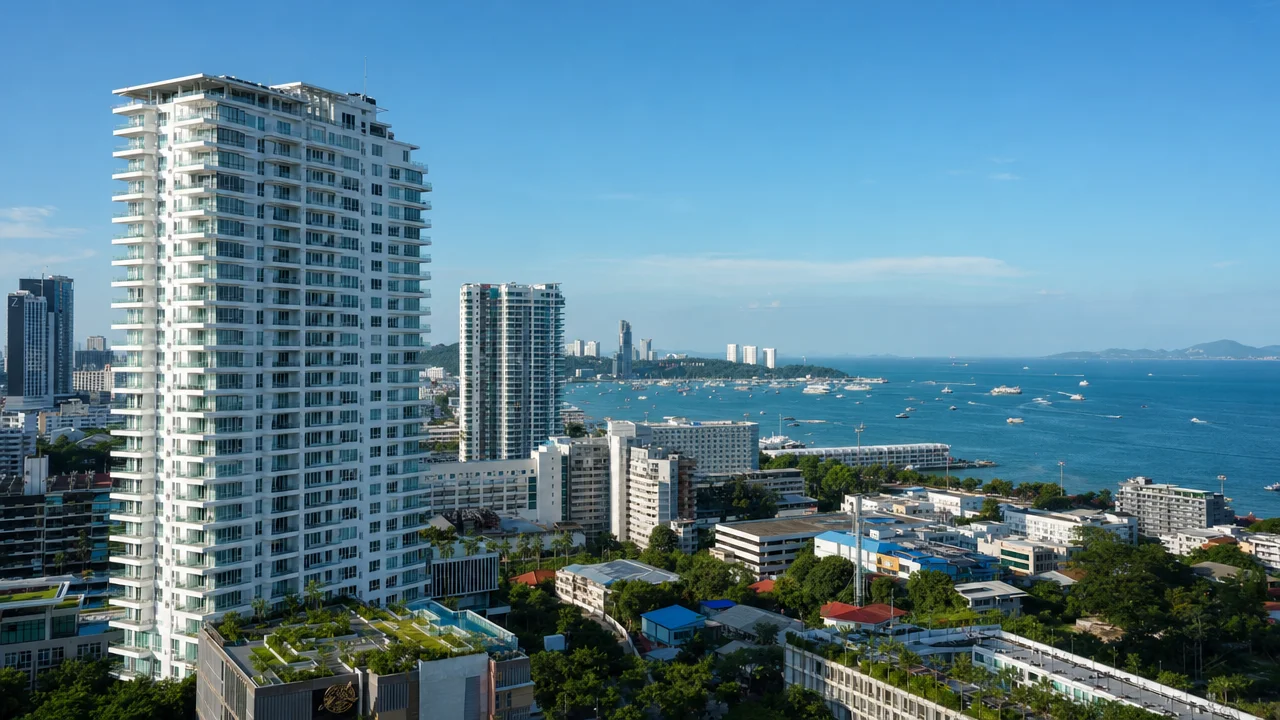
Wongamat - Pattaya's most prestigious district. Coastal condominiums and villas attract buyers with capital from 10 million baht. Price growth is 7-8% annually thanks to limited land supply and high demand from European and Middle Eastern investors. Typical projects: high-rise towers of 30-50 floors with infinity pools, spa centers, and concierge service.
Pratumnak Hill combines seclusion and proximity to entertainment. The elevated location provides panoramic bay views, increasing cost per square meter by 15-20% compared to flat areas. Prices grow 6-7% annually. Development is more strictly regulated: maximum height 8 floors, maintaining low population density.
Jomtien offers the best price-quality ratio for families and medium-term investors. New condominiums cost 20-30% less than comparable properties in central Pattaya with similar characteristics. Price growth 5-6% annually. Jomtien Beach is longer and calmer than the central one, attracting families with children and retirees.
East Pattaya - a suburban zone with houses, townhouses, and low-rise condominiums. Prices are 30-40% below coastal areas, growth 4-5% annually. Suitable for long-term residence with a car: 10-15 minutes drive to the sea. Well-developed social infrastructure: international schools, hospitals, shopping centers.
Na Jomtien - an emerging premium segment south of Jomtien. Villas of 20-50 million baht and resort residences with private beaches are appearing. Price growth 6-7% due to low base and influx of developers from saturated areas. A promising choice for buyers ready to wait 3-5 years for infrastructure development.
Tax and Regulatory Factors for 2026
Since 2020, the Land and Buildings Tax Act B.E. 2562 has been in effect, replacing outdated fees. Residential property is taxed at progressive rates: up to 40 million baht - 0.02%, from 40 to 65 million baht - 0.03%, from 65 to 90 million baht - 0.05%. For an apartment owner worth 5 million baht, the tax will be 1,000 baht per year.
Commercial property and vacant objects are taxed higher: up to 0.3-1.2% depending on use. Unused land may be taxed at up to 1.2%, encouraging development or sale.
In 2024, the government extended the ownership transfer tax exemption for housing up to 3 million baht: the rate reduced from 2% to 0.01%. The exemption is valid until December 31, 2025, and applies to new construction purchased from developers. For a buyer of a 3 million baht apartment, the savings are about 60,000 baht.
Rental income tax for non-residents is charged at 15% (withholding tax) if the tenant is a legal entity. When renting to individuals, tax is paid according to a progressive scale from 5% to 35% depending on annual income. Professional management companies optimize taxation through legal deductions (repairs, depreciation, management).
Risks and Investment Management Strategies
Oversupply remains the main risk in certain microdistricts. According to the Agency for Real Estate Affairs (state regulator), 47 condominiums with a total area of 1.2 million m² were completed in Pattaya in 2024. Unsold units comprise 15-20% in middle-class projects, pressuring secondary market prices.
Currency fluctuations affect international buyers. Baht strengthening against the dollar or euro by 5-10% effectively increases purchase cost for foreigners. Hedging through forward contracts or buying at a favorable exchange rate reduces this risk.
Premium property liquidity is lower than the mass segment. A villa for 30 million baht may sell for 12-18 months, while a studio for 3 million finds a buyer in 2-4 months. Investors with short horizons (3-5 years) are recommended liquid condominiums in coastal areas.
Professional management is critical for yields. Independent rental requires presence in Thailand or a trusted person. Management companies charge 15-25% of rental income but provide marketing, guest service, cleaning, and maintenance. Net yield after expenses is 4-6% for short-term rentals and 3-5% for long-term.
Market Development Forecast Until 2027
CBRE and Knight Frank analysts forecast moderate price growth of 3-5% annually in 2026-2027 as tourism flow normalizes and major infrastructure projects complete. The premium segment (from 10 million baht) may show 5-7% due to limited supply and influx of wealthy Asian buyers.
Legislative changes are being discussed in parliament. Proposals include increasing the foreign quota in condominiums from 49% to 75% in special economic zones and simplifying land lease extension from 30 to 50 years without re-registration. Adoption of these amendments could increase demand by 10-15% within a year.
Sustainable construction is becoming a competitive advantage. Projects with LEED or TREES (Thai green building standard) certificates receive tax benefits and attract environmentally conscious buyers willing to pay a 5-10% premium for energy efficiency and low operating costs.
What This Means for Buyers in Pattaya
Russian-speaking investors remain one of the largest groups of foreign buyers in Pattaya alongside Chinese and Europeans. Price growth of 5-8% annually makes the market attractive for medium-term investments (3-7 years) with the possibility of rental income and capital appreciation.
To purchase a condominium as foreign freehold property, the fund transfer procedure must be followed. Money is transferred from abroad (for example, from a Russian or European account) in foreign currency to an account at a Thai bank. The bank issues an FET certificate with a transaction code confirming the intended use of funds for property purchase. Without FET, the Land Office will refuse to register foreign ownership.
Checking the foreign quota is mandatory before depositing. A legal company or developer requests an extract from the condominium register showing the percentage of area owned by foreigners. If the 49% quota is exhausted, purchase is only possible in a Thai name (spouse, company) or as a lease.
Tax planning reduces costs. When purchasing new construction up to 3 million baht before the end of 2025, a transfer tax exemption applies (0.01% instead of 2%). With annual rental income exceeding 500,000 baht, it's advisable to obtain tax residency in Thailand to apply the progressive scale instead of the fixed 15% withholding tax.
Diversification by area and property type reduces risks. A portfolio consisting of a studio in central Pattaya (high yield, high liquidity) and a two-bedroom apartment in Jomtien (stable long-term rental) balances income and asset value growth. Adding a land plot in the EEC zone creates potential for significant capital appreciation over 5-10 years.
Conclusion: Pattaya Market Enters Mature Growth Phase
The Pattaya real estate market in 2026 is characterized by steady price growth of 5-8% annually, supported by tourism recovery to 12 million visitors and large-scale infrastructure investments under the Eastern Economic Corridor program. For foreign buyers, condominiums remain the only form of full ownership available without corporate structures or land leases.
Investors receive yields of 5-8% from short-term rentals and 3-5% from long-term rentals with competent asset management. Capital appreciation of 5-8% annually in coastal areas exceeds inflation and bank deposits, making Pattaya real estate a competitive tool for capital preservation and growth.
Strategic timing for market entry is the period of infrastructure project completion (2026-2028), when prices have not yet fully reflected future growth in regional connectivity, but project implementation risks are already minimal. Buyers acting on verified data and following legal procedures gain access to one of the most dynamic real estate markets in Southeast Asia.