
Why Young Thais Choose Rental Over Homeownership
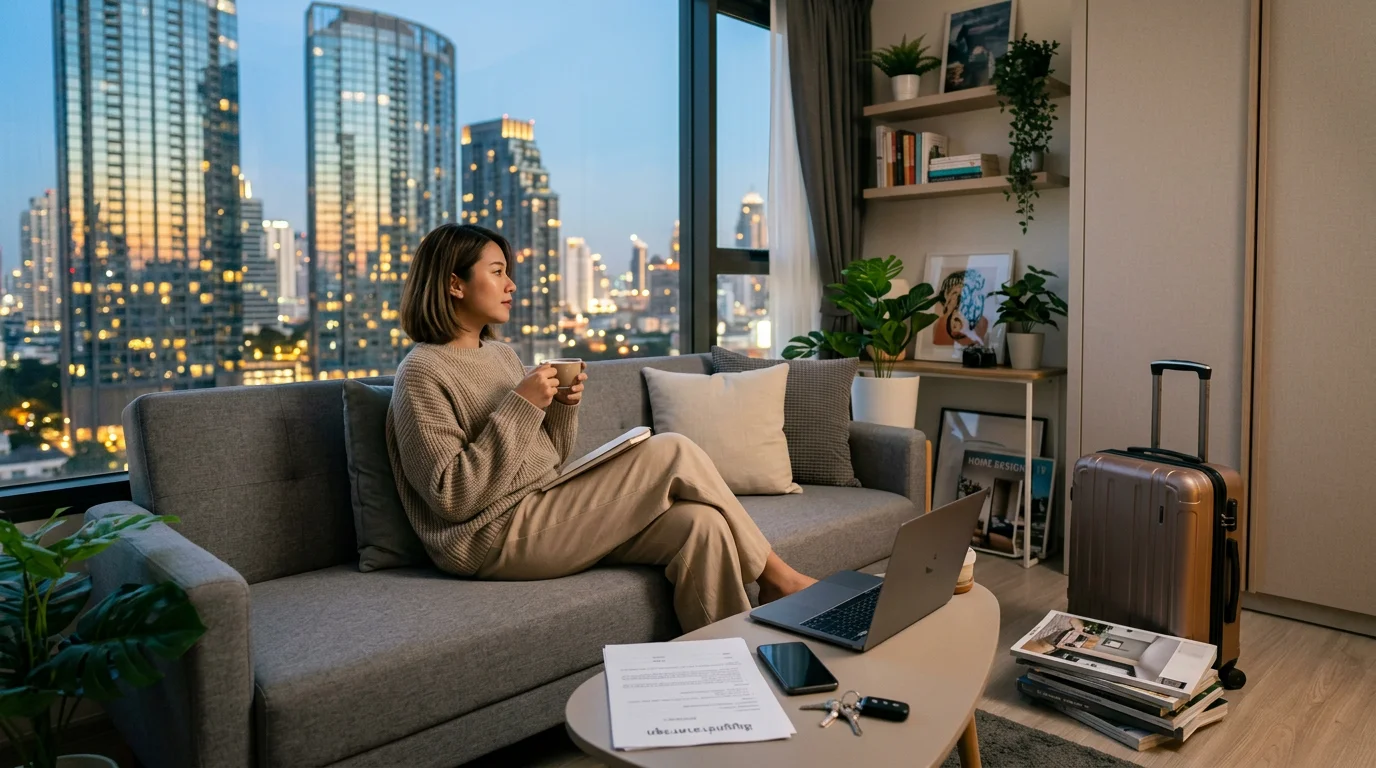
For the first time in decades, Thailand is seeing a generation for whom renting is becoming not a temporary solution, but a conscious choice for years ahead. According to PropertyGuru Thailand data for 2025, the share of Thais aged 21-30 considering purchasing property in the next 3 years has fallen to 34% - compared to 58% in 2019. At the same time, demand for long-term condominium rentals in Pattaya, Jomtien and Bangkok has grown by 12-15% during 2024-2025, with a significant portion of tenants being Thai professionals working in the Eastern Economic Corridor.
The reason is simple: the average income of a young professional in Thailand is 15,000-25,000 baht per month, while average household expenses have reached 22,282 baht. Townhouse prices have increased by 4.88% over the year, and condominiums in coastal areas by 3-6%. Banks have tightened mortgage requirements: less than 40% of applications are approved in the segment up to 3 million baht, where the main youth demand is concentrated. The result is a vicious cycle in which purchasing one's own home is postponed indefinitely or ceases to be a goal altogether.
How Demand Structure Has Changed in Pattaya and Jomtien Market
Before 2020, the rental market in Pattaya and Jomtien was almost entirely dependent on foreign tourists and expats. Seasonality was rigid: high season (November-March) brought 70-85% occupancy, low season (April-October) - 30-40%. Thai tenants comprised no more than 15% of the total.
Now the picture is changing. Development of industrial zones under the EEC (Eastern Economic Corridor) program has led to an influx of Thai professionals to Chonburi, Rayong and Banglamung. Many of them prefer to rent a condominium in Jomtien or Na-Jomtien rather than buy a townhouse in remote areas. Renting provides flexibility: one can move when changing jobs, not tie up capital in a mortgage, and live closer to the sea for the same money that a mortgage on a house 20 km from the coast would cost.
Concrete example: a 28 sqm studio in a middle-class project in Jomtien costs about 2.5 million baht. A 20-year mortgage at 6.5% annual interest would require a monthly payment of about 18,500 baht. Renting a similar studio - 8,000-10,000 baht per month. The difference is almost double, and it's critical for someone earning 20,000-25,000 baht.
Why Banks Refuse Mortgages Even to Creditworthy Borrowers
Thai household debt levels reached 90.6% of GDP in 2024 - one of the highest rates in Asia. The Bank of Thailand has tightened lending requirements to reduce the risk of defaults. Now banks assess not only income but also existing obligations: car loans, consumer loans, credit cards.
Young Thais often have several loans simultaneously: a motorcycle on installment (3,000-5,000 baht/month), a consumer loan for education or medical care, credit card debt. Even with an income of 25,000 baht, a bank may refuse a mortgage for 2 million baht if the total debt burden exceeds 40% of income.
An additional problem is the lack of stable credit history. Many young professionals work on short-term contracts or in the gig economy, which banks view as a risk. As a result, approval is granted either to borrowers with high income (from 40,000 baht) or those who have guarantors or a large down payment (30-40% instead of the standard 10-20%).
How Pattaya Developers Are Adapting to the New Reality
Developers quickly caught on to the trend. In 2025-2026, several major developers in Chonburi launched "rent-to-own" programs. The scheme works like this: a tenant rents a townhouse or apartment for 3-5 years, part of the rent (usually 20-30%) goes toward a future purchase. At the end of the term, the tenant can buy the property at a fixed price, using the accumulated amount as a down payment.
Example from Pattaya: a project in the Amata Industrial City area initially planned to sell 3,000 townhouses at 2 million baht per unit. After two years of weak sales, the developer redirected part of the properties to rental at 4,500 baht per month. Occupancy reached 100% in three months. Tenants are predominantly Thai workers and factory specialists who cannot get a mortgage but are willing to pay for stable housing near work.
However, the rent-to-own model has limitations. A rent of 4,500 baht does not guarantee that in 3 years the tenant will be able to pay a mortgage of 9,000-10,000 baht. Banks assess creditworthiness at the time of application, not the accumulated amount. As a result, many tenants remain tenants even if they formally participate in the buyout program.
Impact of the Trend on Condominium Prices in Jomtien
The growing number of Thai long-term tenants directly affects the structure of supply and demand in Jomtien. Previously, owners focused on short-term rentals to tourists: high rates (1,500-2,500 baht/night), but seasonality and management costs. Now more and more owners are switching to long-term rentals to Thais: lower rates (8,000-12,000 baht/month for a studio), but stability and minimal costs.
This reduces pressure on resale prices. Investors who previously bought expecting quick resale in 2-3 years now hold properties longer, earning rental income. Supply in the secondary market is shrinking, especially in liquid projects with good infrastructure. At the same time, demand for purchases from Thais is falling, which constrains price growth in the budget segment (up to 3 million baht).
According to the Phuket Real Estate Association (similar processes are occurring in Pattaya), condominium prices in coastal areas in 2024-2025 grew slower than in 2019-2020: +3.2% versus +7.8% annually. The reason is a structural shift from buying to renting among the local population, which partially offsets foreign demand.
How the Tenant Profile in Pattaya Is Changing
Five years ago, a typical long-term tenant in Jomtien was a European retiree or freelancer renting an apartment for 6-12 months. Now the portrait has become more complex:
- Thai professionals aged 25-35, working in IT, logistics, industry. Income 25,000-40,000 baht, rent 8,000-15,000 baht/month. Looking for studios or 1-bedroom in projects with fitness, co-working, parking.
- Thai families with children, who moved from Bangkok or Isaan for work in the EEC. Household income 50,000-70,000 baht, rent 15,000-25,000 baht/month for 2-bedroom. Schools nearby, playgrounds, security are important.
- Foreign expats, working on contract at factories or in offices. Income 60,000-150,000 baht, rent 20,000-40,000 baht/month. Prefer projects with an international community, English-speaking management.
Thai tenants are becoming more demanding. They want not just a roof over their heads, but full infrastructure: pool, fitness, barbecue area, pet-friendly policy. Projects built 10-15 years ago without these options are losing competitiveness even at low rental rates.
Risks and Opportunities for Foreign Investors
For buyers from Russia, Kazakhstan and other countries, the trend creates a contradictory situation. On one hand, the growth in Thai tenants stabilizes the rental market: less dependence on tourist flows, higher occupancy in low season. Long-term rental to Thais provides predictable income of 4-6% annually, which is comparable to a deposit but with capital growth potential.
On the other hand, the decline in Thai purchasing power limits liquidity in the budget segment. If you bought a studio for 2.5 million baht in 2023, selling it in 2026 for 3 million may be more difficult than expected. Thai buyers - the main audience for resale of properties up to 4 million baht - either don't get mortgages or prefer renting.
Opportunities:
- Purchasing in projects oriented toward long-term rental to Thais: stable cash flow, low management costs.
- Focus on areas near industrial zones (Na-Jomtien, East Pattaya): growing demand from Thai professionals.
- Choosing projects with strong infrastructure: fitness, co-working, children's areas - what Thai tenants value.
Risks:
- Low liquidity when reselling in the segment up to 3 million baht.
- Competition from developers launching rent-to-own programs.
- Need to adapt the property to Thai tenant requirements (furniture, appliances, internet).
Forecast for 2026-2027: What Awaits the Pattaya Market
The trend toward renting instead of buying is unlikely to reverse in the coming years. This would require structural changes: wage growth, easing of lending conditions, reduction of household debt burden. None of these factors are currently visible.
The Bank of Thailand forecasts that household debt levels will remain at 88-92% of GDP until the end of 2027. Inflation has slowed, but real incomes are growing slower than housing prices. Banks will continue to tighten mortgage requirements, especially in the segment up to 3 million baht, where the main default risk is concentrated.
Expected consequences for Pattaya and Jomtien:
- Further growth in the share of long-term rentals in the overall market structure: from the current 35-40% to 50-55% by 2027.
- Stabilization of secondary market prices in the budget segment: growth no more than 2-3% annually.
- Increased competition among owners for quality long-term tenants.
- Growing popularity of projects with comprehensive infrastructure oriented toward Thai professionals.
What This Means for Buyers in Pattaya
If you are considering buying a condominium in Jomtien or Pattaya in 2026, consider the new market reality. Thai buyers - traditionally the main audience for resale of properties in the segment up to 4 million baht - are increasingly choosing to rent. This means that the strategy of "buy cheap, sell in 3 years with a 30% markup" works worse than before.
Instead, focus on rental yield. Choose projects that are attractive to long-term Thai tenants: with good infrastructure, near industrial zones or transport hubs, with reasonable utility fees (50-70 baht/sqm per month). Such properties will provide stable income of 4-6% annually and maintain liquidity when reselling.
Pay attention to the project's management company. Thai tenants value quick resolution of household issues, cleanliness of common areas, working elevators and security. Projects with poor management lose tenants faster than they reduce rates.
Avoid outdated projects without infrastructure, even if the price seems attractive. Competition for tenants is growing, and properties without a pool, fitness or parking will be increasingly difficult to rent. It's better to pay an extra 300-500 thousand baht for a unit in a project with a full set of amenities than to save and have a vacant apartment half the year.
Finally, if you plan to hold the property for 5-7 years or more, the rental trend works in your favor. The long-term rental market in Pattaya is growing, demand from Thais stabilizes yields, and dependence on tourist flows decreases. The main thing is to choose the right project and properly position the property for the target audience.