

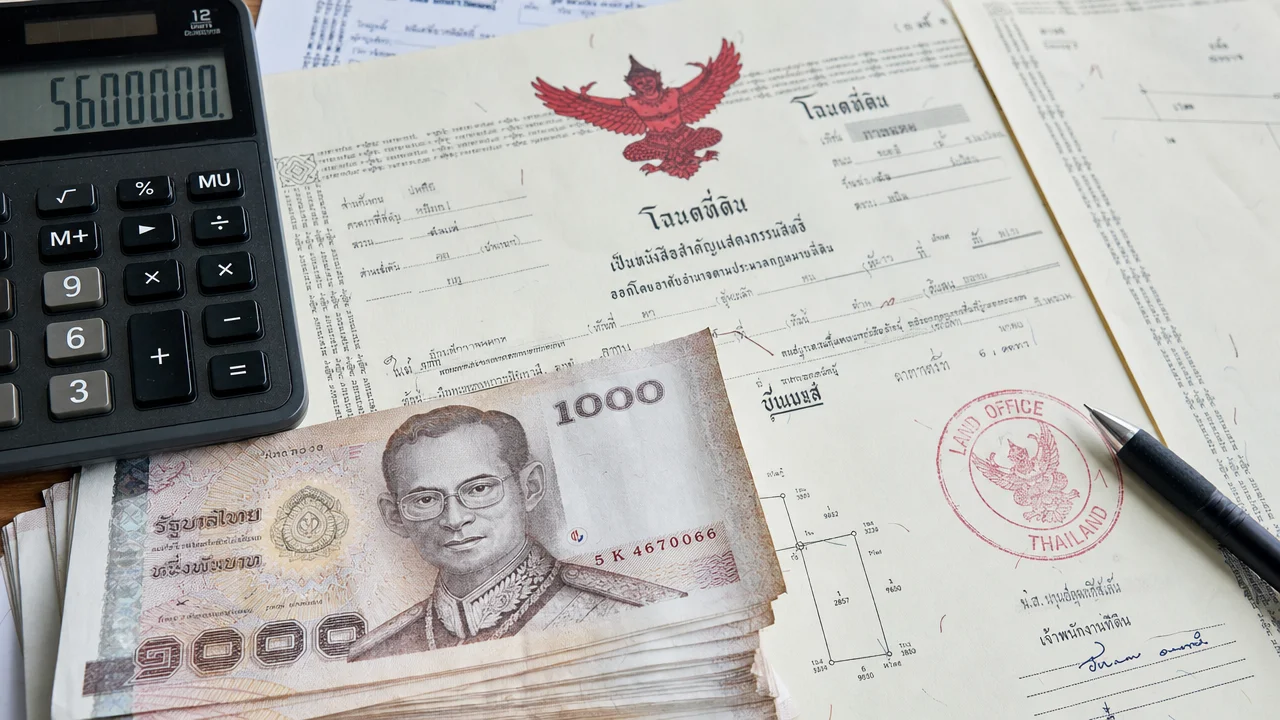

Thai Government Extends Reduced Transfer Fee Rate
The Cabinet of Thailand has approved an extension of the reduced registration fee for property ownership transfer for another year. Instead of the standard 2%, property buyers will pay a symbolic 0.01% when registering the transaction at the Land Office. The measure applies to all residential property purchase transactions registered from April 24, 2025 to April 24, 2026.
The decision comes amid a slowdown in the housing market following the cancellation of previous stimulus programs. Thailand's Ministry of Finance expects the extension of the benefit to support demand from first-time homebuyers and mid-segment investors. According to estimates by the Housing Business Association of Thailand, in the first quarter of 2025, the volume of new transaction registrations decreased by 18% compared to the same period the previous year.
How the Reduced Transfer Fee Works
Under the standard registration scheme, a property buyer in Thailand pays several mandatory fees. The registration fee is 2% of the appraised value of the property or the transaction price (whichever is greater). The stamp duty is 0.5%. The property transfer tax depends on whether the seller has owned the property for more than five years: if less than five years, the buyer pays 3.3% personal income tax calculated on the cadastral value.
Under the current benefit, the registration fee is reduced to 0.01%, which in practice means several hundred baht instead of tens or hundreds of thousands. The stamp duty and transfer tax remain unchanged. For an apartment worth 5 million baht, the savings on the registration fee will be approximately 99,950 baht.
Conditions for Applying the Benefit
The reduced rate is applied automatically when registering a transaction at the Department of Lands (Land Office) during the program period. The buyer does not submit a separate application. There are no restrictions on property type: the benefit applies to condominiums, townhouses, private houses on land plots with Chanote title (Nor Sor 4 Jor). There are also no restrictions on buyer citizenship-foreigners purchasing condominiums within the permitted 49% quota pay the same 0.01%.
Important nuance: the transaction registration date, not the date of signing the preliminary contract or deposit payment, determines application of the benefit. If parties signed a purchase agreement in March 2025 but registered the transfer of ownership in May, they fall under the reduced rate. If registration occurs on April 25, 2026, they will have to pay the full 2%.
History of the Real Estate Market Stimulus Program
The Thai government first introduced the reduction of the registration fee to 0.01% in April 2023 for one year. The goal was to support the housing market after the COVID-19 pandemic and compensate for falling demand due to rising mortgage interest rates. The Bank of Thailand raised the key rate from a historic low of 0.5% in 2021 to 2.5% by mid-2023, making housing loans more expensive.
In April 2024, the program was extended for another year, until April 24, 2025. During the two years of the benefit, according to the Department of Lands, more than 320,000 transactions were registered using the reduced rate. The total amount saved by buyers exceeded 12 billion baht. Developers and agents noted that the benefit became one of the key arguments in negotiations with buyers, especially in the housing segment priced from 3 to 10 million baht.
Why the Government Is Extending the Program
Thailand's Ministry of Finance justifies the extension with three factors. First-incomplete recovery of the housing market. According to the Agency for Real Estate Affairs of Thailand, in the second half of 2024, the number of new project launches decreased by 22% compared to the same period in 2023. Developers are postponing launches due to demand uncertainty.
The second factor is the high share of unfinished construction. At the end of 2024, the Bangkok and suburban market had about 45,000 unsold completed apartments in condominiums handed over within the last three years. The extension of the benefit helps developers sell off inventory and free up capital for new projects.
The third factor is stimulating domestic demand. The government expects that savings on the state fee will push first-time homebuyers who postponed their decision due to rising prices and mortgage interest rates. The average rate on housing loans in Thailand in early 2025 is about 6.5-7% per annum, which is 2-2.5 percentage points higher than the 2021 level.
Comparison of Full and Reduced Registration Costs
| Property Value | Standard Fee (2%) | Reduced Fee (0.01%) | Savings |
|---|---|---|---|
| 3 million baht | 60,000 baht | 300 baht | 59,700 baht |
| 5 million baht | 100,000 baht | 500 baht | 99,500 baht |
| 10 million baht | 200,000 baht | 1,000 baht | 199,000 baht |
| 20 million baht | 400,000 baht | 2,000 baht | 398,000 baht |
The table shows savings on registration fee only. The 0.5% stamp duty and property transfer tax are paid separately at standard rates.
What This Means for Buyers in Pattaya
For foreign buyers considering property in Pattaya, the extension of the benefit until April 2026 provides an additional year to complete transactions with minimal registration costs. Pattaya traditionally attracts condominium buyers in the price range of 2 to 8 million baht-a segment where savings on the state fee are most noticeable.
A buyer of an apartment for 4 million baht in the Jomtien or Pratumnak area will save about 80,000 baht on the registration fee. This amount can be directed toward renovation, furniture, or covering part of the agent commission. For investors buying multiple properties, cumulative savings can reach several hundred thousand baht.
Important point for planning: if you are choosing a property under construction with handover in late 2025 or early 2026, make sure the developer can complete the project and hand over the apartment before April 24, 2026. Handover delays of a month can cost you the full rate of state duty. Check the realism of timelines and the developer's reputation before making a deposit.
For those who already own property in Pattaya and are planning to sell with subsequent purchase of a larger property, the current period is a good window. By selling your first apartment and registering the purchase of a new one before April 2026, you minimize transaction costs on the second deal.
The Pattaya market in 2025 shows stable demand in the segment of completed condominiums with sea views and within walking distance of beaches. Developers offer additional discounts and installment plans, competing for buyers. The combination of reduced state fees, developer discounts, and the ability to choose from a large number of completed properties makes the current period one of the most favorable for buying in the last three years.
Conclusion
The extension of the program to reduce the registration fee to 0.01% for a year gives homebuyers in Thailand additional time to complete transactions with minimal costs. The measure applies to all types of residential property and all buyers, including foreigners. Savings on a mid-price apartment range from 60 to 200 thousand baht-an amount that can be directed toward property improvement or reducing the financial burden when purchasing.
For the Pattaya market, the benefit is particularly relevant in the condominium segment priced from 2 to 8 million baht, where the main demand from foreign buyers is concentrated. When planning a transaction, consider that the decisive date is the day of registration at the Land Office, not the signing of the preliminary contract. Check the handover dates for properties under construction and allow a time buffer until April 24, 2026.