
Investment Boom on the Islands of the Gulf of Siam
Koh Samui and Koh Phangan recorded 154 active real estate projects in the first quarter of 2026 with total investments exceeding 61.14 billion baht. According to Colliers Thailand data, approximately 2,860 properties are listed for sale - from premium villas to studio condominiums. The market is changing status: from tourist locations, the islands are transforming into an international investment hub comparable in scale to Phuket.
Foreign investors account for 85-90% of all demand. The main buyers are citizens of Israel, European countries, Australia, and Russia. Western capital has already passed the exploration stage and moved to large-scale purchases. On Phangan alone, foreign investments totaled 7.9 billion baht, confirms The Nation Thailand.
Why the Islands Have Become a Magnet for Capital
The arrival of major Bangkok developers has changed the rules of the game. Leading developers are massively buying land to prepare future developments. The apartment market remains deficient - Samui features only nine condominium projects with 1,214 units with a total value of 6.03 billion baht. Supply cannot keep up with demand.
Prices are rising at accelerated rates. The average price per square meter in condominiums has reached 60,000-80,000 baht. In the premium segment, the bar has risen above 200,000 baht per square meter. For comparison: two years ago, similar properties were sold 40-50% cheaper.
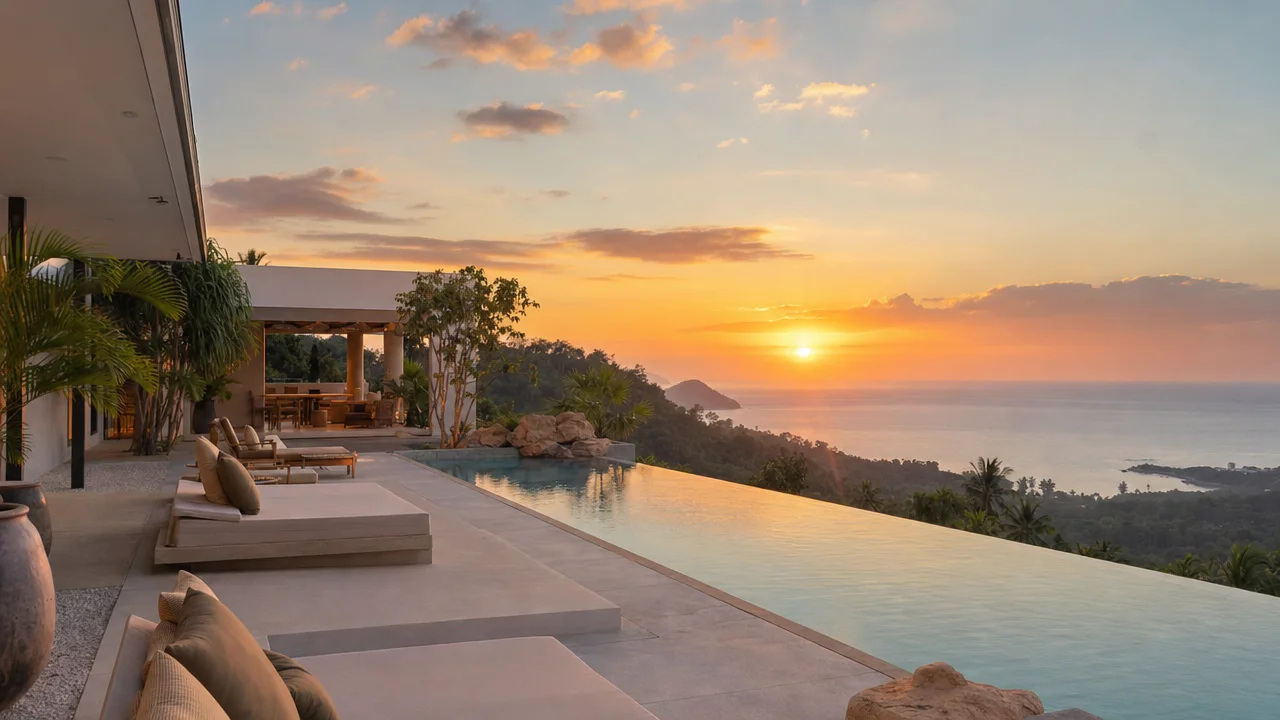
The villa market demonstrates even more impressive dynamics. Samui has 65 projects offering 749 villas with a total value of 29.85 billion baht. More than half of the island's entire residential market value falls precisely in this segment.
Geography of Demand
Buyers are concentrated in four key zones. Chaweng and Lamai attract with developed infrastructure and proximity to the airport. Bophut and Maenam are valued for picturesque views and high levels of privacy. These areas provide stable income from short-term rentals - occupancy reaches 65-70% with an average rate of 60,000-120,000 baht per month for a two-bedroom villa with a pool.
On Phangan, demand shifts toward the western and eastern coasts. Sri Thanu and Mae Haad in the west offer sunsets and developed infrastructure for digital nomads. Thong Nai Pan in the east - seclusion and high rental rates. Ban Tai in the south holds the lead in number of transactions due to proximity to the ferry terminal.
Wellness Tourism as a Growth Driver
Phangan attracts digital nomads and wellness tourists year-round. Demand for pool villas holds from November to April, growing in summer due to Israeli and European renters. With a property cost of 8-12 million baht and 65-70% occupancy, annual yield reaches 7-9% before management expenses.
The island has avoided the mass construction characteristic of Phuket. Part of the territory is occupied by Than Sadet National Park, where construction is prohibited. Free land for development is becoming scarce. Land prices range from 3-5 million baht per rai (1,600 square meters) inland to 15-25 million baht per rai on the beachfront in Sri Thanu and Thong Nai Pan Noi areas.
What Foreigners Are Buying
A foreigner cannot own land in Thailand directly - this is stipulated in the Land Code. Three main property ownership schemes are available:
Villa on Leased Land
The buyer registers the building in their name, leases the land for 30 years with the right to extend for two more terms (30+30+30 years). The leasehold scheme gives full control over the structure with minimal legal risks. Entry cost - from 5-6 million baht for a small one-bedroom villa with a pool.
Condominium Apartment
A foreigner can own an apartment as full property (freehold) if the foreign quota in the building does not exceed 49%. Studios on Phangan start from 2.5-3 million baht - the most accessible entry for an investor with a limited budget. On Samui, the threshold is higher: from 4-5 million baht for a studio in new projects.
Thai Company
Land ownership through a Thai limited liability company where the foreigner is a minority shareholder. The scheme requires annual reporting, auditing, and tax returns. Authorities have strengthened control over nominee structures - the company must be a real operating business, not exist solely for land ownership.
Key Risks When Buying
Checking land documents is a mandatory stage. Part of the land plots on Phangan are located in the national park zone where construction is prohibited. There have been cases of land sales with unregistered encumbrances. Make sure the plot has a full title deed Nor Sor 4 Jor (Chanote) or at least Nor Sor 3 Gor with a clean history.
Samui has special zoning rules, including height restrictions related to elevation and protected forest zones. Check that the plot is in a zone that legally permits villa construction and any planned extensions.
Many old villas were built before current law came into effect. Check the building permit, usage permit, and compliance of structures with approved plans through the Land Office.
Optimal Entry Strategy in 2026
For an investor with a budget of 8-12 million baht, the optimal option is a pool villa in the Sri Thanu or Ban Tai area on Phangan. Rental through a management company provides a target yield of 7-8% net. In parallel, you can secure a land plot for possible construction of a second property in 2-3 years - land prices are growing faster than ready-made real estate.
For a conservative investor with starting capital of 2.5-4 million baht, a studio in an under-construction condominium is suitable. Risks are lower, liquidity is higher, management is simpler. Annual yield from short-term rental will be 5-6% after deducting maintenance costs.
Buyers with a budget above 15 million baht are considering beachfront plots in Thong Nai Pan or Maenam. Land on Samui and Phangan is becoming a scarce asset. The growth in plot values over the past two years reflects feverish demand from Thai and foreign buyers.
Comparison of Returns by Property Type
| Property Type | Entry Cost (million baht) | Annual Yield | Occupancy | Liquidity |
|---|---|---|---|---|
| Studio condo | 2.5-4 | 5-6% | 60-65% | High |
| 2-bedroom villa | 8-12 | 7-9% | 65-70% | Medium |
| Premium villa | 15-25+ | 6-8% | 55-60% | Low |
| Land plot | 3-25 | Value growth | - | Low |
What This Means for Buyers in Pattaya
The investment boom on Samui and Phangan directly affects the Pattaya market. Price growth on the islands of the Gulf of Siam is pulling up prices along the entire eastern coast. Investors who did not manage to enter Samui at old prices are switching to Pattaya - here an entry window with 6-8% annual yield still remains with studio prices from 2-2.5 million baht.
Pattaya wins in infrastructure and transport accessibility. To Suvarnabhumi Airport - 90 minutes, to Bangkok - an hour on the expressway. Samui requires a flight or multi-hour journey with ferry crossing. For an investor planning active rental management and regular visits, logistics plays a decisive role.
Wellness tourism, which has become a growth driver on Phangan, is actively developing in Pattaya. The Pratumnak and Wongamat areas attract buyers seeking a calm atmosphere and quality infrastructure. Occupancy of villas and apartments in these locations reaches 70-75% - higher than on the islands.
Legal ownership schemes are identical. A foreigner can buy an apartment in a condominium as freehold or a villa on leased land. Checking documents through the Land Office is mandatory regardless of region. Pattaya offers a larger selection of proven management companies and law firms specializing in transaction support for foreigners.
The Pattaya market is more mature and predictable. On Samui and Phangan, prices are rising faster, but volatility is higher. Pattaya provides stable returns with lower risks. For portfolio diversification, it makes sense to consider both directions: Samui as a growth asset, Pattaya as a source of stable cash flow.
Conclusions
The islands of Samui and Phangan have gone from tourist destinations to a full-fledged investment hub with project volumes exceeding 61 billion baht in three years. Foreign buyers provide up to 90% of demand, prices for land and ready-made real estate are growing at double-digit rates. Wellness tourism and the influx of digital nomads have created sustained demand for long-term rentals.
For market entry, three strategies are optimal: a studio condominium from 2.5 million baht, a pool villa for 8-12 million baht, or a land plot for the future. Yield varies from 5% to 9% annually depending on property type and location. Checking documents through the Land Office and engaging an independent lawyer are mandatory - the market is growing rapidly, fraud risks remain.
Pattaya remains a more accessible alternative with comparable yields, better logistics, and more mature property management infrastructure. Diversification between the islands and eastern coast reduces portfolio risks and allows capturing growth in both market segments.