

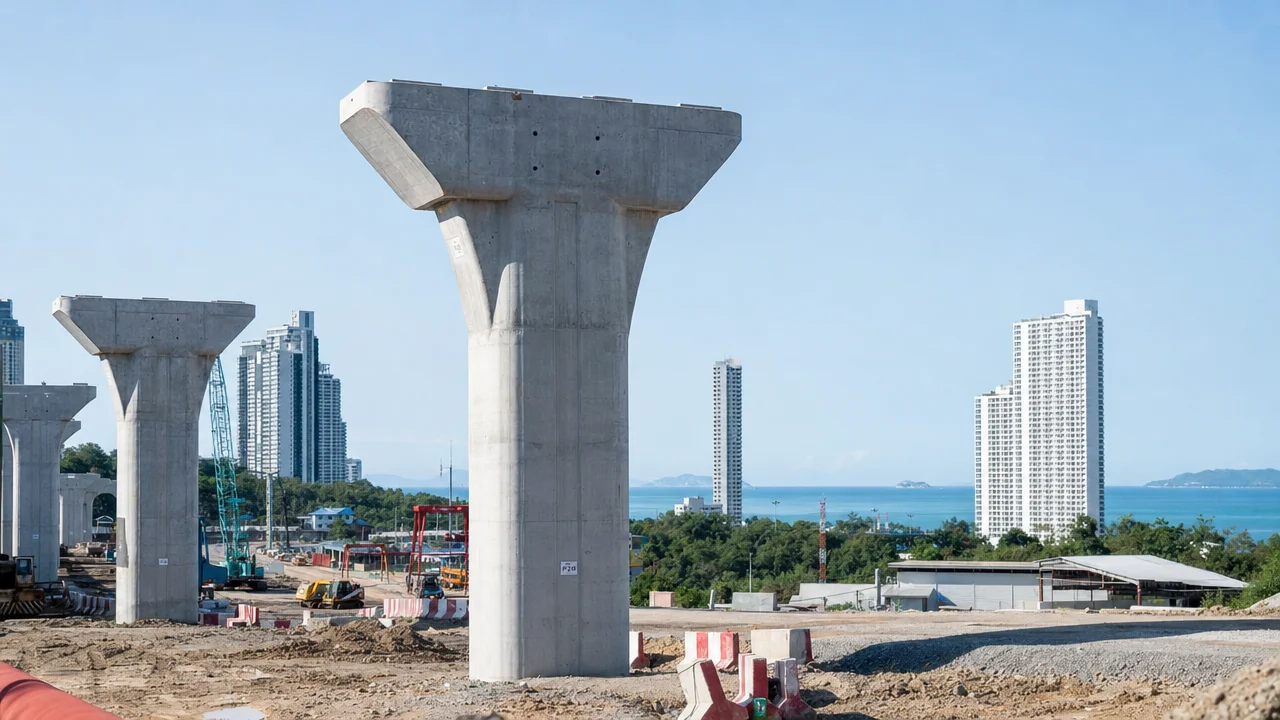

How Infrastructure Megaprojects Are Rewriting the Rules of the Eastern Economic Corridor Real Estate Market
In 2026, Pattaya is undergoing a transformation that goes far beyond ordinary construction market cycles. The expansion of U-Tapao International Airport and the construction of a high-speed railway line to Bangkok are turning the resort city into a key regional transport hub. These projects are part of the government's Eastern Economic Corridor (EEC) development program, which has received direct government support and investments totaling over 290 billion baht.
For property buyers, this is not about speculative growth, but about a fundamental change in Thailand's logistics map. Travel time from Pattaya to central Bangkok will be reduced from the current 2.5-3 hours to 45 minutes. U-Tapao will become the third international airport of the capital agglomeration, handling up to 15 million passengers annually in its first phase.
Current Project Status: Timelines and Implementation Phases
Construction of the Bangkok-Rayong high-speed railway officially began in 2022. The project is being implemented by a consortium managed by Charoen Pokphand Group together with China Railway Construction Corporation. The total line length is 220 kilometers with eight stations, including stops at Suvarnabhumi Airport, U-Tapao, and industrial zones in Chonburi.
As of early 2026, approximately 40% of construction work has been completed. A trial launch is scheduled for the end of 2028, with commercial operations beginning in 2029. Travel speed will reach up to 250 km/h on main sections.
U-Tapao Airport is undergoing its first phase of expansion worth 89 billion baht. Construction of a new passenger terminal with an area of 216,000 square meters is proceeding in parallel with runway modernization. The design capacity of the first phase is 15 million passengers per year versus the current 3 million. By 2035, an increase to 60 million passengers is planned upon full implementation of all phases.
Growth Zones: Which Pattaya Districts Benefit from Infrastructure
Infrastructure projects create a clear geography of investment demand. The greatest buyer interest has shifted eastward-toward the railway route and airport.
Na Jomtien and Sattahip District
The residential area of Pattaya closest to U-Tapao is located 15-20 kilometers from the airport. The Na Jomtien, Huay Yai, and northern Sattahip areas recorded a 23% increase in new projects in 2025 compared to 2023. The average condominium price in this zone rose from 65,000 to 78,000 baht per square meter over two years.
Developers are launching projects here oriented toward long-term rentals by specialists from international companies working in EEC industrial zones. The typical product is condominiums with one or two bedrooms of 35-55 square meters, with starting prices from 2.8 million baht.
Central Pattaya and Sukhumvit Corridor
The planned high-speed railway station in the Pratamnak area is creating a new point of attraction. Projects within a 3-kilometer radius of the future station show a price premium of 12-15% compared to similar properties further from the transport hub.
Villa villages along Sukhumvit Road between Pattaya and Rayong also demonstrate increased demand. Management staff from factories and engineers who prefer to live outside industrial towns but with quick access to workplaces are buying here.
Price Impact: Data and Analyst Forecasts
Pattaya's real estate market is responding to infrastructure changes gradually, without sharp jumps. According to CBRE Thailand's first quarter 2026 report, the average condominium price in Pattaya increased by 4.2% over the past 12 months. For comparison: in Bangkok the growth was 2.8%, in Phuket-6.1%.
Villas and houses with land show more pronounced dynamics. The average price of a house with three bedrooms and a pool in eastern Pattaya projects increased from 8.5 to 9.7 million baht during the 2024-2026 period. Growth amounted to 14%.
Knight Frank analysts forecast a further price increase of 15-20% in areas adjacent to railway stations during the period from 2026 to 2030. This refers to cumulative growth, not annual rates. The key factor is the start of commercial line operation and real reduction in travel time.
Tenant Demand: A New Category of Clients
EEC development is attracting international corporations to the region. According to the Eastern Economic Corridor Office (EEC Office), more than 280 projects with foreign investments totaling over 1.7 trillion baht were registered in the zone as of early 2026.
This creates sustainable demand for long-term housing rentals. The typical tenant is a European or Japanese specialist with a 2-3 year contract, salary from 150,000 baht per month, looking for housing within a 30-40 minute drive from work.
Rental rates for two-bedroom condominiums in the Na Jomtien area rose from 18,000 to 23,000 baht per month over the past two years. Villas with three bedrooms rent for 45,000-65,000 baht per month depending on project class and distance from the coast.
Important point: this tenant segment does not overlap with the tourist short-term rental market. Demand is stable year-round, does not depend on seasonality, and is less sensitive to tourist flow fluctuations.
Risks and Limitations: What Investors Need to Know
Infrastructure projects carry not only opportunities but also risks. The main one is schedule delays. High-speed railway construction has already been postponed twice. The original plan envisaged launch in 2024, then in 2027, the current forecast is 2029.
Delays affect buyer expectations and can slow price growth in the short term. Purchasing property "ahead of the curve" requires an investment horizon of at least 5-7 years.
The second factor is supply concentration. Developers are massively launching projects in the same locations, counting on an infrastructure boom. This creates a risk of market oversaturation in individual microdistricts. Average-quality projects without unique advantages may face prolonged sales.
The third point is liquidity. Real estate in new areas remote from traditional tourist zones is more difficult to resell quickly. If an investor plans to exit in 2-3 years, such properties may prove a less successful choice compared to proven central Pattaya locations.
Tax Conditions for Foreign Buyers in 2026
Purchasing real estate in Thailand involves one-time expenses and annual taxes. For a foreign condominium buyer, standard costs upon transaction registration are:
| Expense Item | Rate | Who Pays |
|---|---|---|
| Registration Fee | 2% of assessed value | Usually split 50/50 between buyer and seller |
| Stamp Duty (if seller owned less than 5 years) | 0.5% | Seller, but can be transferred to buyer by agreement |
| Business Tax (if seller owned less than 5 years) | 3.3% | Seller |
| Condominium Sinking Fund | 300-600 baht per m² one-time | Buyer |
Important clarification: the temporary reduction of the registration fee to 0.01% for housing costing up to 7 million baht, extended until June 30, 2027, applies only to Thai citizens. Foreign buyers pay the full 2% rate.
The annual Land and Building Tax, introduced in 2020, for a condominium used as a second home is approximately 0.02% of assessed value. For a property worth 5 million baht, this is about 1,000 baht per year.
Income from renting property is subject to income tax in Thailand regardless of whether the owner resides in the country. A 30% deduction from gross income is allowed, the rest is taxed on a progressive scale from 0 to 35%. Consultation with a Thai tax specialist is mandatory for correct registration.
What This Means for Pattaya Buyers
For Russian-speaking buyers considering investments in Pattaya, infrastructure projects open two practical scenarios.
The first is purchasing for long-term rental to corporate clients. Properties in eastern areas, closer to industrial zones and the airport, provide stable rental income of 5-6% annually in currency with minimal management effort. Tenants pay on time, contracts are long, turnover is low. This is a conservative strategy with predictable cash flow.
The second scenario is purchasing for capital appreciation in areas of future transport hubs. Here the investment horizon is longer (7-10 years), but the potential for capital growth is higher. The key condition for success is precise selection of micro-location and readiness to hold the asset until the railway launch.
It's important to understand: the Pattaya market is not in a speculative boom phase. Price growth is moderate, the supply of quality projects exceeds demand in some segments. This means the buyer is in a strong position to negotiate price and terms.
When choosing a property, you need to check not only proximity to the future station, but also the legal cleanliness of the project, the developer's reputation, the percentage of foreign quota (for condominiums should not exceed 49%), and the quality of the management company. Infrastructure creates a favorable background but does not cancel basic due diligence rules.
For those planning to relocate to Thailand long-term, improved transport accessibility to Pattaya makes the city more convenient for permanent residence. 45 minutes to Bangkok by train is comparable to traveling from residential areas to the center of a major European city. Pattaya ceases to be an isolated resort and becomes part of a large urban agglomeration while retaining the advantages of the seaside.
Practical Steps to Start Investing
If the infrastructure theme generates interest, the first step is a trip to the region to study specific locations. Developer maps and presentations give a general idea, but real understanding comes only on site. You need to drive the route from the future station to the sea, assess road conditions, proximity to shops, hospitals, schools.
The second step is analyzing at least 5-7 projects in the chosen zone. Comparing prices, layouts, payment terms, developer reputations. Pay attention to the percentage of units sold: if the project is selling slowly, this signals either an inflated price or problems with the developer.
The third step is checking the legal side. For a condominium, you need to ensure the foreign quota is not exhausted, obtain lawyer confirmation of title cleanliness, and check for encumbrances. For a villa on leasehold land-study the land lease agreement, term, renewal conditions, and heirs' rights.
The fourth step is calculating the total cost of ownership. In addition to the purchase price, consider registration fees (2% for foreigners), monthly maintenance fees (usually 30-60 baht per square meter for condominiums), repair fund, taxes, utilities, and rental management expenses if you plan to rent.
The fifth step is arranging fund transfer. To register a condominium for a foreigner, money must arrive from abroad in foreign currency with the corresponding bank certificate (Foreign Exchange Transaction Form). Without this document, the Land Office will not register ownership in your name. Plan the transfer in advance; the process takes 3-5 business days.
Conclusion
The U-Tapao and high-speed railway infrastructure megaprojects are changing the fundamental parameters of Pattaya's real estate market. The city is acquiring a new role in Thailand's economic system-from a tourist resort it is transforming into a transport hub and residential area for international corporate specialists.
For investors, this creates opportunities that go beyond the traditional model of "bought a condo-rent to tourists." A long-term corporate rental segment emerges with predictable income and low volatility. Areas previously considered peripheral are gaining new value due to proximity to transport hubs.
The market remains in a moderate growth phase without signs of overheating. This gives buyers time for considered choice and a strong negotiating position. The main thing is to realistically assess project implementation timelines, carefully verify the legal cleanliness of transactions, and plan for a long-term investment horizon.