

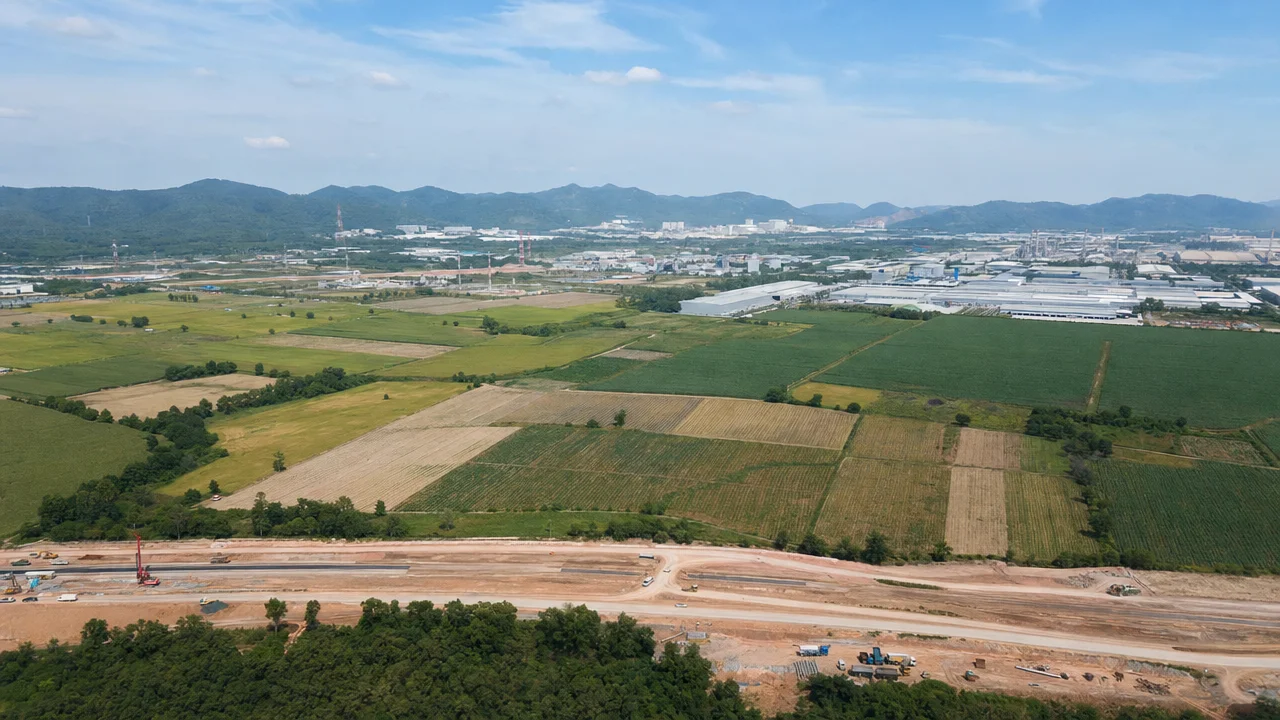

The Ministry of Interior of Thailand on September 7, 2026, implemented the Wang Chan community master plan in Rayong Province. The document covers 394.41 km² and divides the territory into 11 functional zones with strict land use restrictions. For investors and land buyers, this means that two adjacent plots of equal size can now differ in price several times over - everything depends on which color zone they fall into.
The reason for implementing the plan is the need to organize development within the Eastern Economic Corridor (EEC). Wang Chan is located in an area of active industrial and innovative construction: it houses Wang Chan Valley - a technology park covering 3,454 rai (approximately 552 hectares), which the government positions as the future center of Southeast Asia's innovation ecosystem. Without clear zoning, chaotic development could destroy agricultural land and water resources critical to the region.
Eleven Zones - Eleven Usage Scenarios
The master plan divides Wang Chan into plots with color coding. Each zone determines what types of activities are permitted, what the maximum building density is, and what setbacks from plot boundaries are mandatory. Let's examine the key categories.
Three Types of Residential Zones
Yellow zone - low-density residential development. Private houses can be built here, but not multi-unit complexes. Height and density restrictions are strict.
Orange zone - medium-density residential development. Townhouses and low-rise condominiums are permitted.
Red zone - high-density residential and commercial development. This includes plots along major transport arteries. Shopping centers, office buildings, hotels, and high-rise residential complexes are allowed here.
Brown Zone with White Diagonal - Special Economic Zone
This is the most interesting category for major investors. The zone is designated for placing enterprises related to the EEC: research centers, high-tech manufacturing, logistics hubs. This includes plots around Wang Chan Valley. Obtaining construction permits here is easier if the project aligns with EEC priorities - automation, biotechnology, aviation, digital technologies.
The government, through the Eastern Economic Corridor Office, provides tax incentives and simplified procedures for companies operating in this zone. The application review period for construction is reduced to 30 days versus the standard 60-90.
Green Zones - Agriculture and Conservation
Green zone without additional designations - agricultural land. Construction of residential and commercial facilities is prohibited here. Only structures related to farming are permitted: warehouses, greenhouses, farmer's houses not exceeding 200 m².
Green zone with brown border and diagonal - agricultural reform lands. These plots are under special state control. Sale to foreigners is impossible, use is limited to agricultural purposes.
Light green zone - recreational areas and buffer zones for environmental protection. Construction is completely prohibited.
Light green zone with white diagonal - protected forest areas. Any economic activity is excluded.
Blue, Olive and Gray Zones - Infrastructure and Public Facilities
Blue zone - land for government institutions, water treatment facilities, power plants, transport terminals. The master plan provides for the construction of one bus terminal and three public parks.
Olive zone - educational institutions. Schools, universities, and research institutes can be located here.
Gray zone - religious sites: temples, monasteries, places of worship.
How Zoning Affects Land Value and Liquidity
The master plan does not revoke property rights, but radically changes the possibilities for land use. Two plots of 1 rai (1,600 m²) can cost 3 million baht and 12 million baht respectively - if the first falls into a green agricultural zone, and the second into a red commercial zone.
Banks consider zoning when assessing collateral value. A plot in the brown special economic zone will receive a higher valuation than a similar-sized plot in the green zone, even if the market price of the latter is higher due to proximity to water or scenic landscape. Credit committees focus on commercial use potential, not aesthetics.
For investors who purchased land before September 7, 2026, but did not have time to start construction, the situation may be painful. If a plot acquired for a residential complex fell into a forest conservation zone, the project will have to be closed or compensation sought through the courts. There are no precedents yet, but lawyers predict a wave of lawsuits by the end of 2026.
New Road Projects and Transport Infrastructure
The master plan provides for the construction and expansion of four types of roads:
| Road Type | Right-of-way Width | Quantity |
|---|---|---|
| Type A | 12 meters | 1 road |
| Type B | 16 meters | 7 roads |
| Type C | 25 meters | 1 road |
| Type D | 40 meters | 1 road |
The Type D road, 40 meters wide, will become the main transport artery connecting Wang Chan with Highway No. 3 (Bangkok - Rayong). This will reduce travel time to U-Tapao Airport from 45 to 25 minutes. For logistics companies and export-oriented manufacturing, this is critical.
Plots along future roads fall into the expropriation zone. Owners will receive compensation at cadastral value, which is usually 20-30% below market value. You can check whether your plot falls into the road corridor at the Wang Chan district administration (tesaban) or through the online portal of the Ministry of Interior's Department of Town Planning.
Water Resources and Flood Protection
The master plan includes a map of water resources and flood-prone areas. Wang Chan borders the Prasae Reservoir and Prasae River - key water sources for Rayong's agriculture. Coastal territories 50 meters wide from the water's edge are declared buffer zones. Construction here is prohibited.
The plan provides for the construction of three wastewater treatment plants with a total capacity of 15,000 m³ per day. This will accommodate up to 50,000 new residents without harming the ecology of water bodies. For developers of large residential complexes, this means that connection to central sewerage will become mandatory - septic tanks will no longer be approved for projects exceeding 20 houses.
Procedure for Checking the Zone for a Specific Plot
Before purchasing land in Wang Chan, the following steps must be taken:
- Obtain an extract from the Land Office indicating the plot number and coordinates.
- Contact the town planning department of Wang Chan district administration with a request to verify zoning. The service is free, response time - 3 working days.
- Request a certificate confirming whether the plot falls into a road expropriation zone or water protection zone.
- If the plot is located in a special economic zone, clarify the list of permitted activities. The list is published on the EEC Office website.
For foreign buyers, additional verification of compliance with the restrictions of the Land Act of 1954 is required. Foreigners cannot own land in Thailand, except in cases where the plot is acquired through a Thai company with at least 51% of shares controlled by Thai citizens. The master plan does not cancel this rule, but in the special economic zone, the Board of Investment of Thailand (BOI) can provide the right to long-term lease for 50 years with the possibility of extension for another 50 years for projects approved under the EEC.
Master Plan Validity Period and Possibility of Revision
The Wang Chan master plan is designed for 20 years - until 2046. Revision is possible every 5 years at the initiative of local authorities or at the request of at least 500 district residents. The first scheduled review is planned for 2031.
Changes to zoning can be introduced through public hearings. If a developer or investor believes that their plot is incorrectly classified, they can submit a petition to the district administration with justification. Practice shows that 15-20% of such appeals are successful, mainly when it comes to minor adjustments to zone boundaries.
What This Means for a Buyer in Pattaya
Wang Chan is located 90 km east of Pattaya. The master plan does not directly regulate Pattaya's real estate market, but creates two indirect effects.
The first is the redistribution of investment demand. Large companies planning the construction of manufacturing or logistics facilities in the industrial zones of Pattaya or Chonburi may now prefer Wang Chan due to EEC tax incentives and cheaper land. The average price of a plot in Wang Chan's special economic zone is 800,000 baht per rai versus 2.5-3 million baht per rai in Pattaya's industrial zones. This may reduce pressure on Pattaya's industrial land and stabilize prices.
The second effect is increased demand for housing in Pattaya from specialists working in Wang Chan. Travel time between the cities via the new Type D road will be reduced to 50 minutes. Engineers, managers, and researchers employed at Wang Chan Valley prefer to live in Pattaya with its developed infrastructure rather than in rural Wang Chan. This supports demand for condominium rentals in the 15,000-25,000 baht per month price segment.
For land buyers in Rayong considering plots in Wang Chan as an alternative to Pattaya, it is critical to verify zoning before signing a contract. A law firm specializing in real estate transactions in the EEC should provide a conclusion on the compliance of the intended use of the plot with the master plan. The cost of such verification is 15,000-25,000 baht, timeframe - 5-7 days.
If you are considering Wang Chan as a platform for EEC-related business, it makes sense to apply for BOI incentives before starting construction. Approved projects receive corporate tax exemption for 8-13 years and the right to long-term land lease.
Conclusions
The 2026 Wang Chan master plan transforms the district from an amorphous rural territory into a structured space with clear rules. For some investors, this opens opportunities - especially in the special economic zone. For others, it becomes a limitation if purchased land falls into a conservation or agricultural zone.
Before any land transaction in Wang Chan, verification of zoning, road plans, and water protection restrictions is mandatory. The master plan is public, but requires professional interpretation - color designations on the map are not always obvious without knowledge of Thai legislation.