
AWC Abandons 100-Story Skyscraper on Chao Phraya - and Relocates It Inland
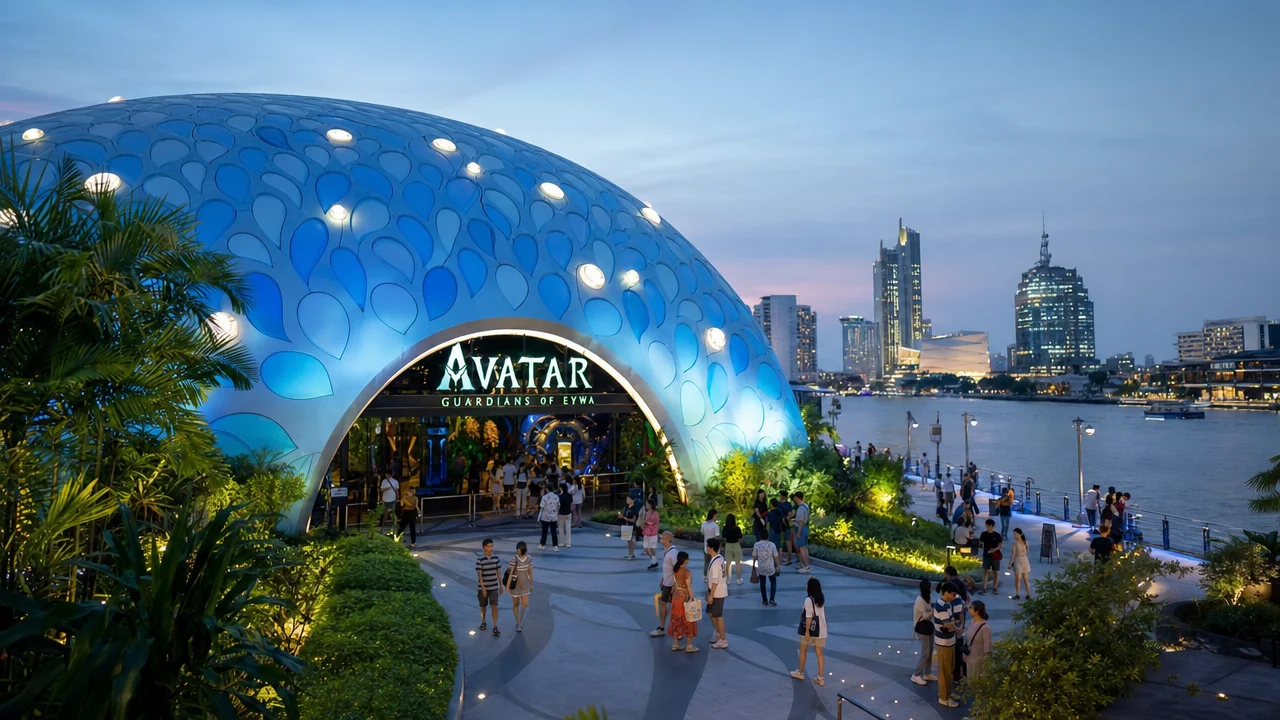
Asset World Corporation (AWC) has reduced the height of its planned tower at Asiatique The Riverfront from approximately 100 floors to 56 and relocated it from the Chao Phraya riverfront to Charoen Krung Road. The decision was made as part of a major restructuring of the project worth over 8 billion baht, transforming Asiatique from a shopping center into a multi-format cultural and entertainment destination. Instead of a commercial high-rise on the waterfront, the Blue Dome - an architectural structure from Expo 2025 in Osaka - will appear, housing the immersive Avatar: Guardians of Eywa attraction spanning over 4,000 square meters.
Wallapa Traisorat, CEO of AWC, announced the changes in the context of the AWC Riverside Journey concept - the company's strategy for developing assets along the Chao Phraya River. The tower was initially planned as a commercial property with hotel and residential components, but the company revised its priorities after analyzing demand for waterfront projects in Bangkok. The number 56 was not chosen randomly: AWC considers it auspicious, and relocating the tower to Charoen Krung Road opens up river views and frees up space for public areas.
Why AWC Stepped Back from High-Rise Development on the Waterfront
The initial plan for a 100-story tower on the Chao Phraya riverbank was announced by AWC as the anchor element of the renovated Asiatique. The project was intended to compete with other premium waterfront complexes - Icon Siam, Magnolias Waterfront Residences, Four Seasons Private Residences. However, by the end of 2025, it became evident that Bangkok's luxury condominium market was oversaturated. According to CBRE Thailand, the average cost per square meter in the capital's premium segment ranges from 250,000 to 450,000 baht, and the share of unsold units in projects on Sukhumvit and Sathorn reached 30-40% in the first half of 2026.
AWC decided to shift focus from residential and commercial real estate to experiential tourism. The company is investing over 5 billion baht in phase 2.2 of the Asiatique project, including the Blue Dome, and another 2 billion baht in a cable car that will connect Charoen Krung with the Charoen Nakhon area on the opposite side of the river. The cable car will be equipped with enclosed and open cabins, turning the Chao Phraya crossing into a tourist attraction.
Reducing the tower height to 56 floors lowers capital costs and construction risks. Projects exceeding 50 floors in Thailand require reinforced foundations due to soft soils in the Chao Phraya delta, which increases the cost per square meter by 15-20%. Moving the tower inland to Charoen Krung Road also simplifies construction logistics: access from the main thoroughfare reduces material delivery time and decreases the load on narrow waterfront streets.
The Blue Dome and Avatar: A New Model for Waterfront Monetization
The Blue Dome, which AWC acquired after Expo 2025 in Osaka, will become the central element of the renovated Asiatique waterfront. Under the dome will be Avatar: Guardians of Eywa - an immersive attraction created jointly with international partners (AWC has not yet disclosed specific names). The Magic Walk™ Experience technology allows visitors to become part of the Avatar franchise storyline across more than 4,000 square meters. Tickets for similar attractions in Asia cost from 800 to 1,500 baht, which with attendance of 2,000-3,000 people per day generates revenue of 1.6-4.5 million baht daily.
AWC expects the Blue Dome to attract tourists who previously did not consider Asiatique a must-visit destination. The project competes with Icon Siam, which also has entertainment zones, but AWC is betting on exclusive content - the Avatar license - and the architectural uniqueness of the dome. Around the dome, green zones and recreational areas with river views will be created, transforming the waterfront into a public space rather than just a commercial territory.
AWC's strategy reflects a global trend: developers are shifting from single-function towers to integrated destinations where income is generated not only from selling square meters but from operations - tickets, rentals, hotel rooms. The company is already testing this model in Pattaya, where it is launching the Aquatique District Pattaya project - a waterfront complex with five hotels, a themed water park, and a shopping zone.
What's Happening with AWC in Pattaya: Aquatique and Partnership with Marriott
Parallel to the Asiatique revamp in Bangkok, AWC is developing a similar concept in Pattaya. In early 2026, the company signed an agreement with Marriott International for two projects: the flagship Aquatique Pattaya resort with The Ritz-Carlton Pattaya hotel and Marriott Koh Samui on Chaweng Noi Beach. Aquatique Pattaya is an integrated platform in the city center, combining hotel, retail, entertainment, and public zones on a plot of approximately 27 rai 2 ngan 75 wa.
The Ritz-Carlton Pattaya will be the brand's first hotel in the city. The project includes 224 rooms with a total area of approximately 34,505 square meters, located on the beachfront. The Aquatique shopping zone will occupy over 110,000 square meters of leasable space with a lifestyle + leisure + experiential living concept aimed at tourists and locals. The total investment in Aquatique Pattaya is estimated at approximately 600 million baht.
The Pattaya project replicates the logic of Bangkok's Asiatique: instead of high-rise development, AWC is creating a horizontal destination focused on experiences. Only half of the approximately 2-rai plot will be developed; the rest is reserved for green zones. The 80-120 room hotel (exact number depends on final layout) will occupy approximately 30% of the built-up area. Construction is scheduled to begin in 2027 and take about two years.
How AWC Is Preparing a 50 Billion Baht REIT - and Why It Matters for Pattaya
AWC plans to launch a real estate investment trust (REIT) called AWR in 2026 with a volume of approximately 30 billion baht. The initial portfolio will include approximately five premium properties from the company's current 61 projects, with priority given to freehold assets rather than leasehold land. The company is considering transferring to the fund properties along the Chao Phraya River included in the AWC Riverside Journey concept, which unites 11 points from Yaowarat (Chinatown) to the Bangkok Yai district.
Launching AWR will allow the company to remove some assets from its balance sheet and free up capital for new projects. AWC has announced a 31% portfolio expansion by 2030, which includes Pattaya projects - Moxy Pattaya The Aquatique and DreamWorks Water Park. The fund will be open to Thai and foreign investors; final IPO timing depends on market conditions. Financial advisors have already been appointed to structure the deal.
Table: Comparison of Original and Revised Asiatique Plan
| Parameter | Original Plan | Revised Plan |
|---|---|---|
| Tower height | ~100 floors | 56 floors |
| Tower location | Chao Phraya riverfront | Plot near Charoen Krung Road |
| Waterfront anchor element | Commercial tower | Blue Dome + Avatar |
| Phase 2.2 investment | Not disclosed | ~5 billion baht |
| Cable car investment | Not planned | ~2 billion baht |
| Project focus | Residential + commercial | Tourism + experiences |
What This Means for Buyers in Pattaya
AWC's decision to reduce the Asiatique tower and shift focus to experiential tourism signals a structural shift in Thailand's premium real estate market. The company has effectively acknowledged that demand for luxury waterfront condominiums in Bangkok is exhausted and has switched to a model where income is generated by operations rather than unit sales. This trend directly affects Pattaya: major developers will be more cautious about launching high-rise residential projects on the beachfront, especially in the segment above 200,000 baht per square meter.
For condominium buyers in Pattaya, this means two things. First, the supply of new premium waterfront projects may decrease in the next 12-18 months, which will stabilize prices for existing properties. Areas near AWC's new commercial and entertainment projects - Jomtien, Pratumnak, Naklua - may show outperforming dynamics if Aquatique Pattaya actually attracts tourists and improves infrastructure. Second, the growth of institutional investment through REITs increases confidence in Thailand as a destination for long-term investment, which reduces baht devaluation risks for foreign buyers.
Investors considering purchases in Pattaya should pay attention to projects copying the AWC model: horizontal complexes with hotels, shopping areas, and entertainment instead of single-function towers. Such projects are less dependent on housing demand and generate stable income from rentals and operations. If AWR successfully launches in 2026 and shows returns above bank deposits, other developers will follow suit, increasing the supply of liquid instruments for investors in Thai real estate.
For buyers focused on residence rather than investment, it's important to understand that reducing high-rise waterfront development doesn't mean falling prices. Rather, the market will redistribute: premium projects with unique amenities (access to water parks, themed zones, branded hotels) will retain value, while standard high-rises without infrastructure may face prolonged sales. AWC's Pattaya projects - The Ritz-Carlton Pattaya, Moxy Pattaya The Aquatique - set a new standard, and buyers should compare other developers' offerings to this benchmark.
Cable Car Across the Chao Phraya: Testing Ground for Pattaya
AWC's plan to invest over 2 billion baht in a cable car connecting Charoen Krung and Charoen Nakhon deserves special attention. If the project proves successful, similar infrastructure could appear in Pattaya - for example, between Pratumnak and Koh Larn Island or along the Wongamat-Naklua coastline. Cable cars in Asian tourist zones (Hong Kong, Singapore, Da Nang) show payback periods of 8-12 years with ticket prices of 150-300 baht and attendance of 3,000-5,000 people per day.
For property owners in Pattaya, the emergence of such infrastructure could significantly increase the value of properties within 500-1,000 meters of cable car stations. Historically, transportation projects - BTS in Bangkok, light rail in Phuket - increase housing prices by 15-25% within two years of launch. If AWC proves the viability of the model in Bangkok, Pattaya will be the next location for testing.
Conclusions: From Vertical to Horizontal
The reduction of the Asiatique tower from 100 to 56 floors is not just a project adjustment but a paradigm shift. AWC has abandoned the race for height and development density in favor of creating destinations where real estate serves as infrastructure for experiences rather than an end in itself. The company is investing 8 billion baht in Asiatique, 600 million baht in Aquatique Pattaya, and preparing a 30 billion baht REIT to scale this model throughout Thailand.
For Pattaya, this means the era of faceless waterfront high-rises is coming to an end. New projects will be integrated, horizontal, with an emphasis on green zones and public spaces. Buyers and investors who understand this shift ahead of the market will gain an advantage: projects copying the AWC model will grow in value faster than traditional condominiums. Those who continue to look for "the tallest tower with sea views" risk buying an asset that will become obsolete in five years.