

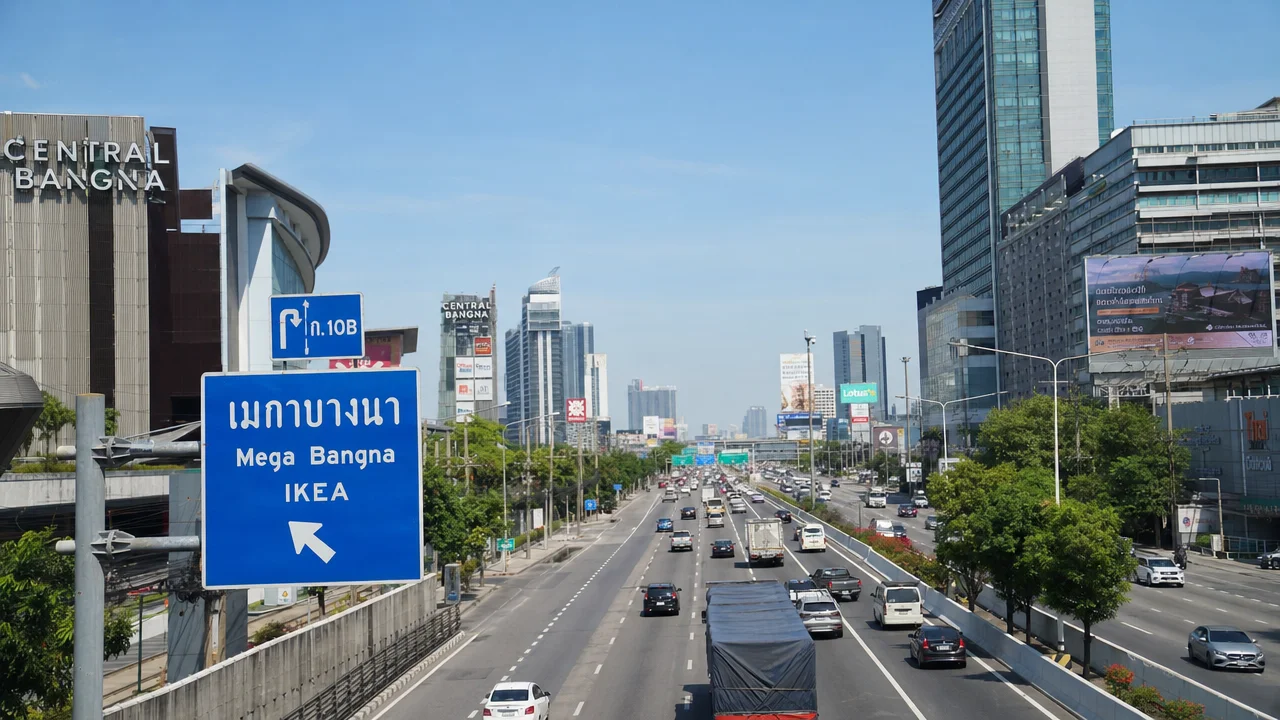

New Business Center in the East: Bang Na Changes Status
Bang Na has ceased to be a suburb. The fourth edition of Bangkok's Master Plan has officially designated this area as a new business and commercial center (New EBD - Eastern Business District), which will connect the capital with Suvarnabhumi Airport and the Eastern Economic Corridor. Land prices at the beginning of the Bang Na-Trat corridor have already exceeded 300,000 baht per square wah (approximately 75,000 baht per square meter) and continue to rise.
The reason for the transformation is not only urban planning. In 2026, the district received investments of 76,000 million baht: The Mall Group and Ikano Centre invested 6,000 million in the expansion of Mega Bangna, while the full implementation of the Mega City master plan on 325 rai of land is valued at 70,000 million. Simultaneously, construction of the Silver Line is underway, which will connect Bang Na to the airport in 20 minutes.
Transport Infrastructure: Silver Line and EEC Connectivity
The Silver Line, 19.7 kilometers long with 14 stations, will run from Bang Na intersection along Bang Na-Trat highway through Mega Bangna to the southern part of Suvarnabhumi Airport. Launch is scheduled for the end of 2027. The project addresses the district's main problem - the absence of rail transport on the section between BTS Udom Suk station and the airport.
Currently, Bang Na is connected to central Bangkok by the BTS Green Line (Bearing station - terminal), Chalerm Mahanakhon Highway and Burapha Withi Expressway. After the opening of the Silver Line, travel time to Silom will be reduced to 35 minutes, to the airport - to 15-20 minutes. The district will gain direct access to Asok and Silom office clusters without transfers.
Proximity to the Eastern Economic Corridor makes Bang Na a logistics hub. From here to the industrial zones of Chonburi and Rayong is 40-60 minutes by highway. Offices of companies working with EEC are already concentrating along Bang Na-Trat: headquarters of logistics operators, manufacturing holdings and retail chains are located here.
Mega City Bangna: 70 Billion Baht Master Plan
The mega-project Mega City Bangna occupies 325 rai (52 hectares) at the 8th kilometer of Bang Na-Trat highway. In 2026, The Mall Group (CPN) and Ikano Centre announced the second phase of expansion of Mega Bangna shopping center worth 6,000 million baht. The complex's area will increase by 170,000 square meters - to 800,000 square meters. Completion is scheduled for the third quarter of 2028.
The complete Mega City master plan envisions development of the entire territory by 2040. The total project area (GBA) will reach 1.3 million square meters. In addition to the shopping center, Class A office towers, international chain hotels, residential condominiums and public spaces will appear here. Mega Bangna already receives 60 million visitors per year - it is one of Thailand's most visited shopping centers.
The second expansion phase will add more than 250 new brands. Among them - the Accessible Luxury category (more than 20 brands) and international retailers that will open their first stores in eastern Bangkok. Currently, 900 tenants operate in Mega Bangna, including IKEA (the first store in Thailand and one of the largest in Southeast Asia), Central Department Store, HomePro, BigC and Mega Cineplex. Occupancy rate - 100% since opening in 2012.
Bangkok Mall and BITEC: Offices and Convention Center
The Mall Group is building Bangkok Mall - another major mixed-use project in the Bang Na area. The complex includes a shopping center, office towers and hotels. The exact opening date has not been disclosed, but the project already features in urban planning as an anchor object of the new CBD.
Nearby is located the Bangkok International Trade & Exhibition Centre (BITEC) - Thailand's largest exhibition complex with an area of 50,000 square meters. International exhibitions, conferences and corporate events are held here. BITEC attracts business traffic: annually the center is visited by more than 2 million people, including foreign exhibition participants.
An office cluster is forming around BITEC. Developers are building Class A and B+ buildings with rental rates of 450-650 baht per square meter per month - this is 20-30% lower than in Asok and Silom areas. Companies from logistics, manufacturing and distribution sectors are relocating offices to Bang Na due to proximity to highways and the airport.
Housing Market: Price Growth and Stable Demand
The eastern part of Bangkok accumulates almost 50% of the total value of development projects and transaction registrations in the capital - according to Real Estate Information Centre (REIC) data for 2025-2026. Bang Na occupies a leading position in this cluster.
Land prices at the beginning of the Bang Na-Trat corridor (kilometers 5-8) have increased from 200,000 to 300,000 baht per square wah over the past three years. This is 75,000 baht per square meter - a level comparable to areas along the BTS Sukhumvit line (Thong Lo, Ekkamai). Further along the corridor, at kilometers 10-15, land costs 100,000-150,000 baht per square wah.
New condominiums in Bang Na are selling for 80,000-150,000 baht per square meter. Projects near future Silver Line stations - for 120,000-180,000 baht. This is 30-40% cheaper than in Asok and Phrom Phong areas, with comparable construction quality.
Who Buys Property in Bang Na
Buyers are high-income Thais and expats. Average household income in the area is 91,000 baht per month, the second indicator in Bangkok after Pathumwan. Families with children earn up to 300,000 baht per month.
A key demand factor is international schools. 15 schools operate in Bang Na, including Wellington College, Brighton College and Concordian International School. Parents buy houses and condominiums within a 5-10 kilometer radius of schools. Prices for townhouses in gated communities - 10-40 million baht.
Sales in the area are growing steadily, without sharp jumps. Pakprin Karun, head of marketing for low-rise projects at Sansiri, notes that Bang Na is less susceptible to economic cycles than other areas of Bangkok. Buyers acquire housing for living, not for speculation.
Population and Infrastructure: Schools, Hospitals, Commerce
The population of Bang Na and adjacent areas exceeds 3 million people. Growth rate - 2.8% per year, higher than the Bangkok average (1.2%). The reason is migration of Thais from central areas and influx of expats working in EEC.
In addition to schools, the area is provided with medical services. Samitivej Srinakarin, Bangkok Hospital and several private clinics are located here. Commercial infrastructure includes Mega Bangna, Imperial World Samrong, Seacon Square and dozens of local markets.
The restaurant sector is represented by 176 establishments in Mega Bangna alone - from food courts to premium segment restaurants. The district has ceased to be "dormitory": here you can work, study, receive treatment and relax without leaving for central Bangkok.
Urban Planning: Change of Land Designation
The fourth edition of Bangkok's Master Plan changed the zoning of a significant part of Bang Na territory. Lands previously designated for low-rise development have been transferred to the category of commercial and mixed-use. Development coefficients have been increased - now developers can build high-rise buildings on plots along main highways.
The plan provides for creation of pedestrian zones, bicycle paths and public parks. Bangkok authorities have allocated 2,000 million baht for landscaping around future Silver Line stations. The goal is to make Bang Na suitable for living without a car.
Changes came into force in 2025. Developers have already submitted applications for construction of more than 50 new projects - condominiums, office buildings and shopping centers. The total volume of investments in Bang Na real estate in 2026-2030 is estimated at 150,000 million baht.
Comparison with Other Bangkok Areas
| Parameter | Bang Na | Sukhumvit (Asok-Thong Lo) | Silom-Sathorn |
|---|---|---|---|
| Land price (baht/m²) | 75,000 | 150,000-250,000 | 200,000-350,000 |
| Condo price (baht/m²) | 80,000-150,000 | 150,000-250,000 | 180,000-300,000 |
| Office rental rate (baht/m²/month) | 450-650 | 800-1,200 | 900-1,500 |
| Time to airport | 20 min (Silver Line, from 2027) | 35-40 min | 45-50 min |
| International schools | 15 | 8 | 3 |
Bang Na offers the best price-quality ratio for buyers who need proximity to the airport and EEC. The area is inferior to central clusters in prestige, but superior in infrastructure growth rates.
Investment Attractiveness: Who Invests Money
The largest investors in Bang Na real estate are Thai holdings The Mall Group, Sansiri, Pruksa Real Estate and AP Thailand. Foreign funds are taking a wait-and-see position so far, but interest is growing. Singha Estate and Hongkong Land are considering purchasing land plots for office development.
Foreigners can own condominiums in Bang Na on full ownership rights (freehold) within the 49% quota. There are no purchase restrictions - the area is not on the list of zones closed to foreign buyers. Townhouses and villas are available through long-term land lease (leasehold) for 30 years with possibility of extension.
Rental yield for condominiums in Bang Na is 4.5-5.5% per annum. This is higher than in central Bangkok areas (3.5-4%), but lower than in Pattaya (6-7%). Rental demand is formed by expats working in offices along Bang Na-Trat and employees of EEC companies.
Project Risks and Limitations
The main risk is delay in Silver Line construction. The project has already been postponed twice: the initial launch was planned for 2025, then for 2026, now - for the end of 2027. Without rail transport, Bang Na remains dependent on cars, and traffic jams on Bang Na-Trat during rush hours reach 40-60 minutes.
The second risk is oversaturation of the housing market. Developers launched more than 30 new condominium projects in 2025-2026. Supply may exceed demand, especially if Thailand's economy slows down. The Real Estate Information Centre records a 50.2% decrease in the number of housing construction permits in the first half of 2026 - a sign of developer caution.
The third factor is the mortgage market. The Housing Business Association of Thailand reports that 44.9% of mortgage applications were rejected in the first half of 2026. Banks have tightened borrower requirements. Buyers counting on credit may face difficulties.
What This Means for Pattaya Buyers
The transformation of Bang Na affects the Pattaya market through several channels. First, investors compare returns: condominiums in Bang Na yield 4.5-5.5% per annum, in Pattaya - 6-7%. The difference is narrowing, but Pattaya still maintains an advantage due to tourist demand.
Second, Bang Na competes with Pattaya for expats working in EEC. Previously, employees of factories in Chonburi and Rayong chose housing in Pattaya - closer to the sea. Now part of them are moving to Bang Na: from here to offices in EEC is 40-60 minutes by highway, there are international schools and developed infrastructure. Pattaya is losing the segment of family buyers with school-age children.
Third, rising prices in Bangkok push investors to look for alternatives. Land in Bang Na costs 75,000 baht per square meter, condominiums - 80,000-150,000 baht. In Pattaya, beachfront land - 50,000-80,000 baht, condominiums - 60,000-120,000 baht. The price gap persists but is narrowing.
For buyers from Russia considering Thailand as a place to relocate or invest, Bang Na becomes the third option after Bangkok and Pattaya. The area is suitable for those who work in the capital or EEC, value proximity to the airport and are willing to live without the sea. Pattaya remains the preferred choice for retirees, freelancers and investors focused on tourist rentals.
However, it is worth monitoring the dynamics: if the Silver Line opens on schedule and Mega City implements its master plan, Bang Na may lure part of the demand from the eastern coast. Real estate agencies in Pattaya should prepare clients for comparative analysis - buyers will ask why choose Pattaya and not Bangkok's new CBD.
Conclusions: Bang Na as a New Growth Pole
Bang Na is turning into a full-fledged business center of Bangkok. Infrastructure investments, changes to the urban planning plan and private projects for 76,000 million baht create conditions for long-term growth. The area attracts offices, shopping centers, international schools and premium residential development.
For investors, Bang Na is an opportunity to buy property in a future CBD at prices 30-40% lower than in central Bangkok. Risks are related to delays in transport projects and oversaturation of the housing market. Buyers should wait for the opening of the Silver Line in 2027-2028 - this will reduce uncertainty and confirm the investment potential of the area.