


Bang Na-Trat Becomes Bangkok's Eastern Business Center
The Bang Na-Trat corridor has officially been designated as the new central business district of Thailand's capital. The fourth edition of the Bangkok Comprehensive Plan has established this territory as the New CBD - an eastern business and residential cluster connecting the capital with Suvarnabhumi Airport and the Eastern Economic Corridor (EEC). This decision comes amid massive infrastructure investments and private capital inflows exceeding 165 billion baht.
The change in territorial status is not merely a formality. The master plan revises land designation along Bang Na-Trat Road (also known as Thepharat Road), expanding opportunities for commercial and residential development. Plots previously classified as medium-density residential zones Y.6 (Floor Area Ratio FAR 4.5, Open Space Ratio OSR 6.5%) are being reclassified to categories Y.9 (FAR 5, OSR 8%) and Y.10 (FAR 5.5, OSR 7.5%). Part of the territory receives commercial land status P.5 with FAR 7 and OSR 5.5%.
Practical result: developers can build higher and denser while preserving less open space. Land prices at the corridor's beginning near the Bang Na intersection have reached 300,000 baht per square wah (approximately 4 m²). Analysts forecast further growth as transport projects are completed.
Infrastructure: Silver Line and EEC Connectivity
The main growth driver is the planned Silver Line light rail, being constructed by the Mass Rapid Transit Authority of Thailand. The 19.7 km Bang Na - Suvarnabhumi section includes 14 stations. The route begins at the Bang Na intersection on the BTS Green Line and runs along Bang Na-Trat Road to the airport.
Silver Line construction reduces travel time from central Bangkok to Suvarnabhumi Airport to 30-35 minutes. The Bang Na district becomes a transit hub between the capital, airport, and Samut Prakan and Chachoengsao provinces, where EEC industrial and logistics facilities are located. For investors, this means increased demand for office space, housing, and commercial real estate along the route.
The current master plan already supports residential and commercial development along the BTS Green Line from On Nut to Kheha stations. The new Bang Na-Trat status strengthens this vector, synchronizing Bangkok's plans with those of Samut Prakan (Samut Prakan Comprehensive Plan 2025).
Megaprojects: Bangkok Mall, The Forestias, Mega City Bangna
Private developers are investing tens of billions of baht in creating a mixed-use urban environment. Bangkok Mall by The Mall Group is the largest project at the Bang Na intersection. The site area exceeds 100 rai (over 1.2 million m²). The complex includes a shopping center, Bangkok Arena concert hall with 16,000 seats, hotel, office buildings, and entertainment park. According to the developer, this will be one of the largest shopping centers in Thailand and Southeast Asia.
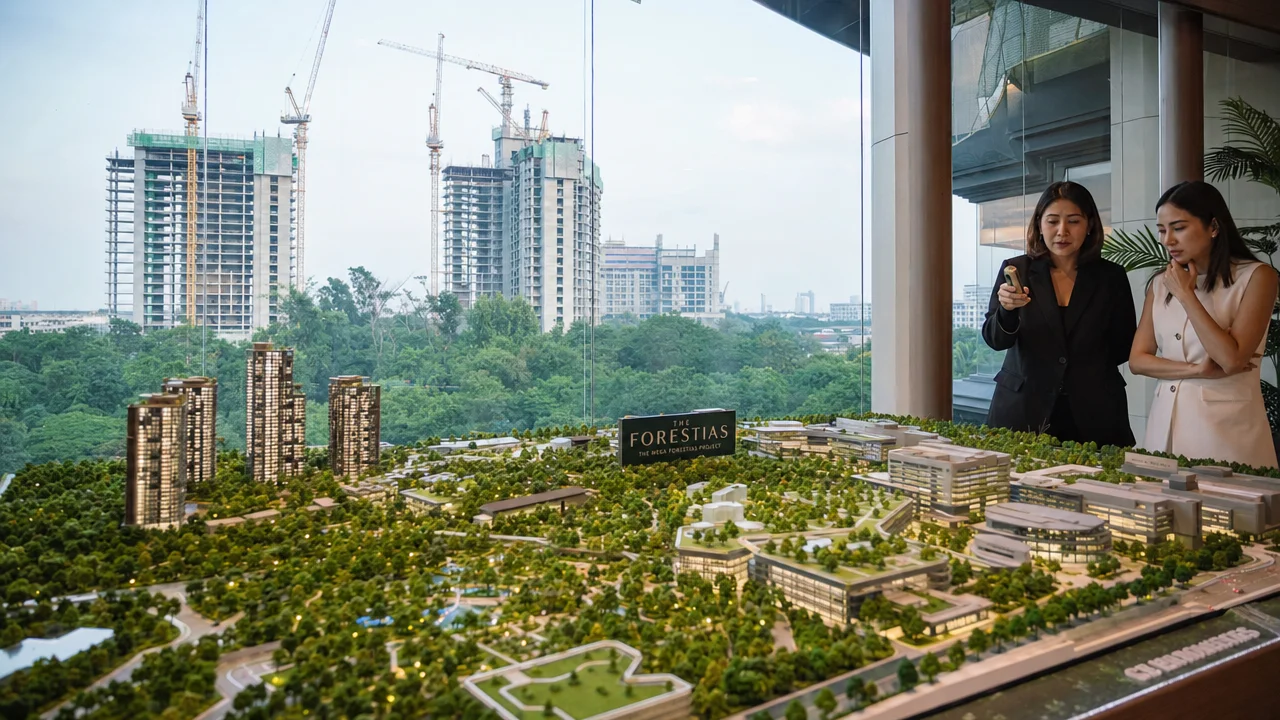
At kilometer seven of Bang Na-Trat Road is The Forestias - a mixed-use project worth 125 billion baht on a 398-rai site. The "city in a forest" concept combines green zones, luxury condominiums, retirement housing, and a medical center. At The Forestias entrance, Happitat has opened - a retail and leisure cluster on 60 rai with investments exceeding 20 billion baht. The project focuses on educational and family activities, landscaped spaces.
Mega City Bangna expands the existing Mega Bangna shopping center, transforming it into a compact urban district with offices, condominiums, hotels, and parks. The goal is to create an ecosystem for work, life, and leisure without the need to travel to central Bangkok.
All three projects target buyers and tenants seeking an alternative to the congested city center. Bang Na offers proximity to the airport, EEC, and lower housing prices compared to Sukhumvit and Silom areas.
Housing Market: Prices, Development Types, Demand
Along the Bang Na-Trat corridor, premium low-rise and high-rise residential complexes, office buildings, and logistics centers are being constructed. Land prices at the corridor's beginning have reached 300,000 baht per wah, 3-4 times higher than in remote Samut Prakan areas.
Condominium prices in the Bang Na area start from 60,000-80,000 baht per m² for mid-segment projects. Studios of 28-35 m² cost 2-2.8 million baht. Premium projects at the Bang Na intersection and along the future Silver Line offer prices from 120,000 baht per m².
Demand is formed by three buyer groups:
- Professionals working in Bang Na and EEC offices.
- Investors betting on price growth after Silver Line launch.
- Buyers seeking housing with good transport access to Suvarnabhumi Airport.
The share of foreign buyers in new Bang Na projects is 15-20%, lower than in central Bangkok (30-35%) but higher than in residential suburbs.
Comparing Bang Na and East Pattaya: Prices, Infrastructure, Legal Status
Investors often compare Bang Na with East Pattaya - both areas are in the EEC influence zone and offer relatively affordable housing. The differences are substantial.
| Parameter | Bang Na (Bangkok) | East Pattaya |
|---|---|---|
| Condominium price | 60,000-120,000 baht/m² | 60,000-90,000 baht/m² |
| Land price | 200,000-300,000 baht/wah | 40,000-80,000 baht/wah |
| Foreign ownership rights | Freehold (condominiums) | Freehold (condominiums), leasehold (villas) |
| Transport to center | BTS, future Silver Line | Car, planned Bangkok - Pattaya railway |
| Airport proximity | Suvarnabhumi 15-20 km | U-Tapao 30 km, Suvarnabhumi 90 km |
| Infrastructure | Offices, malls, medical | Beaches, tourist infrastructure |
Bang Na beats East Pattaya in transport accessibility and office infrastructure. Pattaya offers lower land prices and beach access. For investors planning long-term rentals to EEC professionals, Bang Na is the preferred option. For those focused on the tourist market or villa purchases, East Pattaya remains competitive.
Risks and Limitations for Foreign Buyers
Foreigners are prohibited from directly owning land in Thailand. In Bang Na, this restriction applies to villa and townhouse buyers. Foreigners can purchase condominiums on freehold ownership, provided the foreign ownership share in the building does not exceed 49% of total area. Purchase requires transferring funds from abroad in foreign currency with a Foreign Exchange Transaction Form (FETF) certificate from a Thai bank.
Three schemes are used for villas:
- Leasehold - long-term land lease for 30 years with possibility of two more extensions. Agreement registered at Land Office. Risk: renewal not guaranteed.
- Registration through Thai company - buyer creates legal entity that owns land. Risk: legislative changes may declare such schemes illegal.
- Marriage to Thai citizen - land registered to Thai spouse. Risk: foreigner loses rights upon divorce.
In Bang Na, most new projects are condominiums, reducing legal risks for foreigners. Villas and townhouses are rarer and require thorough legal verification.
Price Growth Forecast: 2026-2031
Analysts forecast 20-28% real estate price growth in Bang Na over five years (2026-2031), or 4-5% annually. Areas along the future Silver Line will show higher rates - up to 6-7% per year. Main drivers:
- Silver Line launch (scheduled 2028-2029).
- Employment growth in Bang Na office and logistics centers.
- Completion of Bangkok Mall, The Forestias, and other megaprojects.
Comparison with East Pattaya: villa price growth forecast in Pattaya is 22-30% over five years, or 4-5.5% annually. Rates are comparable, but Bang Na offers higher liquidity thanks to developed transport network and proximity to central Bangkok.
Slowdown risk relates to Silver Line construction delays or economic downturn. Thai infrastructure project history shows schedules often shift 1-2 years. Buyers should factor this into profitability calculations.
What This Means for Pattaya Buyers
Bang Na-Trat CBD development directly affects Pattaya's real estate market. The Bangkok - Pattaya high-speed railway, scheduled for launch in 2028-2029, will reduce travel time to 50 minutes. Professionals working in Bang Na offices or central Bangkok can live in Pattaya and commute to the capital.
Demand for long-term condominium rentals in East Pattaya will grow 15-20% after railway launch. Jomtien, Na Jomtien, and Bang Saray areas, located 5-10 km from the proposed station, will become attractive to buyers seeking housing cheaper than Bangkok but with good transport access.
For investors, this means:
- Buying condominiums in East Pattaya in 2026-2027 - before active price growth after railway launch.
- Focusing on projects within 5-7 km of future station with developed infrastructure (schools, hospitals, malls).
- Preferring condominiums over villas: freehold without term limits, high liquidity, low maintenance costs (30-50 baht per m² monthly versus 5,000-10,000 baht monthly for villa).
Bang Na development strengthens Bangkok's position as business center while making Pattaya more accessible to those working in the capital. Buyers planning to rent out housing gain access to a new tenant segment - EEC professionals and office workers preferring seaside living to commuting in congested Bangkok.
Conclusion: Window of Opportunity for Early Investors
Bang Na-Trat CBD status is enshrined in Bangkok's master plan. Infrastructure projects totaling over 165 billion baht are already underway. Land prices have reached 300,000 baht per wah and continue rising. Real estate price growth forecast is 20-28% over five years.
For Pattaya buyers, Bang Na development opens two scenarios. First - investing in Bang Na condominiums betting on value growth after Silver Line launch. Second - buying housing in East Pattaya before Bangkok - Pattaya railway completion, when long-term rental demand will increase.
Both options require verifying transaction legal clarity, analyzing rental market within 1-2 km radius, and consulting independent lawyer. Success depends not on purchase speed but understanding transaction structure and choosing the right area. The window of opportunity is open, but decision-making time is limited by completion of key infrastructure projects in 2028-2029.