


Bangkok Condominium Market Faces Oversupply Crisis
Thailand's capital condominium market is experiencing an acute crisis. As of the third quarter of 2026, more than 65,300 unsold units remain, with a total value of approximately 370 billion baht. Floods that affected significant areas of the city in September-October forced developers to postpone new project launches and revise sales strategies. Consumer purchasing power is declining, Chinese investors have not yet returned to the market, and developers are forced to offer unprecedented discounts on completed housing.
Scale of Oversupply: Figures and Forecasts
Of the 65,300 unsold apartments, approximately 25,700 units are already built and ready for transfer to buyers. This represents approximately 40% of the total inventory. At current sales rates, it will take two to three years to fully realize these inventories-provided no new projects enter the market.
The structure of unsold housing shows concentration in the mid-price segment. Apartments priced below 3 million baht (up to 100,000 baht per square meter) account for approximately 55% of inventory. Adding the segment from 100,001 to 150,000 baht per square meter, the share grows to 76%.
Developers are placing their main bets on this range. Surachet Kongcheep, head of research and consulting at Cushman & Wakefield Thailand, notes that the segment up to 150,000 baht per square meter covers a broader audience, including both Thai and foreign buyers.
Floods as Crisis Catalyst
Heavy rains and flooding in September 2026 disrupted developers' plans. More than 1,000 apartments in several major projects did not enter the market on schedule. Chapter One Bloc 19 Ratchada postponed its VIP event from September 26-27 to October 3-4. Sansiri delayed the pre-sale of the Pynn Kaset project. AssetWise canceled the launch of Kave Bloom Kaset on September 26 due to flooding and transportation accessibility issues.
Three projects totaling more than 1,000 apartments, scheduled for launch in the third quarter, were postponed indefinitely. Several of them are located in the eastern part of Bangkok-an area that suffered from flooding more than others.
Patharachai Trakulthong, senior director at Savills Thailand, indicates that developers are exercising increased caution. Reasons include not only weather conditions but also low consumer purchasing power, tightening mortgage lending conditions, and high construction costs.
Market Reaction: What's Happening with Launches
In the third quarter of 2026, 4,876 new apartments were launched in Bangkok-more than double the second quarter. Over nine months, total launches amounted to 14,377 units, 6% higher than the same period the previous year. It is expected that by year-end, 16,000 to 17,000 new apartments will enter the market.
However, these figures do not reflect the real picture. Savills recorded only eight new projects in the third quarter with a total of 3,737 apartments worth approximately 46.3 billion baht. Growth of 80.4% compared to the previous quarter looks impressive, but baseline values remain low.
Developers have focused on liquidity management and selling existing inventory instead of adding new supply. Most third-quarter launches were concentrated around Lumpini Park, along the Chao Phraya River, and in the campus condominium segment-locations with more stable demand.
Survival Strategies: Discounts and Rent-to-Own
Developers in the segment below 100,000 baht per square meter are implementing non-standard schemes. Some companies offer clients to first rent an apartment and then purchase it when the buyer's financial situation stabilizes. This approach helps generate cash flow and retain customers.
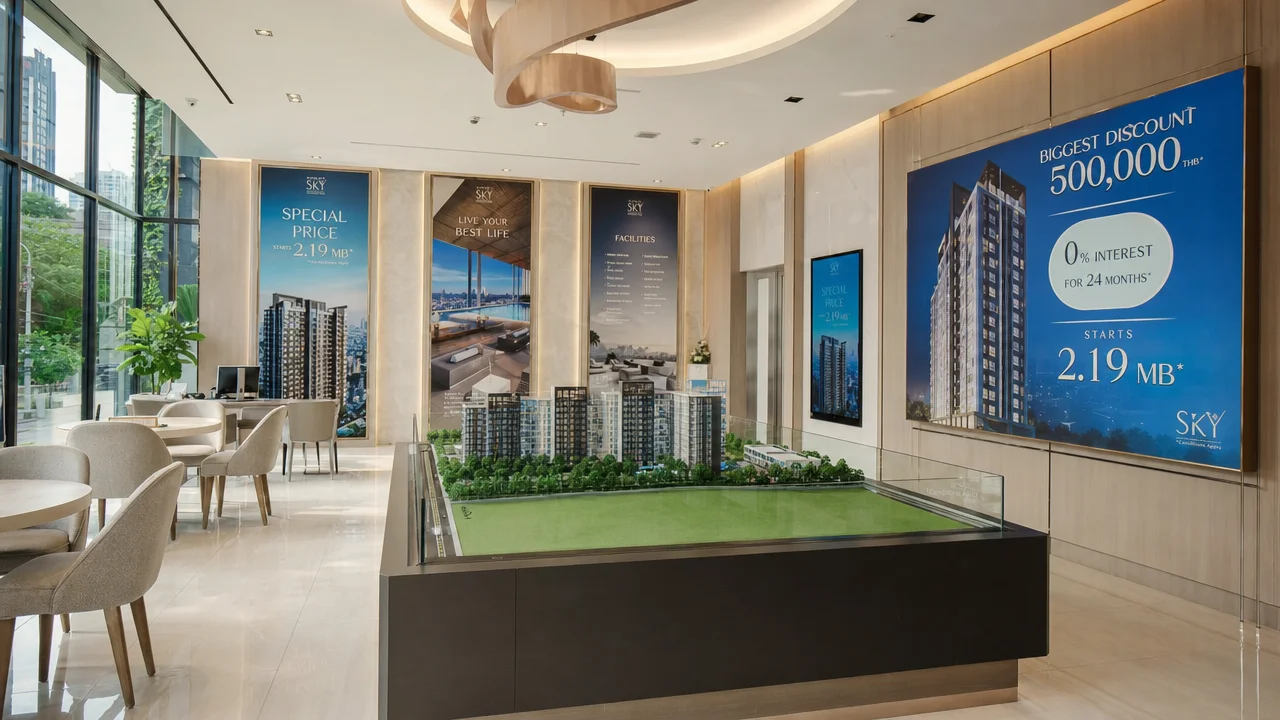
Discounts and promotional campaigns have become standard practice for completed housing. Analysts forecast that some companies may reduce prices on completed properties by more than 50% to accelerate sales and ensure financial stability.
Some projects have chosen a "soft launch" format-limited pre-sales for selected clients before the official launch in the fourth quarter. This allows testing demand without full-scale marketing investments.
Foreign Demand: The Chinese Factor
Chinese buyers have traditionally played a significant role in Bangkok's condominium market. In 2025, the number of Chinese tourists to Thailand fell by 33.6%. The number of condominium ownership registrations by Chinese buyers decreased by 13% during the same period.
Strengthened controls over documents, sources of funds, and corporate structures involving foreign nationals have complicated the purchase process. Transactions now take longer, and some potential buyers refuse to purchase due to additional requirements.
Recovery of Chinese demand has not yet been observed. The economic situation in China and changes in capital outflow regulations continue to restrain investor activity.
Floods Change Housing Selection Criteria
Varatt Sirisukdanukul, senior manager of capital markets and investments, assesses floods as a factor that has increased the weight of risk when choosing real estate. Buyers have begun to more carefully check flood history, site elevation, drainage systems, and project protection measures.
Paradoxically, floods may make condominiums more attractive than low-rise housing. Apartments on upper floors are less exposed to direct flooding risk. However, access, transportation, utilities, and common areas may be disrupted even if the apartments themselves remain dry.
Projects near operating BTS and rail stations, surrounded by developed infrastructure, may become preferable. They allow residents to maintain their usual rhythm of life during unforeseen disruptions.
Market Forecast Through End of 2026
As of the third quarter of 2026, 167,841 apartments are offered in Bangkok. Of these, 103,191 units have been sold (61.5% of total supply). 64,560 apartments remain unsold (38.5%).
Savills forecasts the launch of approximately 20,000 new condominiums this year-20% more than in 2025, but still below pre-pandemic average levels. The market will remain a "buyer's market" through year-end. Developers will focus on projects with high sales potential.
Some major developers are redirecting investments to Phuket and Pattaya due to higher demand in these tourist centers. Risk diversification and capitalizing on tourism sector recovery opportunities are becoming priorities.
The most resilient segment will remain luxury condominiums, especially branded residences in central areas of the capital. Demand from wealthy buyers and foreign investors who value prestige and investment potential persists.
What This Means for Buyers in Pattaya
The Bangkok market crisis creates opportunities for investors considering Pattaya and the Eastern Seaboard. The reorientation of major developers toward tourist centers has already led to the launch of several projects in the Jomtien and Pratumnak areas.
Prices in Pattaya remain stable for now. The average cost per square meter in new projects ranges from 80,000 to 120,000 baht-comparable to Bangkok's mid-price segment. The difference is that Pattaya projects often include resort-type infrastructure: pools, fitness centers, leisure areas.
Tightening checks on foreign buyers applies throughout Thailand. Preparation of documents on source of funds, notarized translations, and confirmation of legal status in the country have become mandatory. Transaction processing time has increased from two-three weeks to one and a half to two months.
Flood risk in Pattaya is lower than in Bangkok. The city is located on hilly terrain, with most residential areas above sea level. Storm drainage problems occur in old downtown areas, but new projects are built with drainage systems in mind.
For those planning rental investments, the Pattaya market offers an advantage: tourist flow is recovering faster than in the capital. Average occupancy for short-term rental apartments during the 2025-2026 high season was 65-70%, providing yields of 6-8% annually.
Market comparison table:
| Parameter | Bangkok | Pattaya |
|---|---|---|
| Unsold units | 65,300+ | Data not disclosed |
| Average price per m² (new housing) | 100,000-150,000 ₿ | 80,000-120,000 ₿ |
| Transaction processing time | 1.5-2 months | 1.5-2 months |
| Rental yield | 3-5% | 6-8% |
| Flood risk | High (certain areas) | Low |
Conclusions: Priority on Liquidity Over Expansion
Bangkok's condominium market is experiencing a correction period. The combination of floods, weak purchasing power, and 370 billion baht in inventory is forcing developers to shift priority from expanding supply to reducing existing inventory.
Cash flow management is becoming critical. Companies unable to quickly convert sales into completed transactions with ownership transfer will face liquidity problems.
For buyers, a favorable moment has arrived. Discounts on completed housing, flexible payment schemes, and developers' willingness to negotiate create opportunities for profitable acquisitions. The key is to carefully check the flood history of specific locations and the developer's financial stability.