
Western Bangkok Opens Up to High-Rises: What the Fourth Edition of the Master Plan Changes
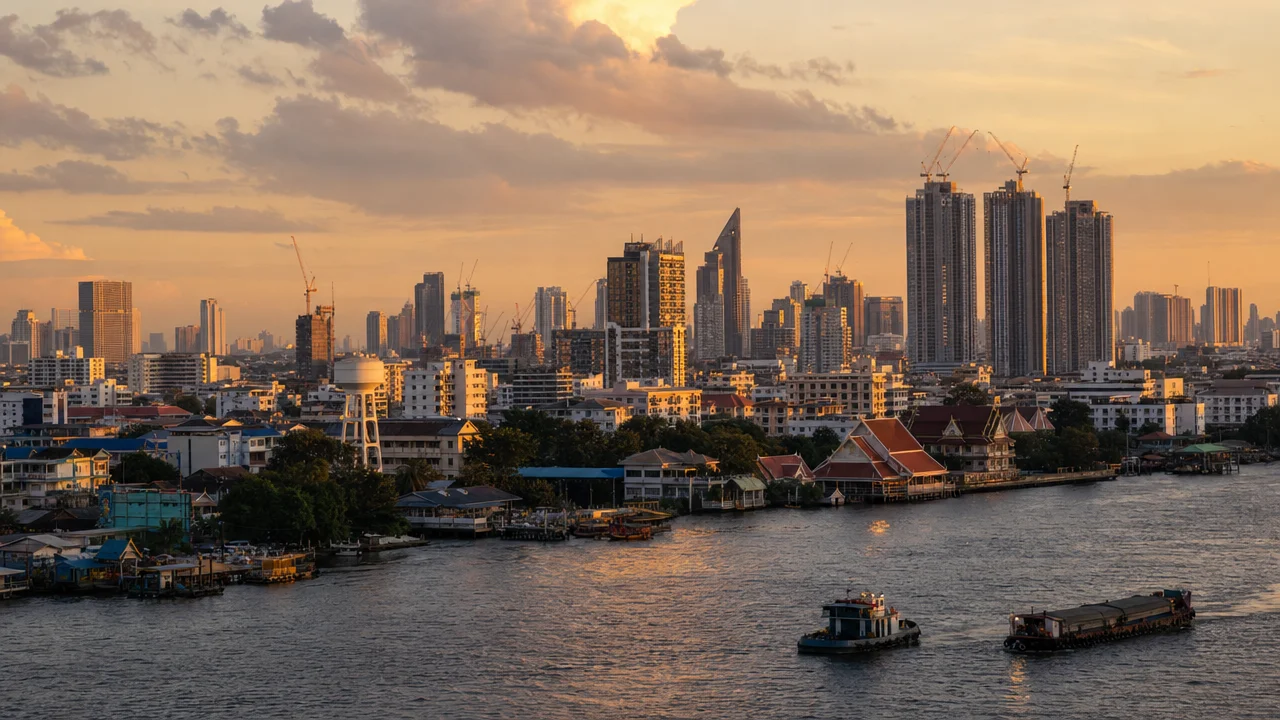
The fourth edition of Bangkok's master plan, which will come into force by the end of 2027, radically revises land use regulations in the western part of the capital. The districts of Taling Chan, Thawi Watthana, Chom Thong and Rat Burana have received permission to construct high-rise residential complexes with areas up to 30,000 square meters where previously only private houses on plots from 100 square wah could be built. The reclassification of zones removes restrictions on development density along electric train corridors - the Orange Line from Bang Khun Non to the Cultural Center, the Red Line from Bang Sue to Taling Chan, and the Southern Purple Line from Tao Pun to Rat Burana.
Which Color Zones Are Changing and What This Means in Practice
Bangkok's master plan divides the territory into color zones that determine permissible types of development. Until now, the western part of the city has been in green-white diagonal zones - agricultural land and conservation areas. The new edition transfers significant sections to brown zones of high-density residential development and red commercial zones.
In the districts of Taling Chan and Thawi Watthana, the former G.2 and G.4 zones (drainage areas) are being replaced with A2, Y.4, Y.6 and Y.7. Development of any type is permitted. Residential buildings can occupy from 1,000 to 30,000 square meters depending on road width (20-30 meters) and distance to elevated metro stations (500-800 meters). The FAR development coefficient reaches 3.5-4, which allows construction of towers 20-30 stories high.
The districts of Don Mueang and Hathairat in the north of the city received a similar upgrade in status. The Songprapha zone was transferred from Y.3 to Y.6 with FAR up to 3.5. The districts of Sai Mai and Khlong Sam Wa were raised from Y.2 to Y.3 and from Y.1 to Y.2, which permits multi-family development on plots where previously only houses on 100 square wah were allowed.
Chom Thong Becomes a High-Rise Condominium Zone
The southern district of Chom Thong received the most notable upgrade. Zone Y.7 with medium density and FAR 5 was transferred to Y.11 with high density and FAR 6. The change covers connected territories: Bang Wa, Talat Phlu, Wongwian Yai, Phet Kasem and Sathon, extending to the southern Purple Line near Phra Pradaeng.
The maximum floor area of a residential building increased from 10,000 to 30,000 square meters. The district becomes a competitor to the existing condominium market along the BTS lines - Green (Saphan Taksin - Bang Wa) and Blue (Tha Phra - Bang Wa), where annual sales volume amounts to 530 billion baht. These lines have accumulated 20-30 projects with a total volume of more than 9,500 units. Middle and high-income buyers from the central business district receive an alternative in Chom Thong with lower prices per square meter and fewer stations to the center.
How Land Prices Are Reacting Along New Electric Train Lines
Land prices in zones that received upgraded status have been growing over the past one to two years in anticipation of master plan approval. Plots along electric train routes in the districts of Wongwian Yai and Rat Burana continue to appreciate. Rat Burana stands out for having available plots for future projects, making it attractive to developers.
Analysts warn about the existence of a "price ceiling." The cost of finished real estate in each zone limits the land price. If landowners inflate their asking prices, developers cannot develop a project and sell it at market prices. The plot remains unclaimed, losing development opportunities.
The liberalization of Taling Chan and Thawi Watthana zones creates a barrier to purchasing power in the existing low-rise housing market in Greater Bangkok with a volume of 1.6 trillion baht per year. The risk is especially high for northern zones along Kanchanaphisek Road, Ban Kluai - Sai Noi roads, Khlong Thanon and Chan Thong Eiam (Bang Yai, Bang Bua Thong), as well as western sections along Boromratchachonnani, Salaya and up to Phutthamonthon Sai 7 in Nakhon Pathom.
Lat Phrao and Ramintra: New Condominium Front
The Lat Phrao - Ramintra district, including Wang Thonglang, Khlong Chan, Nuanchan, Tha Raeng, Khlong Kum and Bang Chan, is being transferred from zones Y.3 and Y.4 to Y.6 (FAR 3.5) and Y.7 (FAR 4). The permitted floor area of residential buildings increases from 1,000-2,000 to 10,000 square meters, with the possibility of expansion to 30,000 square meters subject to a 20-meter road, 500-meter access to elevated metro and 800-meter access to an interchange station.
On the same land plot, it is possible to construct a building with a total area 1.5-2 times larger. Small dormitories and apartments are transforming into condominiums along the Yellow and Pink elevated metro lines. The district competes with the condominium market along the Blue Line (Ratchadaphisek - Rama 9) with a volume of more than 1.08 trillion baht per year. Condominium prices in the Ratchadaphisek area start from 3 million baht and higher, which forces office workers, investors and foreigners to shift attention to Lat Phrao with lower prices per unit and better infrastructure.
Emergence of Sub-Centers and Redistribution of Commercial Demand
The new master plan supports the creation of suburban public centers - sub-centers - through more efficient zoning. These territories will become development nodes, distributing growth beyond the inner city. The changes reduce pressure on the central business district and redirect commercial demand to western and southern districts.
Land use regulations change project types from low-rise housing to condominiums and mixed-use complexes along electric train corridors. Development density is growing, the economic value of territories along electric transport routes is increasing. Plots in suburban zones are appreciating as more locations become attractive for future development.
Risks for Suburban Markets and Price Correction
Suburban markets in Nonthaburi, Pathum Thani and Samut Prakan may face an outflow of buyers. Analysts forecast a price correction of 5-10 percent. Buyers who previously chose the suburbs due to affordability now receive an alternative in western and southern districts of Bangkok with better transport accessibility and developed infrastructure.
The development of western Bangkok competes with accumulated supply of low-rise housing along northern sections of the Ring Road and in the areas of Bang Yai and Bang Bua Thong. Developers in these zones face pressure on margins and the need to adjust sales strategies.
What to Check Before Buying Land in New Zones
Land buyers in zones with changed status need to check several key parameters. The status of land documents determines the possibility of transferring rights and development. Chanote (Nor Sor 4) gives full ownership rights and the possibility of registration at the Land Office. Other types of documents may limit transactions.
Proximity to future electric train stations and planned sub-centers is a key liquidity factor. The plan will come into force by the end of 2027, but construction of lines and issuance of permits will take additional years. Investors need to consider the horizon for infrastructure implementation.
Developers must assess the ratio of land price to the ceiling price of finished real estate in each zone. An inflated plot cost makes a project unprofitable at current market prices per square meter.
What This Means for a Buyer in Pattaya
Changes in Bangkok affect the distribution of investment demand throughout Thailand. The opening of western districts of the capital to high-rise development creates new condominium supply in the price range of 2.5-4 million baht per unit - a direct competitor to projects in Pattaya for middle-income buyers.
Investors who previously considered Pattaya due to lower entry prices and potential for rental to tourists now compare returns with projects near stations of the Southern Purple Line in Chom Thong or along the Yellow Line in Lat Phrao. Rental demand in Bangkok is more stable due to office workers and long-term residents, while Pattaya depends on the tourist season.
For expats working in Bangkok, new districts with improved transport accessibility become an alternative to central locations. This reduces pressure on the rental market in traditional expat zones of Sukhumvit and Silom. Pattaya maintains its position for buyers seeking property for permanent residence by the sea or for short-term rental to tourists.
Foreigners can own condominium units subject to compliance with foreign quotas at the project level (up to 49 percent of the area). Projects in Bangkok's sub-centers promise fewer daily trips to the center, which increases their attractiveness to residents. Buyers in Pattaya should consider intensifying competition for investment capital and focus on the unique advantages of resort real estate - proximity to the beach, recreation infrastructure, income from short-term rentals.
Master Plan Changes the Balance of Power in the Capital's Real Estate Market
The fourth edition of Bangkok's master plan redistributes development opportunities from the center to western and southern districts. Thonburi districts receive the right to high-rise development, which increases the supply of condominiums in the mid-price segment and creates competition for existing markets along BTS and MRT lines. Land prices in new zones have already risen in anticipation of plan approval, but further growth is limited by the ceiling price of finished real estate. Land buyers need to check document status and assess infrastructure implementation timelines. Investors in Pattaya real estate should consider intensifying competition from capital projects and concentrate on the unique advantages of resort locations.