
New Wave of Inspections: Pattaya Under Land Department Scrutiny
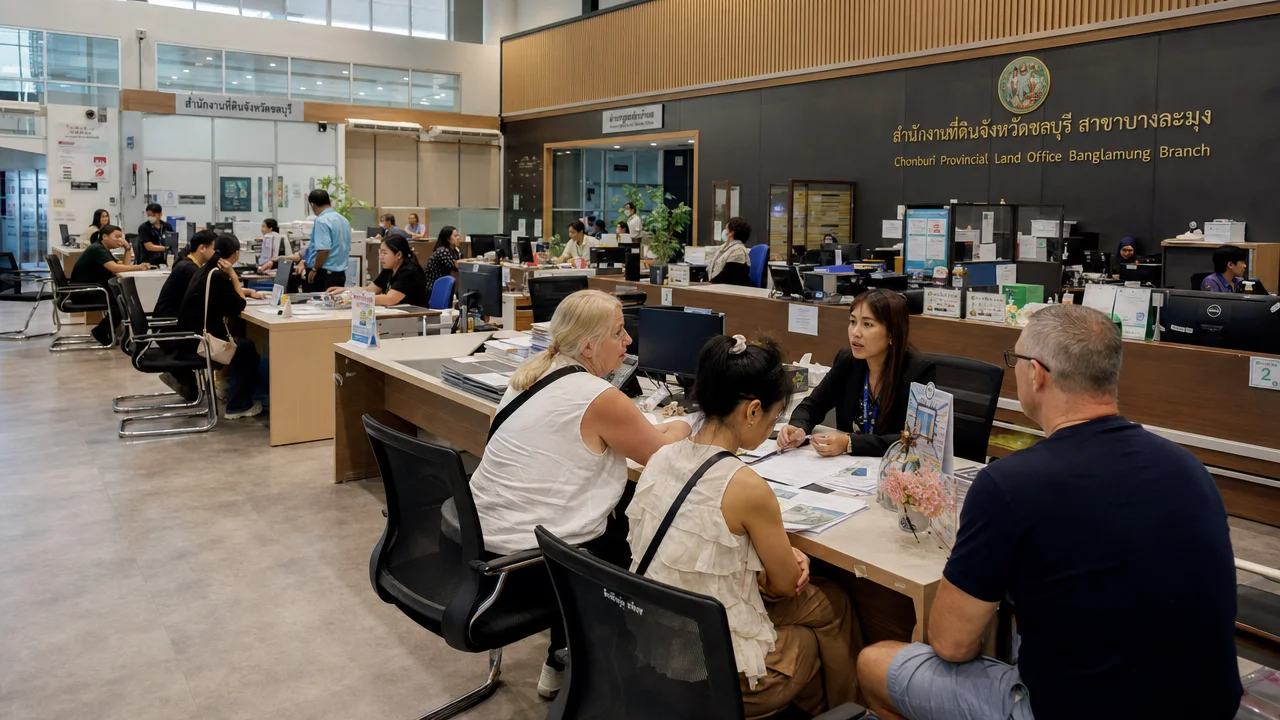
Thailand's Land Department launched a large-scale campaign in 2026 to identify nominee schemes for foreign property ownership. Chonburi Province, where Pattaya is located, was included in the list of eight priority regions for inspection alongside Phuket, Surat Thani, Krabi, and Rayong. According to analysts, up to 60% of villa transactions in the Eastern region involve foreigners, making Pattaya one of the main targets of the new policy.
This concerns systematic control, not one-time raids. The Land Department activated a 116-page guideline for combating nominee transactions, which was issued back in March 2023 by circular มท 0515.2/ว 6346, but until 2026 was applied inconsistently. Now every land office must follow a unified ten-step protocol: from identifying a suspicious transaction to transferring the case to law enforcement agencies.
Which Areas of Pattaya Are Being Inspected First
Pratumnak and East Pattaya came under special attention due to the concentration of villas with foreign buyers. Pratumnak Hill traditionally attracts premium segment investors: villas here cost from 15 to 80 million baht. East Pattaya, including the Huay Yai and Silver Lake areas, is attractive to villa buyers in the 8-25 million baht range.
Inspectors focus on companies that own land but conduct no business activities. If a company is registered with a capital of 1-2 million baht but owns a villa worth 20 million, this is a red flag. Land Office officers request financial reports for the last three years, tax declarations of Thai shareholders, and documents confirming the source of funds for the purchase.
Special attention is paid to transactions where:
- land value exceeds 5 million baht;
- the buyer paid 2 million baht or more in cash;
- Thai shareholders cannot confirm personal income;
- the company has not paid dividends since the purchase;
- land was purchased with funds exceeding registered capital without a mortgage.
What Is a Nominee Scheme and Why Is It Illegal
Thai legislation prohibits foreigners from owning land directly according to Article 86 of the Land Code. Exceptions are extremely narrow: investments through the Thailand Board of Investment from 40 million baht or purchase of a condominium within the 49 percent foreign quota.
The nominee scheme works in two ways. First: a foreigner transfers money to a Thai citizen who registers the land in their name but does not actually control it. Second: a company is created with formal compliance with the requirement of 51% Thai shareholders, but real investments and management belong to the foreigner.
The Land Department has identified six high-risk categories:
Thais Married to Foreigners
When land is purchased by a Thai citizen whose spouse is a foreigner, a declaration is required that the funds are the buyer's personal property and not joint property of the spouses. If the foreign spouse is abroad, a certificate from the Thai embassy is needed. If the spouse refuses to cooperate, a court decision replacing their consent is required.
Companies with Foreign Shareholders or Directors
Inspectors examine the full ownership chain, including indirect shareholders. If Thai shareholders own 51% but cannot prove the source of investments, the company is recognized as nominee. The Department of Business Development identified more than 7,000 such companies nationwide.
Minor Children of Foreigners
Transfer of land to children with a foreign parent is considered a potential way to circumvent the law. Such transactions are checked especially carefully.
Companies Whose Purchase Exceeds Registered Capital
If a company bought land for 15 million baht with capital of 2 million and without a mortgage, officers demand explanation of the source of the difference. Loans from foreign shareholders or related parties are considered a sign of a nominee structure.
Foreign Companies with Long-Term Leases
Land lease by a foreign company is checked for compliance with the Foreign Business Act of 1999. If land use does not correspond to permitted business, the lease agreement may be recognized as a nominee scheme.
Buyers Without Clear Sources of Income
If a Thai buyer works as a waiter with a salary of 15,000 baht per month but buys a villa for 12 million, inspectors will request explanations. Lack of documentary confirmation of the source of funds leads to in-depth investigation.
Consequences of Violation Detection
Legislation provides for criminal and administrative liability.
Under the Land Code:
- Article 111: a foreigner who illegally acquired land - up to two years in prison and/or fine up to 20,000 baht.
- Article 112: foreign company - fine up to 50,000 baht.
- Article 113: Thai citizen acting as agent of a foreigner - up to two years in prison and/or fine up to 20,000 baht.
Under the Criminal Code additional fraud charges are possible.
Besides fines, a confirmed violation triggers a forced sale procedure. The owner is given from 180 days to one year to sell the land. If they do not comply, the Director-General of the Land Department receives the right to sell the land independently. Legal basis - Article 99 in conjunction with Article 94 of the Land Code. In extreme cases, confiscation without compensation is possible.
On the islands of Samui and Phangan in 2026, assets worth over 200 million baht were frozen. Nationwide, more than 850 companies were held liable, and damage to the state is estimated at 15 billion baht.
Four Legal Schemes for Buying a Villa in Pattaya
After the wave of inspections, the market did not disappear, but the rules changed. There are four structures that withstand inspection.
Protected 30-Year Land Lease
A foreigner leases land for 30 years with the right to renew twice (up to 90 years total). The villa is registered as property as a structure. The lease agreement is registered at the Land Office.
Important: renewal for the second and third terms is not automatically guaranteed by law. Competent lawyers include in the contract penalties for refusal to renew, land pledge, right of first refusal, and buyout option. These protection mechanisms make the structure reliable.
This scheme is suitable for villas worth 10-50 million baht. Disadvantage: the lease is not transferred by inheritance as easily as property.
Company with Real Business Activity
The company owns the land, the foreigner owns up to 49% of shares. The remaining 51% belongs to Thai shareholders. After the 2026 inspections, the key requirement: Thai shareholders must be real investors with confirmed source of funds. The company must conduct activities, pay dividends, and submit reports.
Red flags: lack of dividends, minimum registered capital, shareholders without income. The Department of Business Development examines ownership chains and money movement. If Thai shareholders cannot confirm investments, the company is recognized as nominee.
This structure requires annual expenses for accounting and audit but provides more flexibility when selling.
Board of Investment Privilege
A foreigner can own land if they receive permission from the Thailand Board of Investment. The minimum investment threshold is usually 40 million baht and above. The land must be used for an approved business project.
This scheme is suitable for large properties: hotels, resorts, commercial real estate. For a private villa it is impractical due to the high threshold.
Usufruct and Superficies
Usufruct grants the right of lifetime use of land. Superficies allows ownership of a structure on someone else's land for up to 30 years. Both rights are registered at the Land Office.
Disadvantage: usufruct is not transferred by inheritance. After the user's death, the land returns to the owner. This reduces investment attractiveness for families.
Common Buyer Mistakes
Using a nominee company. In 2026 this is the main risk. Consequences: transaction cancellation, asset freeze, criminal prosecution under Article 94 of the Land Code.
Unregistered lease agreement. Lease exceeding three years must be registered at the Land Office. Without registration, the contract has no force against third parties.
Trust in verbal promises about lease renewal. Without contractual protection mechanisms, the tenant risks losing the villa after 30 years.
Lack of transaction due diligence. Land may be in a protected zone, on forest territory, or in a coastal strip with construction restrictions. Chanote title check is mandatory.
Ignoring Thai shareholder verification. If a company structure is chosen, the financial viability of each shareholder needs to be checked. Inspecting authorities do exactly this.
Purchasing without lawyer consultation. Thailand's land legislation is complex. An error in ownership structure can cost the entire investment.
What This Means for Buyers in Pattaya
The villa market in Pattaya has not collapsed but has become more demanding regarding legal purity. Buyers are postponing transactions, awaiting clarity. Decision-making time has increased from two-three weeks to two-three months. Consultations with lawyers have become a mandatory stage.
The condominium segment remains stable. Foreigners can still legally own apartments within the 49 percent quota. This makes condominiums a simpler and safer investment for those not ready to navigate complex villa ownership structures.
For those who still want a villa, there is a proven path: protected land lease with registration at the Land Office and a full package of protection mechanisms. The cost of legal support for such a transaction in Pattaya is 80,000-150,000 baht. This is a reasonable price for confidence that your property will not be frozen in five years.
Provincial inspection committees in Chonburi conduct quarterly reports. Each Land Office must submit data on suspicious transactions on January 10, April, July, and October. If a company is recognized as foreign under Articles 97 or 98 of the Land Code mid-quarter, information is transmitted immediately.
Buyers from Russia who purchased villas through nominee companies before 2026 are at risk. It is recommended to conduct an ownership structure audit and, if necessary, restructure before the case comes to the attention of inspectors. Lawyers in Pattaya offer services to legalize existing structures: transition to protected lease, attraction of real Thai investors, documentation of company business activity.
It is important to understand: inspections are aimed not at expelling foreigners but at law compliance. Legal schemes work and will continue to work. The question is only the willingness to invest time and money in the right structure from the very beginning.