The 2024 Paradox: More Transactions, Less Money
Foreign buyers registered 14,899 condominium units in Thailand in 2025 - a 2.2% increase compared to the previous period, according to Real Estate Information Center data. The total value of these transactions was 60.92 billion baht. The foreign share in overall registrations reached 14.7% by units and 25% by value. China retained leadership in the number of transactions despite declining activity, while Myanmar sharply rose to second place.
The first quarter of 2026 showed cooling: the volume of foreign registrations fell 17.3% compared to the same period in 2025. This concerns demand, not structural restrictions like the 49% quota, which has remained unchanged since 1999.
Who Was Buying: National Composition and Shifts
According to REIC data for 2025, the structure of buyers by nationality was as follows. Chinese registered 36% of all foreign transactions in the country, Russians - 13%, Myanmar citizens - 7%. The United Kingdom accounted for 6%, Germany - 5%, Taiwan - 4%, USA - 4.7%, France - 3.4%, India - 3%. Other nationalities (Gulf countries, Scandinavia, Southeast Asia) accounted for 20.9%.
In Pattaya, the proportions differ from national averages. China occupies 36% of the local market (3 percentage points above the national average), Russia - 13% (5.1 p.p. above), Myanmar - 7% (6.2 p.p. below). British constitute 6% (versus 4.1% nationally), Germans - 5% (versus 3.2%), Swedes - 2.5% (versus 1.2%). The Indian share matches the national figure - 3%.
Pattaya registered approximately 4,000-4,400 foreign transactions in 2025, representing 27-30% of the entire national volume. The calculation is based on Chonburi province, where Pattaya is located, accounting for 33.4% of total foreign registrations, while Pattaya in turn accumulates 75-85% of the province's foreign transactions. REIC does not publish municipal breakdowns, so the figure is a model estimate, cross-checked with Cushman & Wakefield and Colliers data for the Eastern Seaboard.
Why Volume Rose While Value Fell
The average price of new builds in Pattaya rose from 108,000 baht per square meter in 2024 to 114,000 baht in 2025 - a 5.6% increase, according to CBRE and Colliers. In the first quarter of 2026, the range was 118,000-122,000 baht/m². Beachfront prices rose from 158,000 to 173,000 baht/m² (+9.5%), and the 2026 forecast indicates a corridor of 180,000-200,000 baht/m², according to Knight Frank and Hipflat reports.
However, the secondary market shows a different picture. Transactions close on average 6% below asking price. Buyers negotiate more aggressively, sellers make concessions. Average gross yield from long-term rental remains in the 6.2-6.5% range, according to GlobalPropertyGuide and Bamboo Routes, which supports investment interest but does not compensate for falling liquidity in the secondary market.
The gap between the growth in the number of transactions and the fall in their total value is explained by three factors. First, buyers are shifting to cheaper segments: studios and one-bedroom apartments of 25-35 m² instead of two- and three-bedroom units. Second, the share of the secondary market is growing relative to new builds, and secondary properties trade at a discount. Third, the national composition is changing: Myanmar's share has grown to 7%, and the average transaction value of a Myanmar buyer is lower than that of a Chinese or Russian.
Stimulus Measures: Extension Until Mid-2027
The Cabinet approved an extension of the program to reduce ownership and mortgage registration fees to 0.01%. The measure is valid until June 30, 2027, according to a Ministry of Interior notification published in the Royal Gazette.
The program applies only to Thai citizens. Foreigners pay standard rates: 2% of the assessed value for ownership transfer registration and 1% of the assessed value or actual purchase price (whichever is higher) for mortgage registration. The benefit applies to residential property - detached houses, townhouses, commercial buildings or land with such structures, as well as condominiums registered under the Condominium Act, if the purchase price and assessed value do not exceed 7 million baht, and the mortgage amount also does not exceed 7 million baht per contract.
The Ministry of Finance estimates that the measure will support annual transactions worth 540 billion baht and generate approximately 305 billion baht in additional investment compared to the regular fee regime. The state's budgetary losses will amount to approximately 9 billion baht per year. The program does not apply to transactions involving the sale of partial shares.
Analysts point out that the measure may not be the most effective way to stimulate the housing market and call on authorities to adopt more targeted measures instead of a general fee reduction.
The 49% Quota: A Rule That Doesn't Change
Thai law limits foreign ownership in condominiums to 49% of the total saleable area of the building. The quota is measured by area, not by number of units. The rule is enshrined in Article 19-bis of the Condominium Act of 1979 as amended in 1999.
Units within this quota can be registered directly in the foreigner's name as full ownership (freehold) - without a Thai company, without nominee schemes. Units outside the quota (Thai quota, 51%) require either a structure through a Thai company or a leasehold for up to 30 years.
Before making any deposit, you must obtain a written, signed Foreign Quota Certificate from the condominium juristic person or developer for new builds. The certificate confirms that the specific unit number is reserved within the building's 49% foreign quota. Without this document, the Land Office will refuse to register the transfer of ownership.
REIC data shows that only a limited number of projects in Thailand have actually reached the full 49% limit, and foreign purchases accounted for less than 20% of total condominium transactions last year, according to Real Estate Agency president Dr. Sopon Pornchokchai. Saturation, where it exists, is localized in specific pockets: parts of Phuket, central Bangkok, Pattaya, but not the market as a whole.
In April 2024, the Cabinet approved a proposal to study raising the quota to 75% and extending foreign land leases from 30 to 99 years. The approval concerned only studying the issue. As of mid-2026, no bill with amendments has passed parliament, and the 49% quota remains exactly as written in 1999. Political discussion has shifted in the opposite direction: a Nation editorial in June 2026 argued that any future quota increase should be accompanied by stricter and more transparent controls, not easing of rules per se.
How to Check the Quota Before Buying
The first step is to request from the condominium juristic person's office a dated written statement about the current percentage of foreign ownership by area. They maintain this registry and are obliged to provide it. If the building has already reached 49%, the Land Office will not register a new foreign purchase as freehold in that building, and no documents will change this.
The buyer has three realistic options. First - find another unit in a building with available quota. Second - arrange a registered leasehold for up to 30 years. This is a real, enforceable right for that term, but extension beyond it is contractual, not guaranteed. After last year's Supreme Court decision, multi-stage renewal clauses have no legal force after the first 30 years. Third option - structure through a Thai company, which requires legal consultation and carries risks in case of changes in enforcement practice.
Comparison of two ownership regimes:
| Parameter | Foreign quota (freehold) | Thai quota (leasehold or company) |
|---|---|---|
| Name on title deed | Yours | Lessor's or company's |
| Term | Unlimited | 30 years, renewal only contractual |
| Requires transfer of funds from abroad | Yes - FET form required | Not in the same form |
| Pool of buyers on resale | Widest | Narrower, prices discounted accordingly |
| Availability | Limited to 49% of building | Remaining 51% |
Check the quota in writing before paying a single baht, and treat any talk of a 75% quota or 99-year leases as noise until it appears in the Royal Gazette.
What This Means for a Buyer in Pattaya
Pattaya remains the largest single market for foreigners after Bangkok, accumulating 27-30% of all national transactions. Russian buyers are more strongly represented here than the national average: 13% versus 7.9% national share. Chinese account for 36%, which is 3 percentage points above average.
The 6% price decline in the secondary market below asking prices opens a window for negotiations. Sellers make concessions faster than a year ago. Liquidity is falling, but for a buyer with ready capital, this means more choice and less competition at viewings.
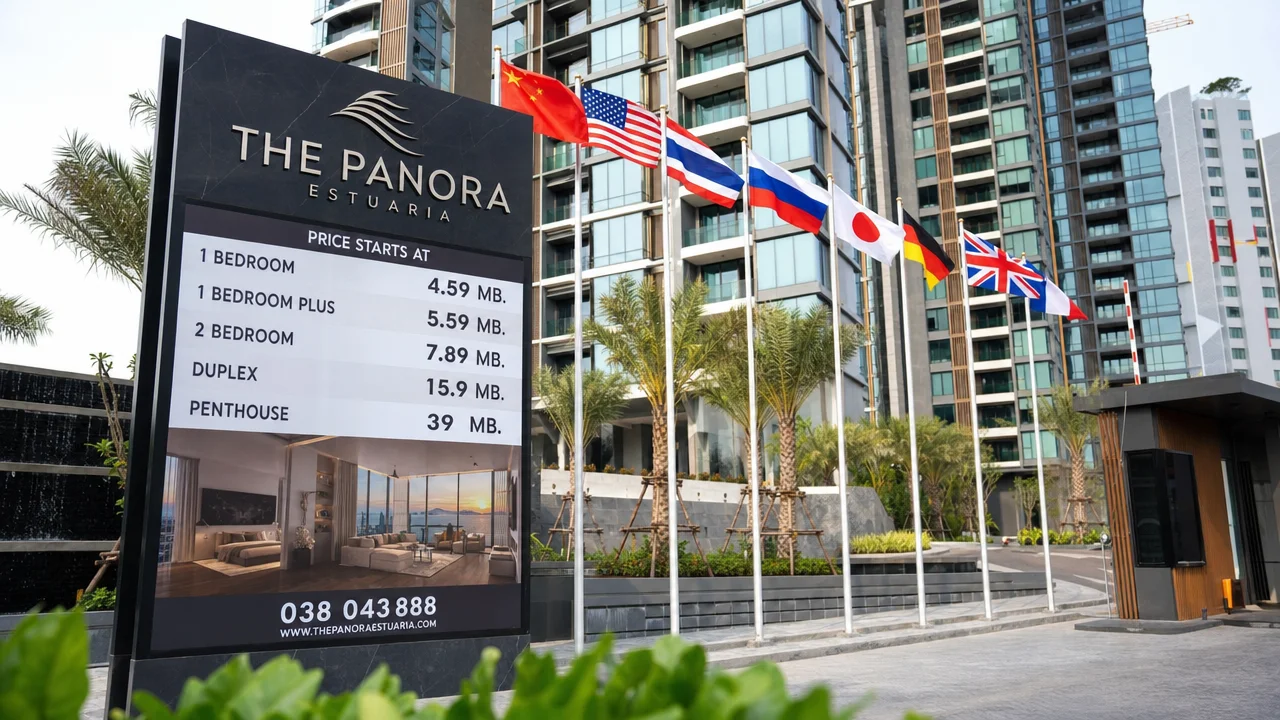
New launches in Pattaya grew from 10,100 units in 2024 to 11,500 in 2025 (+14%), and 13,000 units are in the pipeline for 2026, according to CBRE and Colliers. Developers continue to launch projects despite the first quarter 2026 cooling. The average price of a new build in the range of 118,000-122,000 baht/m² makes 30 m² studios available from 3.54 million baht, 40 m² one-bedrooms - from 4.72 million baht.
The stimulus program with a 0.01% fee does not apply to foreigners. You pay the standard 2% for registration and 1% for a mortgage if taking a loan. For a 5 million baht transaction, that's 100,000 baht in registration costs plus 50,000 baht for a mortgage if financing the full amount. Thai buyers pay only 500 baht for both fees combined when meeting program conditions, giving them a price advantage in the secondary market and intensifying competition for units in the Thai quota.
The 49% quota in popular beachfront buildings in Wongamat, Pratumnak and Jomtien is often exhausted or close to it. Request written quota confirmation before making a deposit. If the quota is closed, consider either a 30-year lease (understanding that renewal is not guaranteed), or second-third line buildings where the quota is still open, or new builds where the developer reserves blocks for foreigners in advance.
Yields of 6.2-6.5% gross from long-term rental remain attractive against deposit rates of 1-2% in Thai banks. However, this is a gross figure before deducting management fees (typically 40-50 baht/m² per month), land and building tax (0.02-0.1% of assessed value), sinking fund and vacancy periods. Net yield for a unit rented through a management company is typically 4-5%.
From reservation to ownership transfer registration in the secondary market takes four to eight weeks provided the seller has provided all documents, there are no encumbrances, and the quota is confirmed. For new builds, the timeframe depends on the construction stage: if the building is complete and has received occupancy certification, the process is similar to secondary; if construction is ongoing, registration occurs only after completion and obtaining all permits.
Buyers from Russia must open a Thai bank account before the transaction and transfer funds from abroad in foreign currency. The bank will issue a Foreign Exchange Transaction (FET) form, which is required by the Land Office to register foreign ownership. Without FET, registration in the foreign quota is impossible. Transfers within Thailand, even if the account is in your name, are not considered foreign capital and do not confer freehold rights.
The current demand correction in the first quarter of 2026 (-17.3%) creates short-term pressure on sellers. Developers offer installment plans, furniture packages, fee coverage and other incentives to close deals before the end of the financial year. For a buyer with ready funds and a clear understanding of objectives (own residence, rental, resale in 3-5 years), the current moment provides more negotiating leverage than the heated market of 2023-2024.
Conclusions
Foreign purchases of condominiums in Thailand showed minimal growth by units (+2.2% to 14,899 in 2025) and a decline in value due to a shift to cheaper segments and an increase in the share of the secondary market at a discount. Pattaya holds 27-30% of the national volume, with an increased concentration of Russian and Chinese buyers compared to the national average.
The 49% quota has remained unchanged since 1999, and no legislative amendments have been adopted as of mid-2026. The stimulus program with a 0.01% fee has been extended until June 30, 2027, but applies only to Thai citizens. Foreigners pay standard rates.
Buyers in Pattaya should request written quota confirmation before making a deposit, prepare to negotiate price in the secondary market (a 6% discount from asking has become the norm), open a Thai bank account and transfer funds from abroad to obtain the FET form necessary for freehold registration. The current demand cooling gives the buyer more leverage, but requires thorough verification of quota and legal clarity of the transaction before closing.