
The 2025 Market Paradox: More Deals, Less Money
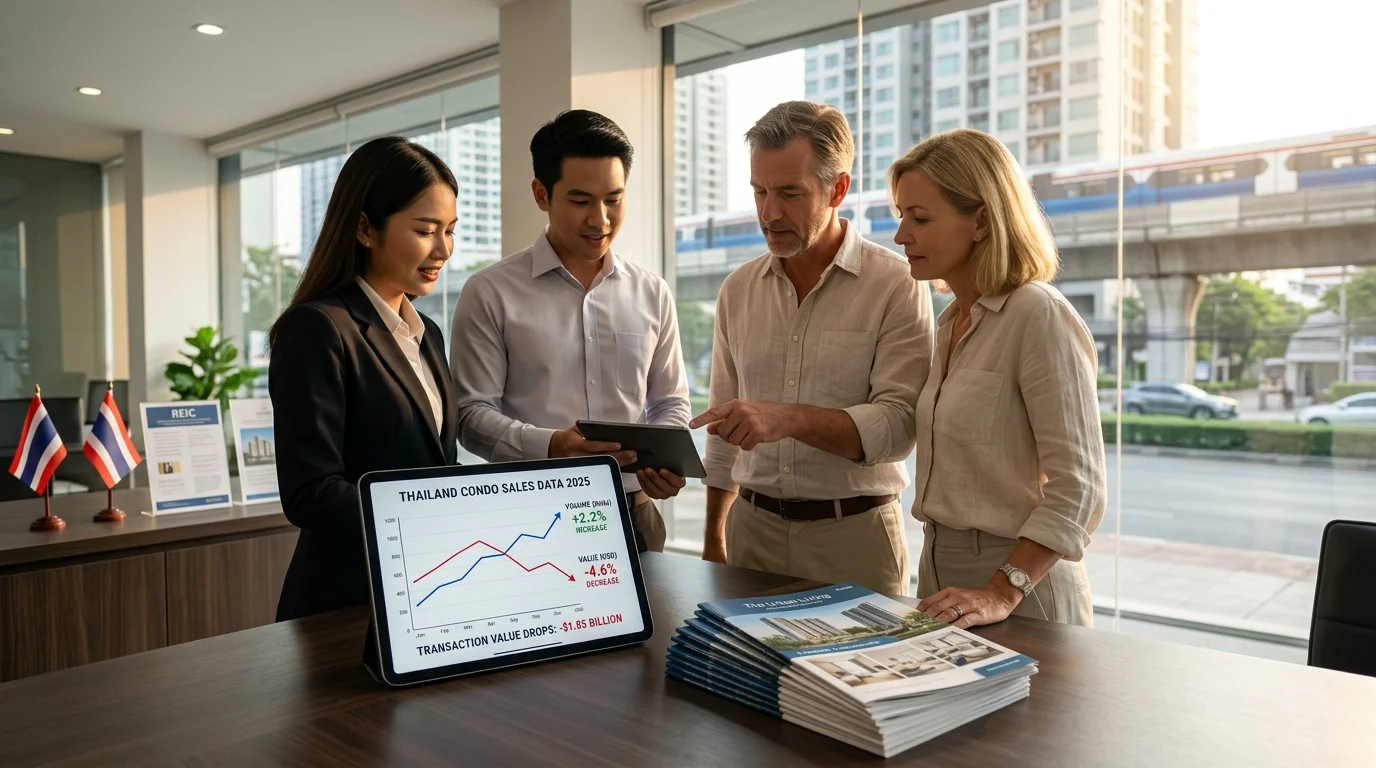
Foreign buyers purchased 14,899 condominiums in Thailand in 2025 - 2.2% more than the previous year. It would seem that demand growth is evident. However, the total transaction value fell from $1.94 billion to $1.85 billion - down 4.6%. The average purchase price decreased from $133,000 to $124,000. Buyers shifted to the mass segment, avoiding luxury properties.
According to Real Estate Information Center (REIC) data published in April 2026, Chinese buyers maintained first place - 4,940 apartments worth $565.6 million. Buyers from Myanmar took second place by number of transactions (1,968 properties), surpassing Russians, who came third with 1,172 apartments worth $145.3 million. Russian investors control 7.9% of all foreign transactions by quantity and 7.8% by value.
The reason for the average price decline is the mass influx of buyers from Myanmar and other Asian countries. They choose studios and one-bedroom apartments of 30-35 m² for $90,000-$100,000. Chinese buyers also reduced their budgets: the average purchase fell from $133,000 to $115,000. Russians, on the contrary, buy more expensive properties - average price of $124,781 with an average area of 42.1 m².
Top Buyers: Top 10 Countries by Number of Transactions
China leads by a margin: 4,940 apartments per year - one-third of the entire foreign market (33.2%). However, Chinese buyer activity decreased by 13% compared to 2024 and by 25% relative to 2023. Economic slowdown in China and capital outflow restrictions are hitting foreign investments.
Myanmar shows explosive growth: 1,968 transactions - up 42% year-on-year and more than quadrupling since 2022. Internal instability and limited investment opportunities within the country are pushing Myanmar citizens to Thailand. They buy the most affordable properties - average price of only $94,347 with an area of 32.9 m².
Russia ranks third: 1,172 apartments - up 9% year-on-year and +44% from 2022. Growth rates are slowing: a significant portion of interested buyers already completed transactions in 2023-2024. New demand is forming more slowly, buyers are acting more pragmatically, paying more attention to location and actual returns.
Taiwan took fourth place - 1,036 apartments (+24% year-on-year, tripling from 2022). Taiwanese are diversifying capital, seeking liquid foreign assets. Average price of $136,955 - above market average.
USA (537 transactions, -12% year-on-year), France (657, +26%), UK (476, +15%), Germany (459, +3%) and India (237) round out the top 9. Indian buyers spend the most - average price of $209,998 with an area of 75.7 m². They focus on the upper segment and large units.
Average Price by Country: Who Buys More Expensive
India leads in average purchase price - $209,998. Indian investors choose spacious apartments and villas, often in Phuket and Bangkok. Average area of 75.7 m² - the largest among all countries.
USA ranks second - $158,259 with an area of 53.8 m². Americans prefer quality projects with high service levels, often in the premium segment.
UK ($146,086, 57.1 m²) and Singapore ($146,086, 37.3 m²) share third place in average price. British buyers choose more spacious housing, Singaporeans - compact investment studios.
Taiwan - $136,955 (35.7 m²), France - $121,738 (47.9 m²), Germany - $121,738 (50.5 m²). Europeans buy medium-sized apartments in good locations.
Russia - $124,781 with 42.1 m². Russian buyers focus on rental investments, choosing one-bedroom apartments and studios in Phuket and Pattaya. Average price is higher than Chinese buyers ($115,651, 35.6 m²) and Myanmar buyers ($94,347, 32.9 m²).
Demand Geography: Phuket Overtakes Pattaya for Russians
According to Tranio data for 2025, Phuket became the main destination for Russian buyers - 71.79% of all transactions in the fourth quarter. This is growth of almost 20% quarter-on-quarter. The island offers the highest liquidity, stable rental demand and developed infrastructure.
Chonburi (Pattaya) takes second place - 15.38% in the fourth quarter of 2025. The share decreased by 31.6% compared to the third quarter, despite annual growth. Pattaya remains more affordable than Phuket: studios start from 2-2.5 million baht versus 3-4 million on the island.
Surat Thani (Samui) is gaining popularity - 12.82% in the fourth quarter, up 95.16% year-on-year relative to Q4 2023. Buyers are seeking alternative resort locations with less competition and a calmer atmosphere.
Bangkok has practically disappeared from Russian preferences - 0% in Q4 2025. The capital interests Asian buyers for long-term rentals, but not Russian investors focused on tourist rental returns.
Purchase Goals: Investments Dominate, Migration Retreats
According to Tranio, 71.79% of Russian buyers in Q4 2025 purchased real estate for investment. This is a recovery after declining to 63.64% in Q3. Investors are sensitive to market conditions and return expectations.
Purchases for vacation comprised 15.38% - moderate growth and stabilization in the second half of the year. Some buyers view an apartment as a personal base for winter stays with the possibility to rent out in summer.
Migration as a purchase goal decreased to 12.82% in Q4 from a peak of 21.21% in Q3. This is related to tightened visa requirements in 2026: mandatory return ticket and proof of financial means cooled migration enthusiasm.
Purchases for residence permit or citizenship disappeared from statistics - 0% in the second half of 2025. Thailand doesn't offer a direct path to residency through property purchase, making this motivation irrelevant.
Quarterly Dynamics: Fourth Quarter Showed Recovery
Russian demand shows seasonality. The first half of 2025 remained at 2024 levels: 288 transactions in Q1, 272 in Q2. Q3 showed growth to 262 transactions. Q4 brought 350 transactions - the highest since Q4 2022 (393 transactions).
Q4 is traditionally strong: buyers close deals before the new year to start renting apartments during high season (November-March). Developers offer discounts and promotions, stimulating demand.
The Chinese market, conversely, is contracting evenly: 1,481 transactions in Q1 2025 versus 1,595 in Q1 2024. Quarterly decline reflects systemic problems in the Chinese economy.
Supply Glut Pressures Prices and Returns
Thailand's market faces oversupply: 74,000 unsold condominiums in Bangkok suburbs, up to 220,000 in the capital, about 400,000 nationwide. New launches in 2025 decreased by 30-94% depending on region.
In Pattaya, Q1 2024 saw 4,493 units worth 16 billion baht launched - a historical maximum. By end of 2024, total new projects reached 7,000 units. Normal volume for Pattaya is 3-5,000 per year. Exceeding this threatens a repeat of the 2013-2014 crisis, when the market needed several years to absorb excess inventory.
In Phuket, 8,743 units launched in 2024 - six times more than 2022. Q1 2025 added another 3,338 apartments worth 25 billion baht. By end of 2025, 8,500 new condominiums were expected. Typical prices rose from 120,000 baht per m² pre-pandemic to 150-180,000 baht per m² now.
Bangkok showed a 15-year low - 3,288 new condominiums in Q1 2024 (-33% year-on-year). Developers shifted to conservative mode due to high mortgage rejection rates: 70% of applications in the under-3-million-baht segment are rejected by banks.
What This Means for Pattaya Buyers
Supply glut in Pattaya creates negotiation opportunities. Developers are willing to reduce prices by 5-10%, offer interest-free installments or cover transfer costs (usually 2% of value). Buyers can choose from hundreds of projects without rushing decisions.
However, investment returns are under pressure. Competition for tenants is growing, rental rates are stagnating. A 30 m² studio in Pattaya brings 12-15,000 baht monthly at 2.5 million baht cost - 5.8-7.2% annual before deducting management expenses (usually 20-30% of rental income). After deductions, net return falls to 4-5%.
Russian buyers' average price ($124,781, about 4.5 million baht at 36 baht per dollar) corresponds to a 40-45 m² one-bedroom apartment in a good Pattaya project. Such a property can bring 18-22,000 baht monthly, or 6-7% annually before deductions.
Phuket is more expensive but more liquid. Average studio costs 3.5-4 million baht, one-bedroom apartment - 5-7 million. Rental rates are higher: 20-30,000 baht for studios, 35-50,000 for one-bedrooms. Returns are comparable to Pattaya (6-8% before deductions), but reselling a property in Phuket is easier due to a broader buyer audience.
Buyers should avoid projects with exhausted foreign quota (49% of building area). If the quota is filled, reselling an apartment to another foreigner is impossible - you'll need to find a Thai buyer or convert to leasehold, which reduces price by 20-30%.
Developer verification is critical. In 2025, several medium-sized developers suspended projects due to lack of financing. Absence of escrow accounts means buyer's money goes directly to the developer. In case of bankruptcy, recovering funds is nearly impossible. Work only with verified companies registered on the stock exchange or with a history of completed projects.
Currency risk remains. The baht has strengthened against the ruble over the past two years. A purchase in 2023 for 4 million baht cost 7.2 million rubles (rate 1.8), now the same amount costs 8.8 million rubles (rate 2.2). Investors counting on ruble income from rentals lose on conversion.
Long-term perspective requires a 7-10 year horizon. Quick speculative profit is unlikely amid oversupply and low liquidity. But for those willing to wait and manage the property through a reliable company, Thailand remains one of the few markets open to Russian buyers without political barriers.