Why the Nominee Scheme Has Ceased to Be a Gray Area
In 2026, the Thailand Land Department launched a series of audits of transactions involving nominee shareholders-Thai nationals who formally own shares in foreigners' companies to circumvent the ban on land purchases. Previously, such structures existed in a legal twilight: the law did not permit them, but there were no mass prosecutions. Now the situation has changed. The Ministry of Interior has been instructed to verify the sources of capital of Thai minority shareholders, and courts have begun to annul transactions based on claims from the nominees themselves or their heirs.
According to Land Department data, 147 lawsuits were filed in the first quarter of 2026 to invalidate land purchase agreements where a foreigner controlled a company through proxy persons. This is three times more than for all of 2024. Simultaneously, the Bank of Thailand tightened requirements for the origin of funds when registering incoming transfers: now the bank must request from the recipient documents confirming the legality of income if the amount exceeds 2 million baht and comes from a non-resident individual.
What is a Nominee Scheme and Why Did It Work
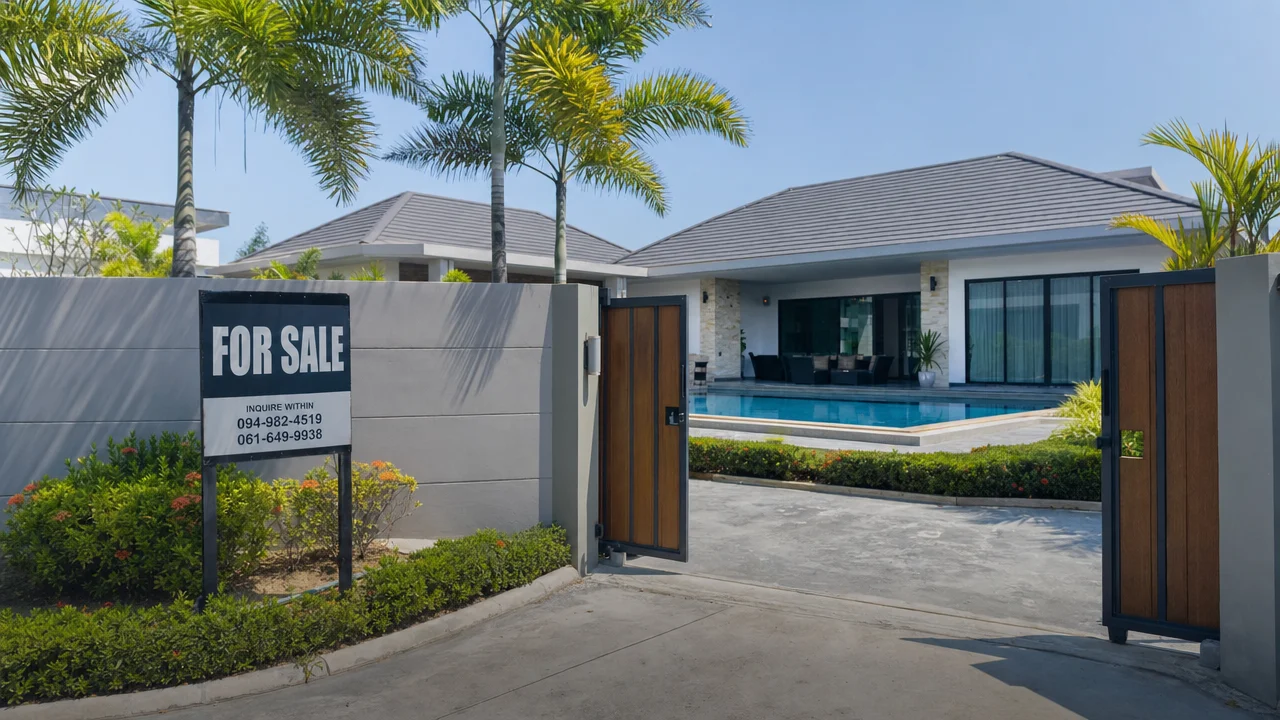
Thai legislation prohibits foreigners from owning land directly. The exception is condominiums, where the foreign ownership share in a building cannot exceed 49%. To purchase a villa or townhouse with land, investors registered a Thai company in which 51% of shares formally belonged to Thai citizens and 49% to the foreigner. In practice, the foreigner financed the entire transaction, while the Thais received symbolic payment for the use of their names.
The scheme relied on two assumptions: Thai shareholders would not challenge the arrangements, and the state would not massively verify the real origin of capital. Both assumptions collapsed. Thai courts have recognized that if a Thai shareholder did not invest their own funds and does not participate in management, their share is fictitious. The Land Department has received the right to annul the title and return the plot to the state without compensation.
Real Cases: From Warnings to Confiscation
In February 2026, the Chonburi Provincial Court annulled ownership rights to a villa worth 18 million baht in the Bang Saray area. A nominee shareholder who owned 26% of the company filed a lawsuit after the death of the foreign investor, claiming he had not received promised payments. The court established that all funds for land purchase and construction came from the deceased, Thai shareholders never visited the property and did not make decisions. The title was declared invalid, and the foreigner's heirs lost the property.
In March, a similar decision was issued by the Phuket court for a plot in the Chalong area. Here, the Land Department itself became the initiator after checking the company's bank statements: all payments came from the personal account of a foreigner registered in Singapore. The company was liquidated, and the land was returned to the state fund.
These precedents created a legal basis for mass audits. The Land Department now has the right to request from any land-owning company documents confirming the source of capital for each shareholder. If a Thai minority shareholder cannot present bank statements, tax returns, or a loan agreement for their contribution share, the transaction will be annulled.
New Government Control Tools
The Ministry of Commerce in January 2026 updated the company annual report form (BOR.JOR.5). It now requires disclosure not only of the list of shareholders but also beneficial owners-persons actually controlling more than 25% of votes or making key decisions. Companies must submit updated data by May 31, 2026. Failure to provide information carries a fine of up to 500 thousand baht and criminal prosecution of directors.
The Bank of Thailand introduced a new transaction category "suspicious transfer for asset purchase." If a foreigner transfers money to a Thai national, and that person registers a share in a real estate-owning company within 90 days, the bank automatically notifies the Anti-Money Laundering Office. The recipient must prove the legality of funds within 30 days, otherwise the account will be blocked.
Risk Table by Ownership Type
| Ownership Type | 2026 Risk Level | Grounds for Audit | Consequences |
|---|---|---|---|
| Condominium in foreigner's name | Low | Not applicable | Legal ownership, protected by law |
| Long-term land lease (30+30+30 years) | Medium | Contesting extension by lessor's heirs | Loss of right to use without compensation for improvements |
| Company with real Thai partners | Medium | Verification of capital source of all shareholders | Fines, requirement to re-register |
| Company with nominee shareholders | Critical | Any complaint, scheduled audit, foreigner's death | Title annulment, confiscation without compensation |
Alternatives to the Nominee Scheme
Long-term land lease for up to 30 years with right of extension remains legal. The contract is registered with the Land Department and is protected from unilateral termination. The key risk is that extension depends on the consent of the owner or their heirs. In practice, Thai courts recognize the right to a second extension if the first was registered before 2008 and the contract specifies an automatic renewal mechanism.
Marriage to a Thai citizen allows the foreign spouse to finance the purchase of land, which is registered in the Thai's name. To protect investments, the parties sign a declaration before the Land Office (Kor.Kor.11), where the foreigner confirms that the funds are personal, and the Thai spouse undertakes not to sell the land without consent. The document does not grant ownership rights but is considered by courts in property division.
Condominiums are the only form of full ownership for foreigners. An apartment is registered in the buyer's name without time restrictions. Condition: the share of foreign owners in the entire building does not exceed 49%, and funds are brought in from abroad with a bank notation of currency transfer (Foreign Exchange Transaction Form).
What Nominee Company Owners Should Do Now
The first step is a legal audit of the structure. A lawyer checks the company charter, shareholder meeting minutes, bank statements, and loan agreements. If Thai minority shareholders did not contribute funds and did not participate in management, the structure is vulnerable. The purpose of the audit is to assess the likelihood of a successful Land Department inspection.
The second step is legalization of Thai shareholders' capital. The foreigner arranges loans to the Thais at market rate (5-7% per annum), they contribute money to the company as payment for their shares, then return the loan from dividends. Operations are conducted through bank accounts with full documentation. This path works if the company has not yet come under regulatory scrutiny and Thai shareholders agree to cooperate.
The third option is selling the asset and transitioning to a legal structure. If the property has increased in value, the owner sells it, withdraws funds, and buys a condominium or arranges a long-term lease. Losses include capital gains tax of 1% of cadastral value plus a stamp duty of 0.5%, but the risk of confiscation disappears.
The fourth path is liquidating the company and re-registering to a Thai spouse or trusted person with a notarized trust management agreement. Such an agreement is not recognized by the Land Department but can be used in civil litigation to recover funds.
What This Means for Buyers in Pattaya
Pattaya and Chonburi Province are areas of heightened regulatory attention due to the high concentration of foreign-owned real estate. According to the Real Estate Development Agency of Thailand, in the Jomtien, Na Jomtien, and Bang Saray areas, up to 40% of villas with land are registered to companies with foreign control. The Chonburi Land Department in April 2026 announced the start of selective audits of companies that purchased land after 2015.
For buyers, this means three practical conclusions. First: villas and townhouses held through companies are now harder to resell. Banks refuse mortgages if the ownership structure raises questions, and buyers demand a 15-20% discount for risk. Second: condominiums in Pattaya gain in liquidity. Projects with a high proportion of Thai buyers (for example, complexes along Sukhumvit with prices up to 3 million baht per studio) maintain demand. Third: long-term land lease for a villa becomes a competitive alternative. Land rental rate in Na Jomtien is 150-250 thousand baht per year for 400-600 sqm, a 30-year contract with right of extension provides predictable expenses without risk of confiscation.
Investors who already own villas through nominee companies in Pattaya should conduct an audit before the end of 2026. If the structure cannot withstand scrutiny, it's better to sell now with a minimal discount than wait for a lawsuit from a nominee or a Land Department notice. The market is restructuring: demand is shifting to legal forms of ownership, and the premium for villa convenience no longer outweighs legal risk.
Forecast: Where Regulation is Heading
The Thai Ministry of Interior in March 2026 submitted to parliament a draft law on a beneficial owner registry. If adopted, all companies owning real estate will be required to disclose individuals controlling more than 10% of capital or votes. The registry will become public, with access granted to the Land Department, tax authorities, and law enforcement agencies. Implementation deadline is 2027.
In parallel, the Bank of Thailand is discussing the introduction of a limit on outgoing transfers for non-resident companies. If a company is registered in Thailand but controlled by foreigners and owns only real estate without operational activity, its transfers abroad will be limited to 1 million baht per year. The goal is to stop capital withdrawal through fictitious structures.
For the Pattaya real estate market, this means a final transition to transparent schemes. Developers are already adapting: new villa projects offer either long-term land lease with the right to purchase the building, or low-rise condominiums where each villa is a separate unit with foreign ownership rights. Buyers are left to choose between legal clarity and ownership flexibility-but the era of nominee companies as a mass instrument is over.