
Bangkok's Office Market Faces Unprecedented Pressure
More than 616,000 square meters of new office space will enter the Bangkok market by 2031, with half of this volume - 436,000 sq. m - scheduled for completion as early as 2026. Owners of older business centers face a choice: invest millions of baht in modernization or watch as tenants massively relocate to new buildings with green certifications and intelligent management systems. The situation resembles the oversaturation crisis in the condominium market, where developers hold 220,000 unsold apartments on their balance sheets in the capital alone.
Old Class B Offices Losing Tenants
Approximately 58% of Bangkok's entire office stock consists of Class B buildings and outdated Class A properties. More than half of these buildings have been in operation for over ten years. In the second quarter of 2026, the total volume of office space in the capital remained virtually unchanged at around 9.15 million square meters, but the structure of demand has shifted dramatically.
Tenants are leaving old complexes for new projects even at comparable rental costs. International companies choose buildings with energy-efficient engineering systems, environmental certifications, developed infrastructure, and public spaces. The average market rate decreased by 0.3% to 850 baht per square meter per month, while Class A office rent increased by 0.5% to 1,247 baht per square meter.
Green-certified buildings account for approximately 36% of total supply and demonstrate the best net absorption. Owners of old properties are forced to conduct large-scale reconstruction: modernize engineering systems, update public spaces, renovate office premises, and improve services for tenants.
Competition Shifts from Price to Quality
Bangkok's office market is changing the rules of the game. Price has ceased to be the main selection factor. Companies are looking for buildings that help attract employees, increase business efficiency, and shape corporate image. Relaxation zones, sports facilities, intelligent building management - these elements are turning from options into standards.
In the fourth quarter of 2025, office occupancy reached 77%, an increase of 0.4 percentage points compared to the previous quarter. Net absorption was approximately 25,000 square meters, and the total volume of leased space exceeded 102,000 sq. m. About 851,000 square meters remain under active construction.
Landlords are offering more and more bonuses: discounts of 5-10%, installment plans, free furniture, first years of service at their own expense. The market has turned into a tenants' market. Owners of old Class A and B buildings face rising vacancy rates and understand: without investments in quality, retaining tenants is impossible.
Parallels with the Condominium Crisis
Bangkok's office crisis is developing according to the same pattern as the oversaturation of the condominium market. According to the Thai Real Estate Information Center, there are about 220,000 unsold condominiums in the capital, and nationwide this figure reaches 400,000 units. The center's president, Dr. Sopon Pornchokchai, calls the situation the worst in the last 30 years - since the Asian financial crisis of 1997.
The number of new construction permits in the first quarter of 2026 fell by 44.3% in the metropolitan region. In the condominium segment, the drop is steeper - minus 71.3%, with only 2,950 apartments receiving approval. Developers prefer to hold prices and reduce construction volumes rather than engage in price dumping. A sharp drop in value would destroy company balance sheets and trigger a wave of bankruptcies.
Old projects are weighing down the market. New offerings are becoming scarce. Quality projects by the sea with good locations and reliable developers retain their value. Second and third-line properties, especially in old buildings, are losing competitiveness.
Why Price Collapse Isn't Happening
There has been no direct price collapse in either the office market or the condominium market yet. Developers are making concessions - discounts, installment plans, bonuses - but not collapsing prices. Three factors are holding prices steady.
First: developers cannot afford a sharp drop in value. Company balance sheets won't withstand it, and bankruptcies will begin. Second: the entry threshold in Pattaya remains one of the lowest among coastal locations in Thailand. A studio by the sea costs from 2-2.5 million baht, while on Phuket a similar option would cost 4-5 million baht. Demand from buyers with limited budgets persists.
Third: the secondary market has already undergone correction. Properties purchased in 2015-2017 at inflated prices are now selling at a 15-20% discount to the original cost. This creates competition for new construction but simultaneously forms a price floor.
Rental Yields Are Falling
Short-term rentals in Pattaya only work in central areas and by the sea. Competition among old stock has grown so much that many owners are lowering rates or switching to long-term rentals. The average rate for a 30 sq. m studio in Central Pattaya during high season has dropped from 1,500-2,000 baht per night in 2019 to 1,200-1,500 baht in 2026.
Long-term rentals are becoming more predictable. Expats, remote workers, and winter visitors are willing to rent housing for 6-12 months at a rate of 15,000-25,000 baht per month for a one-bedroom apartment. Yields are lower - around 4-5% annually, but stability is higher.
Real rental yields will continue to fall due to competition. Liquidity will deteriorate: selling an apartment quickly and at the desired price will become more difficult. Prolonged stagnation is more likely than collapse. Prices will remain at current levels or decrease by 5-10% in nominal terms.
Which Pattaya Areas Are Most Vulnerable
Not all areas of Pattaya are equally subject to pressure. Central Pattaya, especially the Walking Street and Beach Road zone, maintains demand thanks to tourist traffic. Studios and one-bedroom apartments here are liquid, although short-term rental yields have decreased.
Na Jomtien attracts buyers oriented toward quiet life by the sea. Demand for long-term rentals here is more stable than in the center. Projects with good infrastructure - pools, fitness centers, security - hold prices. The average cost per square meter in Central Pattaya remains in the range of 80,000-120,000 baht for beachfront projects and 50,000-70,000 baht for second-line properties. Na Jomtien is traditionally cheaper: 60,000-90,000 baht per square meter in new complexes and 40,000-60,000 baht on the secondary market.
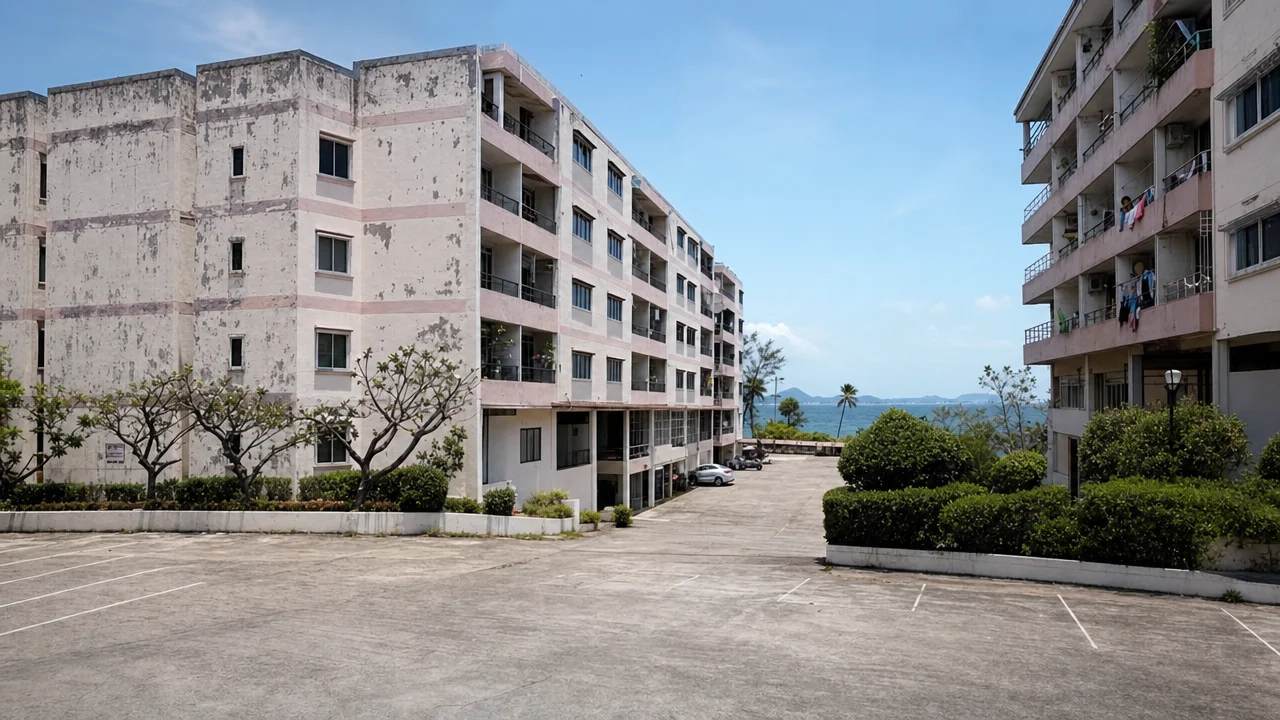
The greatest pressure is experienced by second and third-line areas: Pratumnak (old buildings without renovation), Jomtien second row, Naklua away from the beach. These areas concentrate properties built during the 2015-2018 boom. Many of them are poorly maintained, management companies work poorly, infrastructure is worn out.
| Area | Price per m² (new projects) | Price per m² (secondary) | Demand Level |
|---|---|---|---|
| Central Pattaya (beachfront) | 80,000-120,000 baht | 60,000-90,000 baht | High |
| Central Pattaya (second line) | 50,000-70,000 baht | 40,000-55,000 baht | Medium |
| Na Jomtien | 60,000-90,000 baht | 40,000-60,000 baht | Stable |
| Pratumnak (old buildings) | - | 35,000-50,000 baht | Low |
| Jomtien (second line) | 45,000-65,000 baht | 35,000-50,000 baht | Low |
What This Means for Pattaya Buyers
Bangkok's oversaturation crisis doesn't trigger an immediate price collapse in Pattaya but creates a new reality. The market is transitioning from a growth phase to a selection phase. Projects with strong management, good locations, and adequate pricing win. Old buildings, second-line properties, and everything built hastily during the boom lose.
There's no need to rush. Prices aren't growing, supply is broad, you can choose. Checking the developer and management company becomes critically important. Buying an apartment in a project that will turn into a semi-abandoned building with leaking pools in two years is a direct path to losses.
Betting on long-term rentals and personal use is safer than counting on a tourist boom. Investors with budgets lower than required for Phuket will find more options in Pattaya. Buyers oriented toward long-term rentals and ready to work with expats and remote workers can expect yields of 4-5% annually with the right property choice.
The key condition is a quality project with good management. Bangkok's office crisis shows: without investments in quality and service, old buildings lose tenants even at low prices. The same logic works in Pattaya's condominium market. Choose projects with strong management companies, developed infrastructure, and proximity to the sea. Everything else is risk.