
Bangkok's Western Corridor Emerges from Suburban Shadow
Construction of the western section of the MRT Orange Line from Bang Khun Non station to Thailand Cultural Centre is reshaping the capital's pricing map. Land in Bang Yai, Nonthaburi and Bang Phlat districts has appreciated 17-21% year-on-year, and Cushman & Wakefield analysts forecast another 20-40% growth after the line launches in 2027. For investors, this is the last chance to enter locations that will become part of the central transport network in two years.
The 35.9 km Orange Line will connect Bangkok's eastern and western outskirts through 28 stations. The 13.4 km western section includes 11 underground stations and passes through areas that remained transport-isolated until 2026. Travel time from Bang Yai to Thailand Cultural Centre with a transfer to the blue line will drop from an hour and a half by bus to 25-30 minutes.
Land Prices: Specific Figures by Station
The Real Estate Information Center (REIC) recorded a land price index along the Orange Line at 489 points in Q2 2026 - up 7.4% year-on-year. The western corridor showed sharper dynamics.
Around Ratchathewi station, where the line intersects with the BTS green line, individual condominiums sell for 250,000 baht per square meter. Mixed-use development includes JRK Tower and The Platinum Square projects, despite land ownership restrictions in this zone.
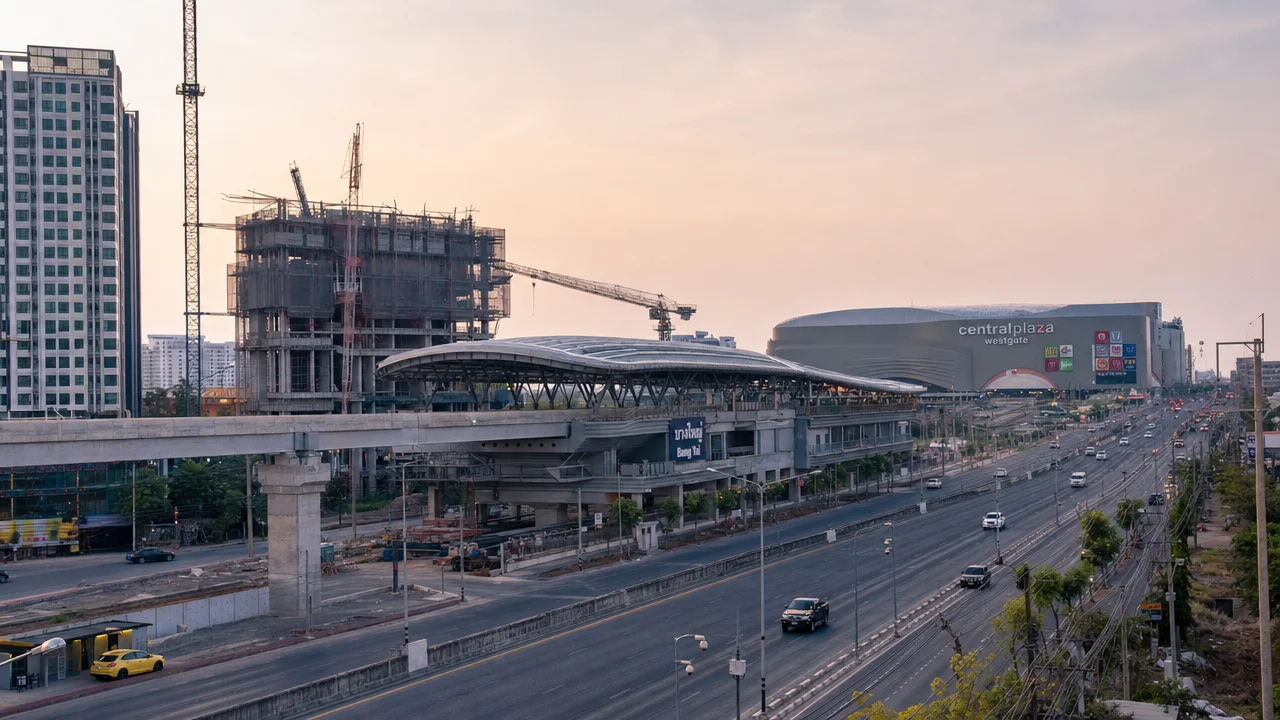
In Bang Yai, the penultimate station of the western section near CentralPlaza WestGate shopping center, rental prices for new one-bedroom apartments of 45-50 sqm rose from 11,000-14,000 baht in December 2025 to 13,000-15,000 baht by February 2026. Land in the area costs 150,000-500,000 baht per square wa (four square meters), depending on distance from the station. In side sois, plots sell for under 100,000 baht per wa.
Mueang Nonthaburi and Pak Kret showed 17.2% growth over the year. Samut Sakhon added 16%, Mueang Pathum Thani - 11.8%. Bang Phlat and Bang Yai districts were until recently considered deep suburbs without tourist infrastructure, but with a developed Thai middle class, schools and parks.
Eastern Section: Betting on Transport Hubs
The 22.5 km eastern branch from Thailand Cultural Centre to Min Buri includes 10 underground and 7 elevated stations. Launch is scheduled for January 2028, construction is 100% complete.
The Ramkhamhaeng - Lam Sali - Min Buri corridor attracts developers due to future transfers to yellow and brown lines. Average price of new condominiums along Ramkhamhaeng is 85,000 baht per sqm, exceeding 100,000 baht in select locations. Land at Thailand Cultural Centre station, a key transfer hub to the blue line, costs over 1 million baht per wa.
The Phra Khanong - Bang Na - Suan Luang - Prawet district showed the highest growth: 36.3% year-on-year. Next are Bang Khen - Sai Mai - Don Mueang - Lak Si - Min Buri - Nong Chok - Khlong Sam Wa - Lat Krabang with 21.1% growth.
Around Lam Sali station, prices grew at double-digit rates in certain periods due to high developer demand. Current range is 150,000 to 500,000 baht per wa, with potential for another 20-40% growth within five years after line launch.
Comparison with Operating Lines: Where It's Most Expensive
In absolute values, the most expensive land remains along the BTS Sukhumvit line - index 504 points, up 7.3% year-on-year. Airport Rail Link showed similar dynamics (7.3%) at index 460 points. The Orange Line ranks third with index 489.
The fastest growth was recorded along the green line extension (Khu Khot - Lam Luk Ka): 17.6% year-on-year, index 361 points. This reflects demand for affordable housing in suburbs with direct access to the center.
| Metro Line | Price Index (Q2 2026) | Year-on-Year Growth |
|---|---|---|
| BTS Sukhumvit | 504 | 7.3% |
| Orange Line | 489 | 7.4% |
| Airport Rail Link | 460 | 7.3% |
| Green Line Extension | 361 | 17.6% |
The overall land price index in Greater Bangkok reached 441 points in Q2 2026 - up 6.2% year-on-year, but down 1.8% quarter-on-quarter. The slowdown after 1.4% growth in Q1 indicates stabilization after several years of sharp rise.
Commercial Development and Mixed-Use Projects
Besides residential, shopping and office facilities are emerging along the Orange Line. New hotels and business centers opened in the Phetchaburi - Pratunam area. Phoenix wholesale-retail food center launched in Bang Yai zone, CentralPlaza WestGate offers free coworking space for mall visitors.
On Rama 9, where the Orange Line intersects with the blue line, Central Pattana plans to develop a corner plot. The district is rapidly changing thanks to large land assets, including MCOT plots.
Mass Rapid Transit Authority forecast: The Orange Line will carry up to 300,000 passengers per trip daily, creating new premium locations around key stations.
Restrictions for Foreigners: What Can Be Purchased
Foreign nationals can own condominiums in full ownership (freehold) only within the 49% foreign quota in each building. Direct land purchase is impossible without registering a Thai company or arranging long-term lease (leasehold) for 30+30+30 years.
The optimal strategy for non-residents is purchasing apartments within 500 meters of stations at pre-sale stage, before construction completion and line launch. After metro opening, prices will rise and available units in the foreign quota will decrease.
Land on average in Bangkok in areas with developed transport costs over 400,000 baht per wa, according to Agency for Real Estate Affairs (AREA). In 2015, the figure was about 250,000 baht - 60% growth over ten years.
Infrastructure Plans and Legislative Changes
Thailand's Ministry of Transport plans to introduce amendments to land use regulations in mid-2027. The goal is to synchronize development with mass transit routes, encourage mixed land use and reduce air pollution by decreasing private vehicle share.
New regulations will incentivize residential construction near metro stations and restrict low-density development in transport corridors. For investors, this means rising value of plots for multi-family housing and falling demand for detached villas in remote sois.
Bang Na, Bangkadi, Lak Si and Thung Song Hong districts remain undervalued despite proximity to operating or under-construction lines. Land below market average can still be found there, but the window is closing as launch dates approach.
What This Means for Pattaya Buyers
Bangkok price growth affects the Pattaya market through two channels: redistribution of investment demand and changing yield expectations.
When land in the capital appreciates 17-36% year-on-year, investors start seeking alternatives with lower entry points. Pattaya with its average new condominium price of 80,000-120,000 baht per sqm looks more attractive than Bangkok, where similar projects cost 150,000-250,000 baht. A twofold difference with comparable rental yield of 4-6% annually.
The Bangkok - Pattaya high-speed railway launch, expected in 2028-2029, will reduce travel time to 45 minutes. Pattaya will effectively become a suburb of the capital, like Bang Yai or Nonthaburi today. Land along future stations in Sriracha and on Sukhumvit is already appreciating, though slower than in Bangkok.
For Russian-speaking buyers choosing between investing in a capital condominium at foundation stage and ready property in Pattaya, the key factor is ownership horizon. If the goal is resale 2-3 years after Orange Line launch, Bangkok offers greater growth potential. If priority is current rental income and personal use, Pattaya remains more profitable due to year-round tourist flow and simpler property management.
Restrictions for foreigners are identical in both cities: 49% quota in condominiums, inability to directly own land. The difference is in liquidity: in Bangkok, apartments in foreign quota near metro sell within 2-4 months, in Pattaya exposure time is 4-8 months depending on district.
AREA agency forecasts that average land price in Greater Bangkok will reach 500,000 baht per wa by 2028 in zones with completed transport infrastructure. In Pattaya, a similar figure for central districts (Pratumnak, Jomtien, Naklua) will be 250,000-350,000 baht per wa. The 1:1.5 ratio favoring the capital will persist, but absolute growth in baht will be higher in Bangkok.
Conclusions: Window of Opportunity Closing by 2027
The western section of the Orange Line will open in a year and a half. Land in Bang Yai, Nonthaburi and Bang Phlat has already appreciated 17-21%, but analysts expect another 20-40% growth after launch. The eastern Ramkhamhaeng - Min Buri corridor shows 21-36% growth thanks to future transport hubs.
For investors, the optimal entry point is purchasing condominiums at pre-sale stage within 500 meters of stations. After line construction completion, prices will rise and available units in the foreign quota will be exhausted. Direct land ownership for non-residents is impossible without a Thai company or long-term lease.
Pattaya's market benefits from Bangkok price growth through demand redistribution. A twofold difference in cost per square meter with comparable yield makes the Eastern Seaboard an attractive alternative for those seeking a lower entry point and willing to wait for the high-speed railway launch in 2028-2029.