
Eastern Section of Orange Line 100% Complete - and the Land Market Has Already Responded
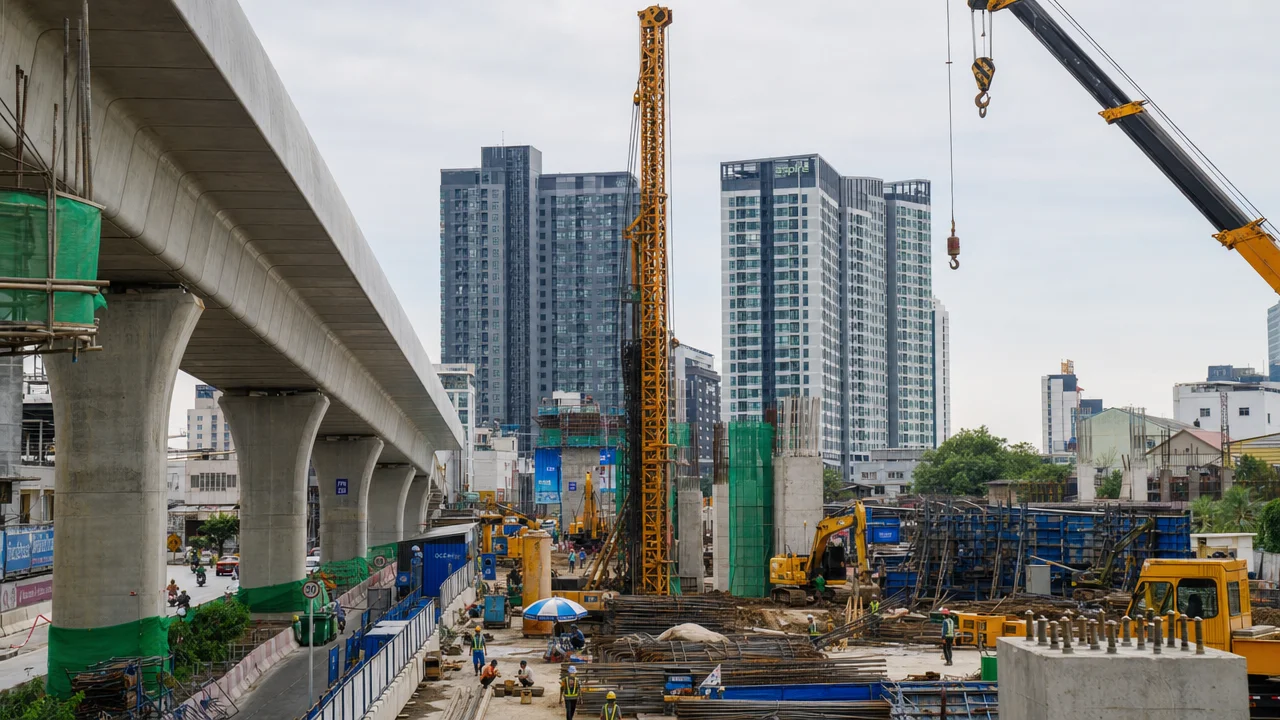
The Thailand Cultural Centre - Min Buri route, spanning 22.5 km, is fully constructed and ready for launch in 2027. The western section Bang Khun Non - Thailand Cultural Centre (13.4 km, 11 stations) is in active construction phase and will open by 2030. The Mass Rapid Transit Authority of Thailand (MRTA) forecasts passenger traffic of up to 300,000 people per day, which will transform the Orange Line into a key artery connecting the western and eastern districts of the capital. Investors have already recorded land price growth along the corridor of 20-25% over the past three years, and some plots near Thailand Cultural Centre station have exceeded the 1 million baht per square wa mark.
Why Interchange Stations Are Becoming the Main Value Drivers
The main growth is concentrated around hub stations where the Orange Line intersects with operating and under-construction metro lines. Thailand Cultural Centre connects with the blue MRT Blue Line and has already become the pricing benchmark for the entire corridor. Land plots within a 500-meter radius of the station are trading at 800,000 - 1,500,000 baht per square wa, comparable to central districts like Silom and Sukhumvit.
The Rama 9 district is changing before our eyes thanks to major land assets, including MCOT plots, and Central Pattana's investment plans for the corner plot at Rama 9. Lam Sali is emerging as a future transport hub: here the Orange Line will intersect with the Yellow Line and the planned Brown Line. Land in this area shows double-digit growth rates in certain periods, with current values ranging from 150,000 to 500,000 baht per square wa along Ramkhamhaeng Road.
Min Buri attracts buyers with a lower entry point and future connection with the Pink Line. Plots in the area cost from 80,000 to 300,000 baht per square wa, leaving significant room for growth compared to established transport corridors.
Eastern Corridor: New Condominiums on Ramkhamhaeng and Hua Mak
The eastern section of the Orange Line has become a catalyst for residential construction along Ramkhamhaeng Road, especially in the Hua Mak and Lam Sali areas. The average price of new condominiums has reached 85,000 baht per square meter, with individual projects exceeding the 100,000 baht per square meter mark. For comparison: three years ago, similar properties sold for 60,000 - 70,000 baht per square meter.
Land in the Lam Sali area has more than doubled in price in recent years, reflecting increased demand from developers. Plots in secondary sois are still available at prices below 100,000 baht per square wa, creating opportunities for early entry before the line launches in 2027.
Cushman & Wakefield research shows that Orange Line construction progress has already pushed up land and condominium prices along the entire corridor. The market reacts not to the fact of station openings, but to the approach of this moment - the main jump occurs 1-2 years before launch and in the first two years of operation.
Western Side: Ratchathewi and Mixed Development in Phetchaburi-Pratunam
On the western section, the most noticeable price movement has been recorded near Ratchathewi station, where individual condominiums are valued at 250,000 baht per square meter. The Phetchaburi-Pratunam district continues to attract mixed-use projects, including JRK Tower and The Platinum Square, as well as Phoenix shopping center, specializing in wholesale and retail food trade.
New hotels and office buildings are appearing in this area, despite restrictions related to land ownership and development regulations. The western section demonstrates the Orange Line's influence on short-term urban changes even amid a cooling overall Bangkok condominium market.
Bangkok Master Plan Revision and New Land Use Logic
The revised Bangkok master plan (4th edition) is expected to come into force by mid-2027. The document aims to align land use regulations with the mass transit network, encouraging residential construction, mixed-use projects, and more efficient use of plots near stations. The goal is to stimulate public transport movement instead of private cars to reduce congestion and air pollution.
This shift creates additional incentive for investors planning long-term investments in land and commercial real estate along new transport corridors. Areas previously classified as low-density residential may receive permission for higher development and commercial use.
Comparison of Growth Rates Across Key Transport Corridors
According to market research, land prices along the Orange Line grew on average 6% annually before the active construction phase began. After completion of the eastern section and as the launch date approaches, rates have accelerated to 20-25% over a three-year period in certain locations.
The Pink Line has shown one of the strongest growth rates among new routes - averaging around 5% annually along several sections. Land along Ram Intra and Min Buri costs from 80,000 to 300,000 baht per square wa, significantly lower than prices on established transport routes like Sukhumvit and Ratchadaphisek.
| Corridor | Average Land Price Growth | Current Value (baht/sq.wa) | Key Stations |
|---|---|---|---|
| Orange Line (east) | 20-25% over 3 years | 150,000 - 500,000 | Lam Sali, Hua Mak, Min Buri |
| Orange Line (center) | 6% annually (until 2024) | 800,000 - 1,500,000 | Thailand Cultural Centre, Rama 9 |
| Pink Line | ~5% annually | 80,000 - 300,000 | Ram Intra, Min Buri |
| Central Bangkok (CBD) | 4-8% annually | 800,000 - 2,000,000 | Silom, Sukhumvit, Siam |
Restrictions for Foreign Buyers and Alternative Strategies
Thai legislation (Land Code Act) prohibits direct land ownership by foreigners. Land purchase is only possible through a Thai company with lawyer approval or in long-term lease (leasehold) format for 30 years with the possibility of extension for two more 30-year periods.
For foreign investors, the optimal strategy is purchasing condominiums within 500 meters of stations at the pre-sale stage. Direct ownership (freehold) is available within the 49% foreign quota in each building. Buying at the pre-sale stage in projects near under-construction Orange Line stations typically yields 15-25% growth by the time the property is delivered.
It's important to note that plots in secondary sois (lanes) remain available at lower prices but require thorough verification of land title (Chanote, Nor Sor 4) and infrastructure conditions.
Areas with Undervalued Potential for 2026-2027
Several areas remain undervalued despite proximity to operating or under-construction stations. Bang Na retains growth potential thanks to its connection with the Eastern Economic Corridor (EEC) and planned line extensions to the eastern economic corridor zone. Bangkhadi, Lak Si, and Thung Song Hong are in analysts' sights as the next growth points after the Orange Line launches and other routes are completed.
CBRE Thailand analysts forecast that completion of the Orange Line's eastern section in 2027 and line extensions to the EEC zone could raise land prices in eastern suburbs by another 15-20% during 2026-2028. This creates a window of opportunity for entry before the main jump.
What This Means for Buyers in Pattaya
Land price growth along the Orange Line directly affects the investment climate throughout the Eastern Seaboard. Bangkok and Pattaya are connected not only by Motorway 7, but also by a unified logic of transport infrastructure development. Completion of the Orange Line and its connection with the Eastern Economic Corridor strengthens the eastern region's position as a long-term growth zone.
For Russian-speaking buyers in Pattaya, this means several practical conclusions. First, price growth in Bangkok makes Pattaya more attractive in terms of price-quality ratio: beachfront condominiums in Pattaya are still available at 80,000 - 150,000 baht per square meter, while similar properties near Orange Line stations in Bangkok cost 85,000 - 250,000 baht.
Second, improved transport connectivity between Bangkok and eastern provinces increases liquidity of Pattaya real estate for Thai buyers working in the capital. Travel time from Orange Line stations to Pattaya is reduced thanks to connections with high-speed routes, expanding the target audience for investment properties.
Finally, the strategy of portfolio diversification between Bangkok and Pattaya becomes more relevant. Bangkok offers stable rental income from locals and expats, as well as capital appreciation due to infrastructure. Pattaya is focused on tourist rentals with higher seasonality but potentially higher peak yields. Combining both markets reduces risks and uses different demand cycles.
Buyers should track price dynamics on eastern Orange Line sections as an indicator of overall investment interest in the Eastern region. If Lam Sali and Min Buri continue to show double-digit growth, this signals capital inflow that will eventually spread to Chonburi and Rayong.
Practical Steps for Investors in 2026
The optimal entry moment is after route approval and construction commencement, but before station opening. The main price jump occurs in the first 1-2 years after line launch. For the Orange Line, this means 2026-2027 remains a window of opportunity before full opening of the eastern section.
When choosing a property, prioritize projects within 500 meters of future or operating stations. Verify land title (Chanote is preferable to other forms), infrastructure conditions, and district development plans according to Bangkok's new master plan.
For foreign buyers without the ability to own land directly, focusing on condominiums at the pre-sale stage remains the most accessible and legally transparent strategy. Ensure the foreign quota in the project is not yet exhausted, and the developer has a reliable reputation for completing projects on time.
Bangkok metro expansion is not a speculative story, but a fundamental value driver backed by government investments in trillions of baht. Investors should focus on specific transport corridors, buy during the construction phase, and prioritize properties within walking distance of stations.