

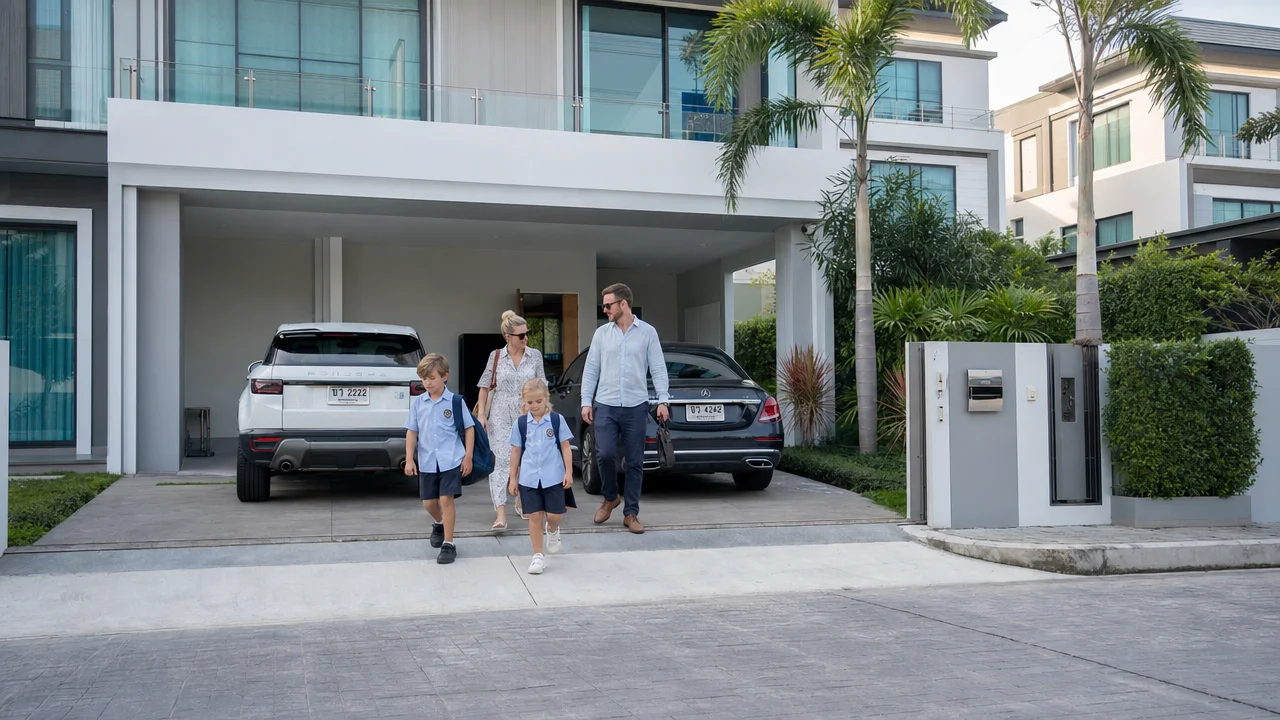
Pattaya is no longer just a resort - people are now staying to live here
In 2026, Pattaya has finally shed its image as a city for short vacations. Today, people don't come here for a week - they relocate with their families to work, educate their children, and build careers in the industrial clusters of the Eastern Economic Corridor (EEC). The reason is simple: over the past three years, the city has acquired a dense network of international schools that have attracted Western managers, automotive plant engineers, and robotics specialists. These people aren't buying studios to rent out to tourists, but townhouses and villas near schools - demand for such housing has grown by 40% since 2024, according to CBRE Thailand.
School infrastructure has become the main factor in choosing a district. Lovell International School, which opened in 2025 with a British curriculum and Reggio Emilia approach, filled its entire primary level within a year. Parents choose homes within a 15-minute radius of the campus - this includes East Pattaya, Huay Yai, and Na Jomtien. Developers have responded: the Lalin Town Pattaya-Na Jomtien project worth 650 million baht consists entirely of three-bedroom townhouses, with no studios. Developer Churat Chakarakul stated that "Pattaya now functions as a year-round city, not a seasonal resort." The figures confirm this: the share of transactions with foreigners buying property for permanent residence has grown from 22% in 2023 to 38% in early 2026.
Where expat children study - property prices rise
The global pattern works in Thailand too: the appearance of a strong school increases property values in the area by 15-25% over two years. In Pattaya, this connection became obvious after the expansion of Rugby School Thailand and the opening of Regents International School Pattaya campus in the Huay Yai area. Townhouse prices in projects around these schools rose from 3.5 to 4.8 million baht per unit from 2024 to 2026. Buyers are families of British, American, and German managers who work at factories in Rayong and Chonburi and transport their children to school by shuttle.
East Pattaya has become a family enclave. It houses Tara Pattana, Regents, and Rugby School - all three serve children from kindergarten to graduation. Houses in villages (muban) account for over 90%, with almost no condominiums. Demand is formed not by retirees, but by working parents: electric vehicle production engineers, deep-sea port logistics specialists, and IT professionals from digital hubs. They're looking for houses with three bedrooms, parking for two cars, and a garden - the classic format for a family with two children.
School buses have become a new planning criterion. Developers coordinate shuttle routes at the village design stage. A project that falls within the service radius of Rugby School or Regents gains an advantage over competitors - parents are willing to pay an extra 500 thousand baht for a house if they don't have to drive their child 40 minutes each way themselves.
The EEC industrial boom has created a shortage of family housing
The Eastern Economic Corridor isn't an abstract strategy, but real factories. In 2025, three electric vehicle plants launched in Rayong, and two robotics centers opened in Chonburi. Each factory brings 200-300 senior foreign specialists. These people receive three-to-five-year contracts, bring their families, and look for schools and houses. Hotel rooms don't interest them - they need a kitchen, washing machine, and space for bicycles.
Developers have responded by changing their product line. Back in 2023, 70% of new projects in Pattaya were studio condominiums for tourists. In 2026, the ratio changed: 55% of new launches are townhouses and houses. The Lalin Town project is a prime example: three bedrooms, 120-150 m², prices from 4.2 to 6.5 million baht, oriented toward families with school-age children. The developer signed a memorandum with Lovell International School for priority places for village residents.
The shortage of such housing is noticeable. The average sale time for townhouses in East Pattaya has shortened from 180 days in 2024 to 65 days in early 2026. Buyers often book houses at the foundation stage, paying a 500-thousand-baht deposit. This isn't speculative demand - families move in immediately after receiving keys and live for five to seven years while their contracts last.
The market is shifting from tourist yields to long-term rentals
Ten years ago, investors in Pattaya calculated short-term rental yields: a studio for 2 million baht brought 8-10% annually if it stood near the beach. In 2026, the logic has changed. Institutional buyers - funds, family offices - seek stability, not peak yields. They buy houses and townhouses, rent them to expats on contracts from one year, receive 5-6% annually, but without seasonal dips and without daily cleaning costs.
The long-term rental segment has grown. An American engineer's family rents a townhouse in Na Jomtien for 35-45 thousand baht per month, signing a three-year contract. The owner receives a predictable stream, the tenant gets stability for children who attend the same school throughout. This format attracts buyers who previously didn't consider Pattaya: Singapore funds, Hong Kong family offices, European pension portfolios.
Price volatility has decreased. When the market depended on tourists, quarterly fluctuations reached 15%. Now family housing prices grow linearly - 3-5% per year, without sharp spikes. Institutional capital prefers precisely this dynamic: less risk, more predictability.
Infrastructure retains population - tourism is no longer the main driver
Historically, property prices in Pattaya followed tourist flow. Many Chinese came - studio sales grew. Flow dropped - prices fell. In 2026, this connection has weakened. The reason is infrastructure that retains people regardless of season: the Bangkok-Pattaya high-speed railway (launching in 2027), international schools, private hospitals at the level of Bangkok Pattaya Hospital, Terminal 21 and Central Festival shopping centers.
Demographic stability has increased. Previously, Pattaya's population in winter was twice as large as in summer. Now the difference has shrunk to 20%: schoolchildren study year-round, parents work on contracts, retirees stay permanently. This stability reduces risks for developers and investors - demand doesn't disappear in low season.
Buyers ask different questions. Ten years ago they asked: "How many tourists will pass by?" Now they ask: "What school is within five kilometers? Is there a shuttle to the factory? Where's the nearest hospital?" These are questions from someone planning to live, not rent out an apartment weekly.
Market analytical maturity: comparing cities instead of impulsive purchases
The Southeast Asian property market is entering a phase of analytical maturity. Buyers have stopped acting impulsively - they compare Pattaya with Penang, Da Nang, and Bali across dozens of parameters: school quality, tax burden, cost of living, medical accessibility. Data transparency has increased: you can find statistics on prices, construction timelines, and school ratings in an hour.
Investors think like portfolio managers, not tourists. They evaluate the long-term demographic trajectory of a district, rental demand sustainability, and compliance of development density with residential standards. Projects optimized only for short-term rentals are losing attractiveness - high tenant turnover, noise, wear.
Tenant segmentation has deepened. Alongside tourist studios exists a segment of long-term professionals, retirees, and remote workers. They evaluate property by different criteria: soundproofing, living layout, parking, community culture. Buildings designed to residential standards show higher occupancy and lower turnover.
What this means for a buyer in Pattaya
If you plan to buy property in Pattaya in 2026-2027, consider the shift toward family housing and educational infrastructure. Studios in tourist areas remain liquid, but their yields are declining due to supply growth and competition with hotels. Townhouses and houses in East Pattaya, Huay Yai, and Na Jomtien are growing in price faster - 5-7% annually versus 2-3% for studios.
Check proximity to international schools. A house within a 5-kilometer radius of Rugby School, Regents, or Lovell costs 15-20% more than a similar one in a remote area, but sells three times faster. If buying for rental, target long-term tenants - expats with contracts from one year. Yields are lower (5-6% instead of 8-10%), but without empty months and marketing costs.
Pay attention to project infrastructure. The presence of a school shuttle, gated community, playground, and parking for two cars aren't decorations, but factors determining demand from families. Projects without these elements are harder to sell and rent.
Monitor the high-speed railway launch. When the train connects Pattaya and Bangkok in 40 minutes in 2027, housing demand will grow even stronger - working in the capital and living by the sea will become a real scenario for thousands of families. Areas along future stations are already appreciating: land prices have risen 30% in a year.
Conclusion: Pattaya is building a residential base
Pattaya in 2026 is a city building a sustainable residential base. People here don't vacation for two weeks - they live for years: work in the EEC, educate children in international schools, use private medicine, visit shopping centers. This shift changes the structure of property demand: from studios for tourists to houses for families, from short-term yields to long-term stability.
Educational infrastructure has become a key price growth factor. Areas around schools appreciate faster than the market, developers change product lines, investors shift from speculative purchases to portfolio logic. Pattaya has ceased to be just a resort - it's now a full-fledged city for living, working, and investing.