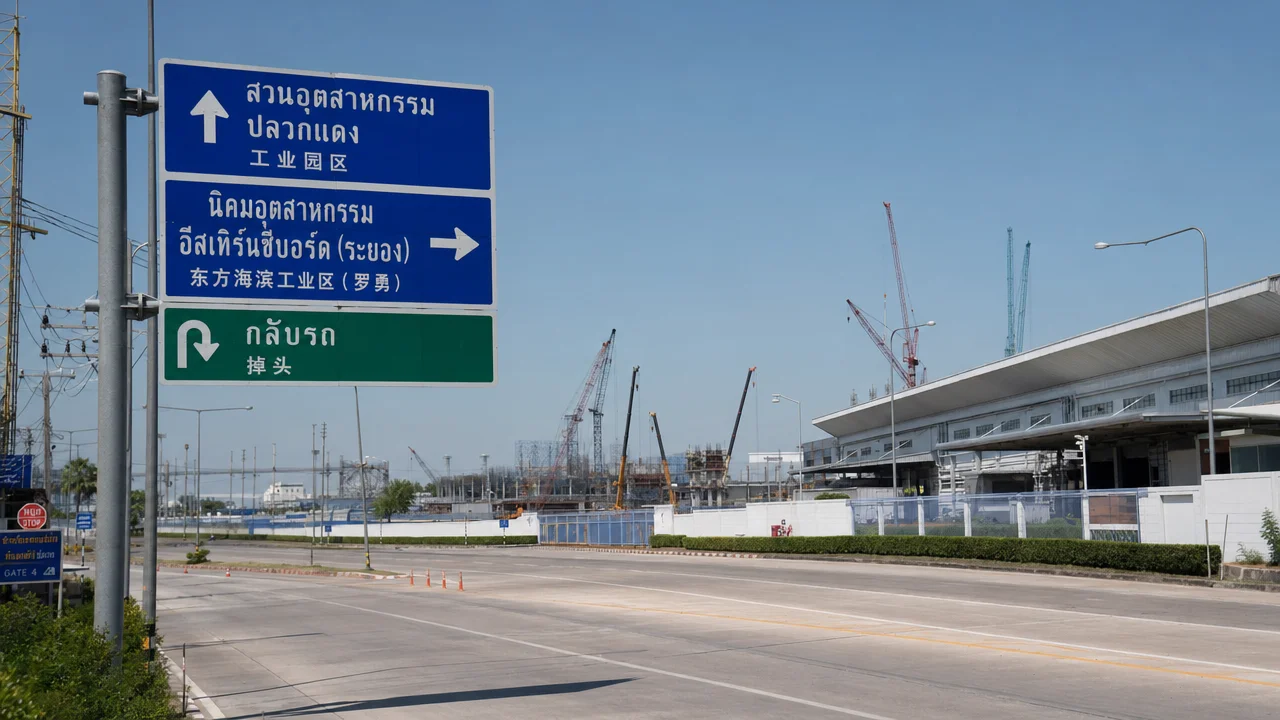

Pluak Daeng District in Rayong Province has earned the nickname "Little Guangzhou" following a massive influx of Chinese industrial investment, which has driven land prices up 44% in two years and forced local authorities to prepare a new master development plan.
According to the Rayong Chamber of Commerce, from January 2024 to March 2026, the cost of roadside plots in Pluak Daeng District rose from 2-3 million baht per rai to 5-6 million baht, with some locations reaching 40 million baht per rai - equivalent to 250 million baht per hectare. The reason - Chinese manufacturers of electric vehicles, batteries and data centers are buying up land both inside industrial zones and beyond their boundaries, creating pressure on residential development and municipal infrastructure.
Why Chinese investors chose Pluak Daeng
Pluak Daeng is located in the center of the Eastern Economic Corridor (EEC) between Pattaya and the industrial hub of Si Racha. The distance to U-Tapao International Airport is 25 kilometers, to Laem Chabang deep-sea port - 18 kilometers. This logistical accessibility has transformed the district into a priority zone for manufacturers working for export.
Chinese companies have opened factories here for producing batteries for electric vehicles, car assembly lines and more than ten data centers. Boonyuen Laohavittayarat, Secretary General of the Rayong Chamber of Commerce, reported that investors are purchasing plots outside industrial zones, where control from the Thailand Board of Investment (BOI) and EEC office is limited.
The problem is that many Chinese factories use robotic lines instead of hiring Thai workers. Chinese investment has spread to restaurants, retail stores and residential complexes that serve predominantly Chinese employees. Local entrepreneurs complain about competition, while authorities record overloading of power grids and water supply.
New master plan and investment review committee
Thailand's Department of Public Works and Town & Country Planning has accelerated the development of a master plan for Pluak Daeng to separate residential zones from industrial ones. The document will be coordinated with the EEC development plan, but will introduce stricter land use conditions taking into account projected population growth.
The Rayong Chamber of Commerce has proposed creating a provincial committee to review major investment projects before their approval. Boonyuen Laohavittayarat noted that there is currently no clear regulatory framework for data centers, which consume large volumes of electricity and water but do not fall under standard industrial norms.
Authorities are considering introducing special rules for high-resource facilities, including mandatory environmental impact assessments and limits on connection to utility networks. The goal is to preserve the economic benefits from Chinese investment, but prevent chaotic development and environmental risks.
How industrial growth affects residential real estate
Rising land prices in Pluak Daeng have directly impacted the cost of villas in neighboring residential areas of East Pattaya and Na Jomtien. Developers are competing with industrial buyers for plots, which has raised the base cost of land for residential development.
According to real estate market data, the average price of a three-bedroom villa in the Huay Yai area (East Pattaya) rose from 8.5-10 million baht in January 2025 to 10-12 million baht in April 2026 - an 18% increase. In Na Jomtien, villas with two-three bedrooms increased in price from 6-7.5 million baht to 7.2-8.8 million baht over the same period - a 15% increase.
Reasons for growth:
Land shortage. Developers factor into villa prices the cost of plots, which now cost 80-100% more than two years ago.
Infrastructure costs. Connection to power grids, water supply and roads has become 20-25% more expensive due to overloading of utility systems. Industrial facilities consume more resources than residential ones, and local authorities have increased tariffs for new connections.
Speculative demand. Some foreign investors who could not buy land directly due to restrictions on foreign ownership have switched to buying ready-made villas in anticipation of further growth. This has raised prices on the secondary market by 8-10% per year.
Condominiums fall in price amid rising villa costs
While villas are becoming more expensive, condominiums in the three EEC provinces are losing value. The condominium price index fell to 101.9 points in the first quarter of 2026 - down 1% year-on-year and down 0.3% quarter-on-quarter. This is the second consecutive decline after peaking in late 2024.
The reason is excess supply and low demand from Thai buyers who prefer houses with land. Foreign buyers are concentrated in Pattaya and Phuket, and Rayong's industrial areas do not attract them due to the lack of tourist infrastructure.
Condominium developers in Pluak Daeng and Si Racha areas are offering discounts of 10-15% plus free furniture worth 200-300 thousand baht to sell off inventory. Units of 50-70 square meters can be found for 3.5-5 million baht - 500 thousand to 1 million baht cheaper than in 2024.
Risks for villa buyers in the EEC zone
The massive land grab by Chinese companies has created legal risks for residential property buyers. Some developers purchased plots in 2024-2025 at inflated prices through schemes with Thai nominee shareholders. The Department of Business Development (DBD) is checking 20,000 companies for violations of the law on foreign land ownership.
If a developer bought land through a company with nominee shareholders, the transaction may be challenged and the land confiscated. A villa buyer who has executed a long-term land lease (leasehold) from such a developer risks losing the right to use the plot.
Check the land ownership structure before buying. Request an extract from the Land Office (Chanote, Nor Sor 4 Jor) and check the transaction history. If land was purchased in 2024-2025 at a price above 5 million baht per rai, there is a likelihood that the transaction was conducted with violations.
Alternative to villas: condominiums in foreign quota
A condominium in full ownership (freehold) is safer from a legal standpoint. A foreigner can own an apartment without restrictions if it is included in the foreign quota (up to 49% of the total building area). Prices have been falling for the second quarter in a row, and you can get a 10-15% discount plus free furniture.
The Na Jomtien and Pratumnak areas offer units of 50-70 square meters for 3.5-5 million baht. Purchasing a condominium from 3 million baht provides eligibility for a long-term LTR visa for retirees over 50 years old subject to additional income requirements, or a Privilege Entry visa for any age.
Forecast: market stabilization by third quarter 2026
The mass sell-off of industrial plots will stabilize the land market by August-September 2026. Villa developers will gain access to cheaper plots and reduce prices on new projects by 5-10%. Rayong authorities will introduce a new master plan that will limit industrial development in residential zones and simplify control over land use.
For buyers, this means it is more advantageous to wait until the third quarter of 2026, when villa prices will be adjusted and legal risks will decrease. Developers who purchased plots at inflated prices will be forced to sell villas with minimal margin or freeze projects.
What this means for a buyer in Pattaya
The situation in Pluak Daeng affects the entire real estate market of the Eastern Seaboard. Rising land prices in EEC industrial zones have pushed developers to seek plots in Pattaya residential areas, which has raised the cost of new projects by 12-18% per year.
If you are planning to buy a villa in East Pattaya, Na Jomtien or adjacent areas, now is a turning point. Prices have peaked and are beginning to correct. Wait until the third quarter of 2026, when the land market stabilizes after the sell-off of industrial assets.
Check the land ownership structure. If you are buying a villa on leasehold land, make sure the developer owns the land directly, not through a company with nominee shareholders. Request an extract from the Land Office and check the transaction history.
Avoid schemes with a Thai company. Registering a company with nominee shareholders to buy a villa is a direct path to asset confiscation in 2026. A legal alternative is a long-term land lease for 30 years with a renewal option, registered at the Land Office, or purchasing a condominium in the foreign quota.
Consider condominiums instead of villas. If your budget is up to 10 million baht, a condominium in full ownership is safer. The Na Jomtien and Pratumnak areas offer units for 3.5-5 million baht without risks associated with land leases. Purchase provides eligibility for a long-term visa subject to age and income requirements.
Monitor the new Pluak Daeng master plan. Rayong authorities will introduce stricter land use rules that may extend to neighboring Pattaya areas. This will reduce the risk of chaotic development and protect residential property buyers from conflicts with industrial facilities.