
Why Secondary Bangkok Locations Outpaced the Center in Search Queries
Social media analysis for the first quarter of 2026 revealed an unexpected picture: the Rama IX district accounted for 42% of all discussions about buying and renting condominiums in Bangkok, while Bang Na captured 75% of queries for private houses and townhouses. These figures were published by RealWatch Lab, which tracks user activity in Thai real estate groups. Central districts like Sukhumvit and Silom were left behind.
The reason is simple: buyers are seeking affordability without losing connectivity. Rama IX offers studios from 3.5 million baht with MRT access and proximity to office centers. Bang Na attracts families thanks to the BTS extension and the under-construction Yellow Line monorail. Both districts are 15-25% cheaper than the center but maintain infrastructure. For Russian-speaking investors, this demand shift raises a question: if Bangkok buyers are moving to the second line, how will this affect Pattaya?
Rama IX: Why Condos in the Office District Became a Hit Among Foreigners
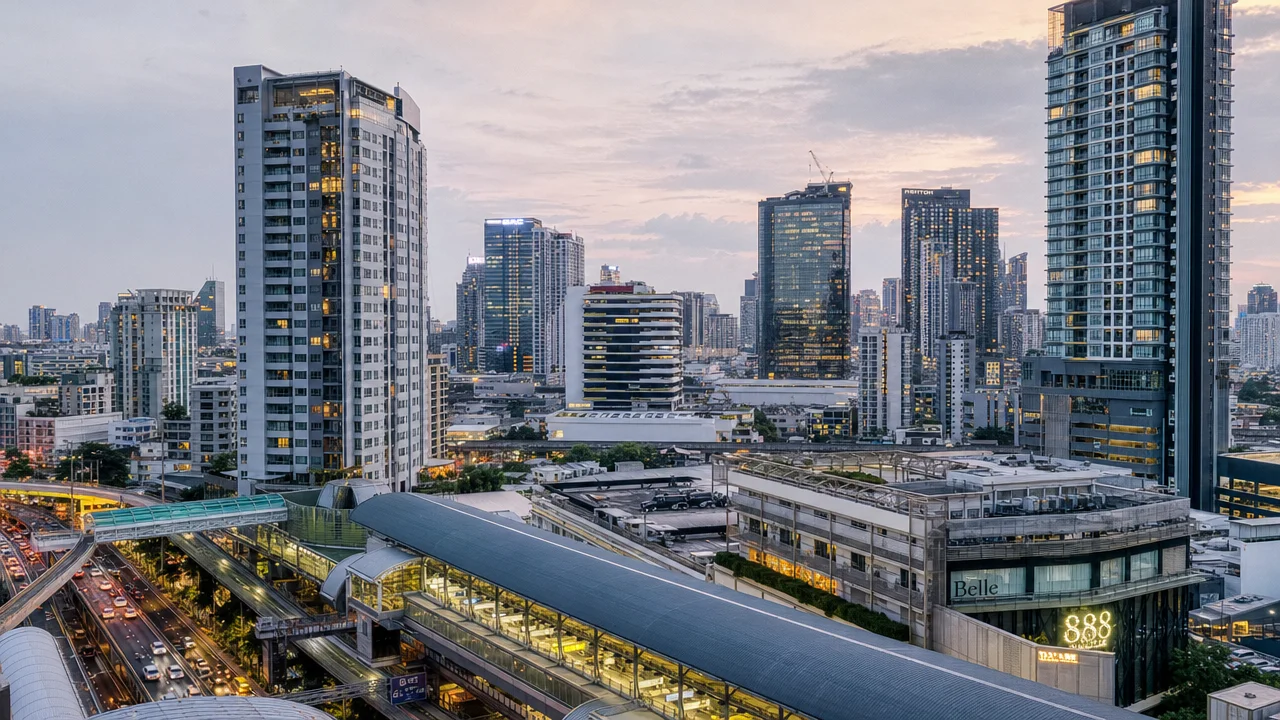
Rama IX has transformed into Bangkok's new business center over the past ten years. The MRT station connects the district to Siam in 15 minutes, while the Airport Rail Link provides direct access to Suvarnabhumi. Nearby are offices of major corporations, including headquarters of banks and IT companies. For foreign buyers, this means a stable pool of tenants: expats working on contracts and young Thais from the middle class.
The cost per square meter in Rama IX ranges from 80,000 to 150,000 baht for mid-level projects. Studios of 25-30 sqm sell for 3.5-5 million baht, two-bedroom apartments of 45-55 sqm cost 6-8 million baht. Premium complexes with panoramic windows and designer lobbies ask up to 15 million baht for spacious layouts. According to the Thai Real Estate Information Center, the average price per sqm here is 20% lower than in Thonglor or Ekkamai, but higher than in distant districts like Lat Phrao.
Rental rates hold at 12,000-20,000 baht for a studio and 20,000-35,000 baht for a two-bedroom. Yield is 4.5-5.5% per annum with proper management and minimal vacancies. The period between tenants rarely exceeds 60 days due to high demand from office workers. Legally, foreigners can own condos as full freehold property if they comply with the 49% quota and complete the FETF-foreign exchange transfer form from abroad.
Bang Na: Why Houses Attract Thais but Are Closed to Most Expats
Bang Na occupies the opposite niche. This district stretches southeast from the center along Sukhumvit Road and the expressway. Private houses, townhouses, and low-rise villages dominate here. According to RealWatch Lab data, 75% of house queries in Bangkok fall on Bang Na. The reason is proximity to Suvarnabhumi (20 minutes via toll road), presence of international schools, and BTS extension to Kheha station.
Houses in Bang Na cost from 4 to 12 million baht depending on plot size and village level. Townhouses start from 2.5 million baht. For Thai families, this is an attractive alternative to cramped condos: own yard, parking for two cars, possibility to have a dog. But foreigners face a legal wall: Thai law prohibits them from owning land plots.
The only legal way for an expat to acquire a house is to arrange long-term land lease (leasehold) for up to 30 years with the possibility of extending another 30 years. The lease agreement must be registered at the Land Office, otherwise it has no force. The tenant typically pays 50-70% of the house's market value as a lump sum for ownership, but does not receive land rights. After the lease expires, renewal depends on the will of the plot owner or their heirs. Legally, renewal cannot be enforced.
How Foreign Demand Works: Why Rama IX Works and Bang Na Doesn't
Thai Real Estate Information Center statistics for the first quarter of 2026 show: the number of new construction permits in the metropolitan region fell by 44.3%, and in the condominium segment-by 71.3%. Only 2,950 apartments received approval in three months. Developers slowed project launches due to oversaturation: according to the Real Estate Agency, Bangkok has accumulated over 350,000 unsold condos.
Foreign buyers will complete about 15,200 transactions throughout Thailand in 2026-this is 5% of the market. Growth compared to 2025 will be only 1.8%. Rama IX attracts expats precisely because it corresponds to their legal capabilities: condos can be bought as freehold, and the price remains affordable for a first acquisition in Thailand. Bang Na, on the contrary, is oriented toward Thais who buy houses for family and don't face land restrictions.
The gap between these two markets explains why demand concentrates geographically. Foreigners seek condos in districts with metro and offices. Thais choose houses in suburbs with good schools and car accessibility. Both segments avoid the center due to high prices, but their paths don't cross.
What's Happening with Prices: Rama IX Holds, Bang Na Under Pressure
Prices in Rama IX remain stable thanks to limited land supply and control by major developers. Most plots belong to institutional players who are in no hurry to sell off assets. New projects emerge in measured doses, which prevents collapse. The secondary market shows moderate liquidity: apartments sell in 3-6 months at adequate prices.
Bang Na experiences greater pressure. Developers of private villages faced slower sales: Thai families postpone purchases due to rising mortgage interest rates. The Bank of Thailand raised the base rate to 2.5% in 2025, which increased loan costs. Average house selling time grew to 8-12 months. Some developers offer interest-free installment plans for two years to accelerate turnover.
There's no direct collapse, but pressure is felt indirectly. Developers who faced problems in Bangkok are cutting new project launches across the country. This reduces competition but also freezes the market. Buyers wait for further price drops, sellers don't want to concede. A stalemate situation.
Comparison of Key Indicators of Rama IX and Bang Na
| Parameter | Rama IX | Bang Na |
|---|---|---|
| Property Type | Condominiums | Private houses, townhouses |
| Average Price per sqm | 80,000-150,000 baht | 50,000-90,000 baht (house) |
| Accessibility for Foreigners | Freehold up to 49% | Leasehold up to 30 years |
| Rental Yield | 4.5-5.5% per annum | 3-4% (long-term) |
| Transport | MRT, Airport Rail Link | BTS (under construction), roads |
| Target Audience | Expats, office workers | Thai families |
| Selling Time (resale) | 3-6 months | 8-12 months |
What This Means for Buyers in Pattaya
The demand shift in Bangkok to secondary locations creates direct consequences for Pattaya. If capital buyers prefer Rama IX to the center due to price and transport, then Pattaya finds itself in the same logic: cheaper than Phuket, more affordable financially, but with good infrastructure. The average price per sqm in Central Pattaya holds at 80,000-120,000 baht by the sea and 50,000-70,000 baht on the second line. Na Jomtien offers new projects from 60,000 baht per sqm. This is comparable to Rama IX, but with a sea bonus.
Pressure from Bangkok oversaturation is felt indirectly. Developers who froze projects in the capital are in no hurry to launch new ones in Pattaya. The number of construction permits fell nationwide. This reduces competition among new builds but also decreases choice for buyers. The secondary market becomes more active: owners who bought at the 2019-2021 peak are starting to sell with small discounts.
For Russian-speaking investors, this means three tactics. First: don't rush. Prices aren't rising, supply is wide, you can choose and negotiate. Second: check the developer and management company. Buying an apartment in a project that in two years turns into a semi-abandoned building with leaking pools is a direct path to losses. Third: focus on long-term rental and personal use. Short-term rental yield in Pattaya decreased due to tourist flow recovery in other countries. Studios and one-bedroom apartments in Central Pattaya are liquid, especially in the Walking Street and Beach Road zone.
Buyers considering Bangkok as an alternative to Pattaya should account for lifestyle differences. Rama IX suits those who work in the capital and need daily office access. Pattaya-for those who value the sea, a more relaxed pace, and the possibility to live on rental income or remote work. Legally, both options are available to foreigners through freehold condos, but Pattaya gives more freedom in location choice: from quiet Na Jomtien to bustling center.
Another factor is the foreign quota. In Rama IX, many new projects have already sold out the 49% foreign allocation, which limits choice. In Pattaya, the situation is better: developers actively work with expats, offer installment plans, and reserve quotas in advance. Quota availability can be checked through a sales office inquiry or with a lawyer who will make an extract from the Land Office.
Conclusions: Where Demand Is Moving and How to Profit from It
Rama IX and Bang Na show that the Bangkok market has divided by property type and purchasing power. Foreigners concentrate in districts with condos and metro, Thais-in suburbs with houses and schools. Both segments avoid the center due to prices, but their demands don't intersect. For an investor from Russia or CIS, this means: buy condos in second-line districts with good transport and office base. Rama IX in Bangkok, Central Pattaya and Na Jomtien on the coast-logical entry points.
Pattaya maintains an advantage in the form of sea and tourist flow, but requires more careful project selection. Developers with strong management and adequate pricing win. Old buildings and second-line objects without infrastructure lose. The market is transitioning from a growth phase to a selection phase. Winners are those who buy with a view to long-term rental, personal use, and liquidity when reselling in 3-5 years.