Foreigners Switched to Profitability: What Has Changed in Thailand's Market
Foreign property buyers in Thailand in 2026 have shifted their priorities. Instead of expensive penthouses and view apartments, investors are choosing properties with proven rental yield-income from rent. According to the Thai Department of Lands data published in April 2026, the number of registered condominium transactions increased by 18% compared to the first quarter of 2025. At the same time, the average purchase price fell by 11%. Investors are massively switching to studios and one-bedroom apartments of 26-35 m² within walking distance of the beach, expecting a net yield of 6-8% per annum after deducting all expenses.
Why Rental Yields Have Become the Main Selection Criterion
The market has stopped forgiving emotional purchases. Investors who bought two-bedroom apartments for 5-7 million baht in central Pattaya in 2023-2024 faced reality: 60-70% occupancy, high utility bills, difficulties with quick resale. Rental yield of such properties rarely exceeds 2.5-3% per annum.
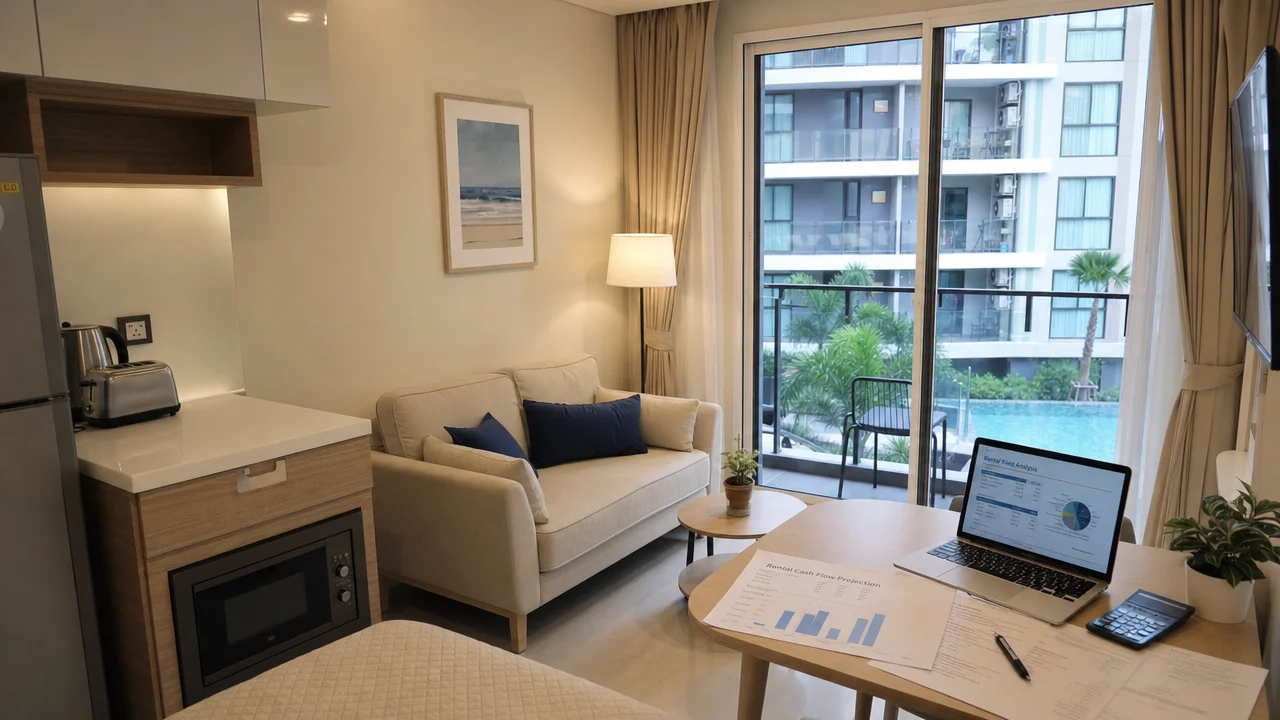
The budget segment shows the opposite picture. A studio for 2.8 million baht in the Jomtien area generates 18-20 thousand baht in rent monthly with 85% occupancy. Annual income is about 200 thousand baht. After deducting taxes, management and repair fund, 130-140 thousand remains net. Rental yield reaches 4.7-5%.
According to CBRE Thailand data published in May 2026, 62% of foreign transactions were for studios and one-bedroom apartments. A year ago, this share was 54%. Two-bedroom units accounted for 28%, three-bedroom and penthouses-only 10%. Buyers are voting with their money for liquidity and predictable cash flow.
Where Rental Yields Are Highest: Geography Has Changed
Central Pattaya lost 8% of transactions in the first quarter of 2026 compared to the same period in 2025. Wongamat dropped by 12%. Investors moved to the outskirts, where rental yields are higher due to lower entry prices and stable demand for long-term rentals.
Jomtien showed a 29% increase in registrations. Pratumnak-by 34%. Na Jomtien grew by 41%. These areas attract long-term tenants: retirees from Europe, remote workers, Eastern Economic Corridor company employees. Average rental period increased from 4.2 days in 2023 to 23 days in early 2026, according to Pattaya Hospitality Association.
Owners are restructuring their management strategy. The Base Central Pattaya project recorded an increase in the share of contracts from 30 days from 18% in 2024 to 56% in May 2026. Long-term rentals reduce dependence on seasonal fluctuations and make rental yields more predictable.
Rental Yields by Property Type: Specific 2026 Figures
The market has clearly divided by profitability. CBRE Thailand agency and RestProperty analysts publish the following rental yield ranges for foreign investors:
| Property Type | Average Price | Rental Yield | Features |
|---|---|---|---|
| Studio 26-30 m² (Jomtien, Na Jomtien) | 2.5-3.2 million baht | 6-8% | High liquidity, long-term rental |
| One-bedroom 35-45 m² (Pratumnak) | 3.8-4.5 million baht | 5-7% | Stable demand, European tenants |
| Two-bedroom 52-65 m² (central Pattaya) | 5.5-7 million baht | 2.5-4% | High expenses, difficult resale |
| Pool villa (Phuket, Samui) | 15-25 million baht | 8-12% | Requires active management, seasonality |
| Penthouse (premium projects) | 12-20 million baht | up to 3% | Long tenant search, high costs |
Villas show rental yields up to 12%, but require significant investment in maintenance: gardener, pool cleaning, repairs after each guest. Net profitability after all expenses rarely exceeds 8-9%. Entry threshold from 15 million baht makes this segment accessible to a limited circle of investors.
Condominiums in the budget segment require minimal involvement. Management company takes care of finding tenants, cleaning, minor repairs. Commission 15-20% of rental income, but the owner receives stable cash flow without headaches.
Two Investment Scenarios: Rental Yields in Numbers
Let's compare two strategies for the same amount of 5.8 million baht.
Option A: Two-bedroom apartment 52 m² in central Pattaya
Rent 25 thousand baht per month. Occupancy 70% due to high competition from old stock. Annual income: 210 thousand baht. Management expenses (18%), taxes, repair fund, utilities: 65 thousand baht. Net profit: 145 thousand baht. Rental yield: 2.5%.
Low liquidity. Selling a two-bedroom apartment at a fair price takes 6-9 months. Buyers negotiate aggressively, knowing about oversupply in this segment.
Option B: Two studios of 28 m² in Jomtien area
Price 2.9 million baht each. Rent 18 thousand baht per month each. Occupancy 85% due to affordable price and demand for long-term contracts. Annual income: 367 thousand baht. Expenses: 92 thousand baht. Net profit: 275 thousand baht. Rental yield: 4.7%.
High liquidity. Selling a studio takes 2-3 months. If one studio is vacant, the second continues to generate income. Risk is diversified.
The second option brings 90% more with the same investment amount. Rental yields are almost twice as high. This is why foreign investors are massively switching to the budget segment.
How Developers Respond to Demand for Rental Yields
Major developers have adjusted their plans to the new reality. Sansiri launched Base Central Pattaya project in February 2026-384 studios priced from 1.99 million baht. All units sold out in 72 hours. Buyers appreciated the transparent model: guaranteed 6% annual rent for three years, management through the developer's own platform.
Origin Property announced Origin Seaside Jomtien in March 2026. Layouts: 60% studios of 26-30 m², starting price 2.3 million baht. Pre-sales closed at 78% in the first month. The developer offered rental pool-a combined rental income fund where owners receive fixed payments regardless of their specific unit's occupancy.
Laguna Beach Resort 4, launched in February 2026, abandoned studios completely. The project offers 72% of units sized 40-65 m²-one-bedroom with separate bedroom and two-bedroom. Average price 4.3 million baht. The developer targets Russian-speaking buyers looking for housing for themselves with long-term rental potential.
Legal Nuances Affecting Rental Yields
Foreign ownership quota in condominiums remains at 49%. In popular projects, this quota is exhausted during construction. A buyer who comes to a completed property may find that all units for foreigners are sold. Only 30-year land lease with renewal option remains-leasehold. Rental yields from such properties are lower because leasehold is harder to resell.
Transaction verification is critical. Land Office must confirm that the apartment is registered on Chanote title (Nor Sor 4), not on an intermediate document. The seller must provide a certificate of no debts to the management company and repair fund. Debt automatically transfers to the new owner and eats into rental yields.
Currency control has tightened. Bank of Thailand requires documentary proof of source of funds for transactions over 50 thousand dollars. The buyer must provide a statement from a foreign account and Foreign Exchange Transaction Form (FETF), issued by a Thai bank upon transfer. Without this document, registering ownership in a foreigner's name is impossible.
Rental Yields and Operating Expenses: What to Consider
Many investors mistakenly calculate rental yields as the ratio of annual rent to purchase price. Real profitability is always lower due to operating expenses.
Management company takes 15-20% of rental income. Sinking fund-500-800 baht per m² annually. Utilities during vacancy-2-3 thousand baht per month. Rental tax 12.5% of income for individuals. Repairs after tenants-15-30 thousand baht once every two years.
For a studio at 2.8 million baht with 18 thousand monthly rent, the calculation looks like this:
- Annual income at 85% occupancy: 183,600 baht
- Management 18%: minus 33,048 baht
- Repair fund 28 m² × 600 baht: minus 16,800 baht
- Utilities during 2 months vacancy: minus 6,000 baht
- Tax 12.5%: minus 22,950 baht
- Repairs (averaged): minus 10,000 baht
Net profit: 94,802 baht. Rental yield: 3.4%. This is a realistic figure, not the marketing 6-7% promised by developers.
What This Means for Buyers in Pattaya
Russian-speaking investors received a window of opportunity in 2026. Chinese buyers, who comprised 61% of condo tenants in central Pattaya in 2023, decreased to 28% according to Pattaya Hospitality Association. They were replaced by European digital nomads and Russian long-term tenants. Average rental period increased, rental yields stabilized.
The secondary market is saturated with offers from sellers who bought at the peak in 2023-2024. They are ready to discount 10-15% from the original price for a quick sale. A studio for 2.6 million baht in Pratumnak area, which cost 3 million two years ago, is a real opportunity to enter the market with rental yields of 5-6%.
Jomtien and Na Jomtien areas offer the best price-to-rental potential ratio. Proximity to the beach, developed infrastructure and relative quietness attract long-term tenants. Occupancy there is consistently higher than in the center, directly affecting rental yields.
Avoid projects at foundation stage from little-known developers. Risk of construction freeze has increased. If buying at excavation stage-choose only top companies: Sansiri, Ananda, Origin, LPN. They have financial cushion and access to bank loans.
Start with analysis of specific complexes. Request occupancy data, average rental rates and current resident debts from the management company. High debt is a red flag indicating management or property quality problems. Rental yields in such projects will be lower than stated.
For Pattaya buyers in 2026, rental yields have become the main selection criterion. The budget segment offers profitability 1.5-2 times higher than premium with comparable risks. A ready property from a reliable developer in a proven area with legal transaction purity will bring stable income over a 7-10 year horizon. Cold calculation beats emotions.