


Why Data Centers Became Thailand's Main Infrastructure Priority in 2026
Thailand has approved 36 data center projects totaling 728 billion baht, and in early 2026, the Board of Investment (BOI) added seven more projects worth 96.8 billion baht. Total investments expected by 2030 reach 570 billion baht. However, the main challenge is no longer attracting capital, but the ability of the power grid, water supply, and telecommunications infrastructure to support these facilities. The Eastern Economic Corridor Office (EECO) forecasts long-term electricity demand for data centers at 10,000 MW, while the current allocation plan provides only 3,800 MW.
The gap between announced investments and actual grid capacity has turned data center location selection into an infrastructure logistics task. Land is no longer the primary criterion. Now developers are looking for sites within reach of EGAT substations, water sources, and fiber optic network hubs. This shift in priorities is changing Thailand's industrial real estate map and creating new growth points for investors ready to work with tech real estate.
How BOI Changed Incentive Criteria for Data Centers
The Board of Investment has updated tax incentive conditions, linking them not only to capital volume but also to resource efficiency. Projects meeting high efficiency criteria (Power Usage Effectiveness, PUE, water consumption, local employment) receive an eight-year corporate tax exemption of up to 100% of investment value. For standard projects, the term is reduced to five years. Exemption from import duties on equipment and the right to 100% foreign ownership remain in effect.
The 2026 innovation is a mandatory requirement for Thai workforce development and local supply chains. BOI no longer grants incentives automatically. Companies must present a plan for staff training and integration of local contractors. This is a compromise: years of tax holidays in exchange for technology and job localization.
EECO promotes the Green Data Center concept with a target PUE not exceeding 1.3. This means that for every watt of computing power, no more than 0.3 watts should be spent on cooling and infrastructure. For comparison: standard old-generation data centers operate with a PUE of 1.8-2.0. Reducing energy consumption is becoming not an environmental declaration, but a condition for receiving eight-year incentives.
Project Geography: Bangkok, Transition Zone, and Hyperscale Cluster in the East
Thailand's data center market has divided into three location profiles. Bangkok remains a connectivity hub and corporate center. Data centers that require proximity to clients and telecommunications networks are located here. Rental rates are higher, but access to fiber optic backbones and submarine cables compensates for costs.
The transition zone-Samut Prakan, Bang Na, Pathum Thani-balances Bangkok accessibility with industrial territory capabilities. Here you can find sites of 15,000-50,000 sq. m while maintaining quick connection to capital infrastructure. Rental rates for Class A industrial areas in this zone have grown 12% over the past 12 months, according to CBRE Thailand.
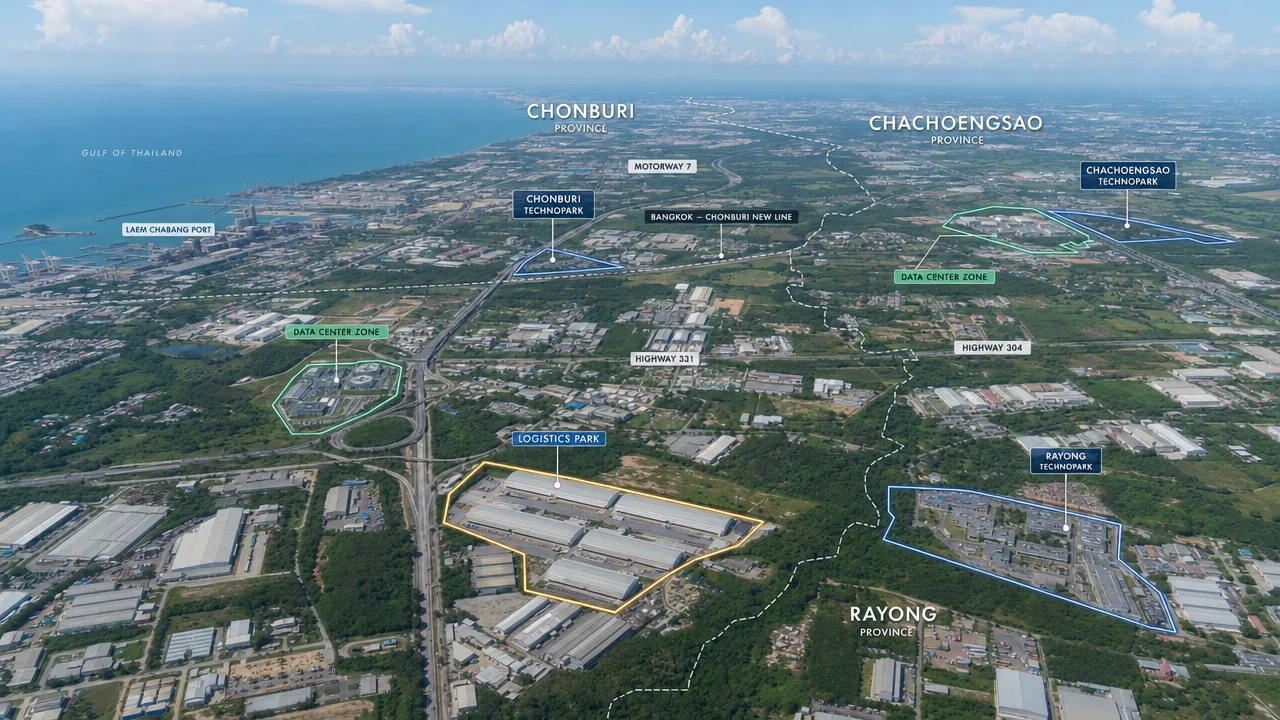
The Eastern Economic Corridor-Chachoengsao, Chonburi, Rayong-is becoming the base for hyperscale projects. These data centers require enormous areas: server halls, cooling systems, backup power, roads, security, and space for future campus expansion. EEC industrial zones can offer sites from 50,000 sq. m and above, as well as specialized infrastructure. Land plots within a 20 km radius of major EGAT substations in Chonburi province have increased in price by 18-22% over two years.
Why Electricity Became the Main Constraint
Thailand does not experience a generation deficit. Reserve capacities are sufficient. The problem is delivery. Transformer substations in EEC clusters were designed for ordinary factories, not facilities consuming 200 MW per campus. As a result, a "megawatt gap" emerged: energy exists in the system, but it cannot be allocated to specific substations within the timeframes tenants require.
EGAT has announced multi-billion (in baht) grid modernizations targeting data center corridors. Regulators are testing direct power purchase agreements (PPA) with third-party grid access. This is a structural break from the single-buyer model that will allow operators to contract renewable energy directly. The pilot framework is around 2,000 MW. Both steps affect project financing capability more than any headlines about approved investments.
Access to substation capacity has become one of the most critical variables in location selection. A "ready for sale" site does not mean "ready for data center construction" if the local grid cannot allocate sufficient capacity within the required timeframe. This constraint has already delayed several major projects in 2025.
Water as the Second Critical Resource
Data centers consume enormous amounts of energy, part of which must be removed through cooling systems. Location decisions must consider water volume, backup sources, water supply systems, and the ability to manage water during drought periods or competition with other industrial sectors. The problem is particularly acute for EEC, which already has a large industrial base, and now resources must be distributed between factories and the growing needs of data centers.
Green data centers use circular water management technologies: closed cooling loops, recirculation systems, rainwater harvesting. However, even with these solutions, primary water supply needs remain high. Locations near reservoirs and industrial water pipeline systems gain a competitive advantage.
If Bangkok adopts PPA rules in 2026, investment flow into industrial zones will accelerate. Each major project generates demand for 15,000-50,000 sq. m of buildings and adjacent infrastructure. This pushes up prices for industrial real estate and creates demand for residential rentals for highly qualified specialists.
Telecommunications: Fiber Optics and Submarine Cables
Data must move in and out of data centers with high speed and stability. A good location must efficiently connect to fiber optic networks, internet exchange points, and submarine cable systems. Bangkok maintains an advantage in telecommunications infrastructure density, but EEC is rapidly building capacity.
The high-speed railway connecting three airports (Don Mueang, Suvarnabhumi, U-Tapao) is turning the Bangkok-Chonburi-Rayong corridor into a single economic agglomeration. For data centers, this means not only equipment logistics but also access to international communication channels through submarine cables entering Eastern coast ports.
Multiple projects in one zone create an ecosystem and allow the government to plan supporting infrastructure on a cluster basis. However, this also creates risk of resource competition-especially electricity and water. EECO has stated that future planning must consider an integrated infrastructure approach, including electricity, water, fiber optics, and submarine cables, and is promoting dedicated zoning specifically for data centers.
New Logic for Location Assessment: Not Land Price, but Resource Access
Location factors for data centers in the AI era are evaluated not by price per square wah or rai. The questions are different: Is there enough electricity? Is there enough water? Is there fiber optic and connectivity? Can the area and capacity be expanded? Is system stability guaranteed? How much clean energy can be used?
Through these factors, Thailand's data center map becomes clearer. Bangkok continues to play the role of connectivity hub, but the future of hyperscale projects shifts to Samut Prakan, Chachoengsao, Chonburi, and Rayong. The next round of competition will not be about which province has the cheapest land, but which province can accommodate more data centers without encountering bottlenecks in electricity, water supply, and infrastructure.
This is a turning point for the real estate market. Data center location is no longer a matter of finding a large plot and building on it. It is creating digital infrastructure zones where electricity, water, and communication systems must be planned in parallel with land allocation.
Indirect Impact on Residential Real Estate and Local Economy
Each major data center creates 200-500 jobs for highly qualified specialists: engineers, system administrators, security specialists. These people create demand for residential rentals within a 15-30 km radius of the facility, pushing up prices for apartments and townhouses. Zones around technology parks in Chonburi and Rayong are already recording rental rate growth of 8-12% per year.
Rental yields in industrial technology parks are 7-9% per annum in baht, significantly higher than 4-6% from resort condominiums. Vacancy risk is lower, rental contracts are longer (from three to ten years), and anchor tenants are international technology corporations. This is an alternative strategy for investors accustomed to resort real estate in Phuket and Pattaya.
Foreigners cannot own land in Thailand directly, but can acquire buildings and structures, as well as obtain long-term leases (leasehold) for up to 30 years with renewal options. Special conditions for foreign investors operate in EEC zones, including the right to 49-year leases.
What This Means for a Buyer in Pattaya
The data center boom on the Eastern Coast indirectly affects Pattaya's real estate market through three channels. First-migration of highly paid specialists. Engineers and IT managers working in Chonburi and Rayong data centers often choose Pattaya for permanent residence due to developed infrastructure and international environment. Demand for quality housing in Pratumnak, Jomtien, and Naklua areas is growing.
The second channel is infrastructure improvements. Modernization of power grids, roads, and telecommunications for data centers extends to the entire Bangkok-Pattaya-Rayong corridor. The high-speed railway reduces travel time to Bangkok to 45 minutes, making Pattaya attractive for those working in the capital or EEC technology parks.
The third channel is diversification of investment strategies. Industrial real estate prices in EEC zones have already risen 18-22% over two years. Growth potential remains, but entry is worthwhile only with clear understanding of the legal deal structure and a five-year horizon. For those seeking shorter cycles and familiar environment, Pattaya residential real estate remains a stable choice with predictable yields of 5-7% in baht.
If you are considering investments in tech real estate or housing for rent to data center specialists, start with an inspection trip to the Sri Racha and Laem Chabang areas. This is the epicenter of new technology parks, and understanding local infrastructure will provide a competitive advantage when selecting properties.
Conclusions: Infrastructure Defines the Future of Tech Real Estate
Thailand is investing hundreds of billions of baht in data centers, but the success of these investments depends not on capital, but on the ability of the power system, water supply, and telecommunications to support facility operations. The gap between declared 10,000 MW demand and 3,800 MW allocated capacity creates bottlenecks that EGAT and EECO are trying to eliminate through grid modernization and pilot PPAs.
For investors, this means a shift in priorities. Land price is no longer the main criterion. Access to substations, water, and fiber optics determines where the next projects will be built. Chonburi, Rayong, and Chachoengsao provinces are becoming the center of the hyperscale cluster, while Bangkok maintains its role as a connectivity hub. Pattaya receives indirect benefits through specialist migration and infrastructure improvements, remaining attractive for those seeking balance between working in technology parks and quality of life on the coast.