

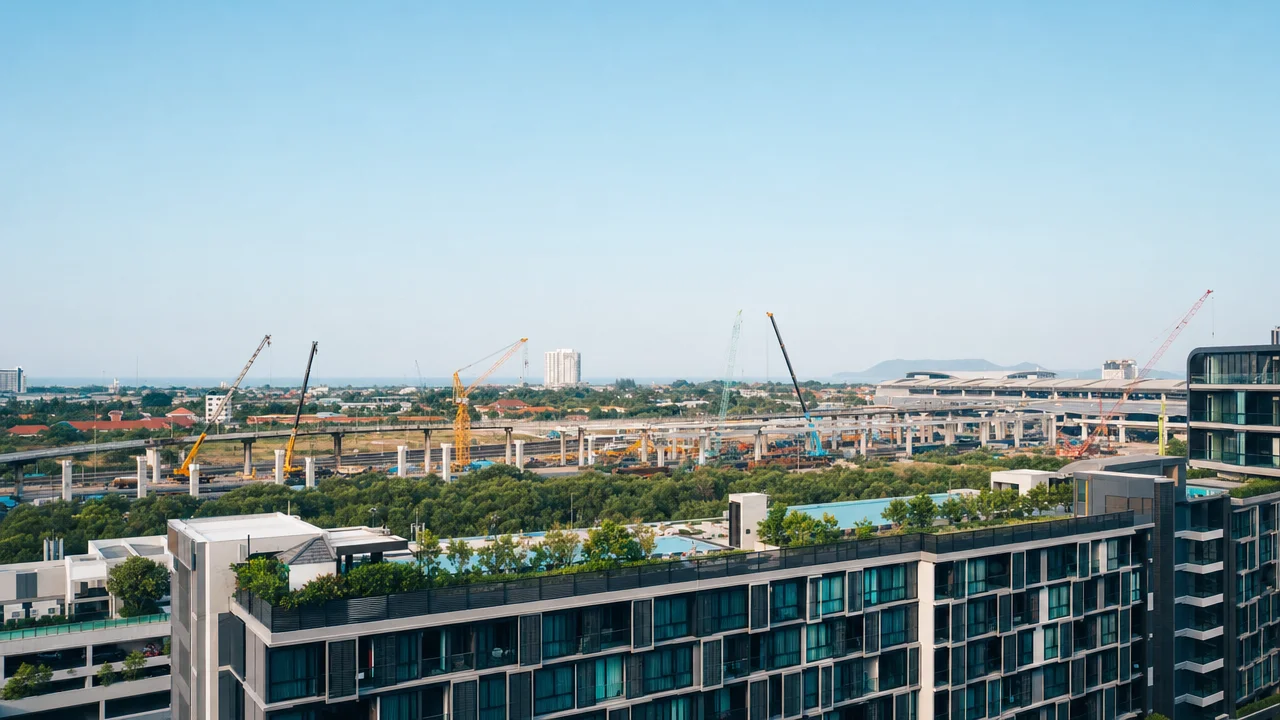

How the New Railway Line is Changing Thailand's Investment Geography
The Bangkok-U Tapao high-speed railway, being built as part of the Eastern Economic Corridor (EEC) project, will reduce travel time between Thailand's capital and the coast of Chonburi Province to 45 minutes. Currently, the car journey takes 90 to 120 minutes depending on traffic. The project will connect three airports-Suvarnabhumi, Don Mueang, and the expanded U-Tapao International Airport-into a unified transport network, making Pattaya and the eastern coast part of Bangkok's one-hour commuter zone. For the property market, this means a structural shift: the region is no longer just a resort destination but becomes a suburb of a metropolis with a population of over 10 million.
Eastern Economic Corridor: What's Behind the Infrastructure Boom
The Eastern Economic Corridor is a government development program for three provinces: Chonburi, Rayong, and Chachoengsao. The Thai government launched the EEC in 2017 with the goal of transforming the eastern coast into a center for high-tech industry, logistics, and tourism. Total investment in EEC infrastructure projects exceeds 1.5 trillion baht.
In addition to the Bangkok-U Tapao high-speed railway, the program includes expansion of Laem Chabang deep-sea port, highway modernization, and construction of new industrial zones. U-Tapao Airport, which until recently primarily served military and charter flights, is gaining status as the third international hub of the Bangkok metropolitan area with a capacity of up to 15 million passengers per year in the first phase and up to 60 million after completion of all phases.
For property investors, it's not just about transport. The EEC is attracting international corporations in automotive, electronics, biotechnology, and digital economy sectors. Job creation in the region is generating demand for housing from qualified professionals, which supports long-term rental and stabilizes investment property yields.
How the High-Speed Railway Will Change Housing Demand Geography
Travel time is one of the main factors determining the boundaries of residential agglomerations. When the journey from central Bangkok to Pattaya is reduced from two hours to 45 minutes, the economic logic of property purchase changes. Buyers gain the opportunity to live on the coast and work in the capital while maintaining an acceptable commute schedule.
Currently, most foreign buyers view Pattaya as a place for vacation or short-term tourist rental. After the high-speed line launches, a segment of buyers will emerge who need permanent housing with access to Bangkok. Demand for two-bedroom apartments with parking spaces and family infrastructure will grow, which is already reflected in new project planning.
High-speed railway stations will become new attraction points. The main Pattaya station is planned in the Ban Chang area, between the city center and U-Tapao Airport. Districts within a 5-10 kilometer radius of the station will gain accessibility advantages, which historically leads to growth in land and property prices. Similar dynamics were observed in Bangkok after the launch of BTS Skytrain and MRT subway lines.
Current Property Prices in Pattaya and Change Forecast
As of 2026, average condominium prices in Pattaya remain affordable compared to Bangkok and international resort markets. Studios in new projects start from 1.8-2.5 million baht (approximately $50,000-70,000 USD), one-bedroom apartments from 2.5 to 4 million baht, two-bedroom apartments from 4 to 7 million baht. Sea view properties in premium areas such as Wongamat or Pratamnak can cost from 8 to 15 million baht and higher.
Villas with land plots start from 5-6 million baht for properties in remote areas and reach 15-30 million baht in gated communities with infrastructure. Luxury beachfront villas or those with panoramic bay views sell for prices from 30 million baht.
After the high-speed railway launches, analysts forecast price growth of 15-25% within the first three years of operation in areas located within the transport accessibility zone from the station. Growth will be uneven: projects near the station and on routes to Bangkok will show higher dynamics than remote tourist zones.
Rental Yields: Tourists, Long-Term Tenants, and New Opportunities
Pattaya traditionally attracts investors with high rental yields. Average annual condominium yields in the city are 6-8%, which is higher than in most European capitals and major Asian cities. Tourist flow ensures stable demand for short-term rentals, but Thai legislation permits condominium rentals only for periods of one month or longer.
Many owners work with tourists by executing rental agreements for one month or more, allowing them to legally receive income. Seasonality in Pattaya is less pronounced than in Phuket or Samui: tourists arrive year-round, with peak periods from November to March, but summer months also show acceptable occupancy.
The high-speed railway will add a new tenant segment-professionals working in Bangkok or in EEC industrial zones. Demand for long-term rentals from 6 to 12 months reduces dependence on tourist cycles and ensures stable cash flow. Two-bedroom apartments with parking and work areas will be especially in demand.
Legal Conditions for Foreign Buyers in 2026
Foreign citizens can own condominiums in Thailand with full ownership rights (freehold) subject to two conditions. First: the total area of apartments owned by foreigners in one building cannot exceed 49% of the project's total area. This rule is called the foreign ownership quota and is established by the Condominium Act of 1979.
Second condition: the buyer must provide confirmation of foreign currency transfer into Thailand for the purchase amount. The bank issues a Foreign Exchange Transaction Form (FET), which is submitted to the Land Office when registering ownership rights. Without FET, registration is impossible.
It's important to verify available foreign quota in the project before signing the contract. If the quota is exhausted, a foreigner will not be able to register ownership in their name, even if money has already been transferred. Professional agencies check the quota at the property selection stage.
Foreigners cannot purchase land directly. Villas with land plots are usually registered through long-term land lease (leasehold) for up to 30 years with the possibility of extension for two more 30-year periods. An alternative option is registering a Thai company that owns the land, but this scheme requires compliance with strict corporate rules and is not recommended without legal support.
Taxes and Fees for Property Purchase and Ownership
From June 30, 2026, Thailand has an updated registration fee reduction program approved by the Cabinet of Ministers. The program is extended until June 30, 2027, and applies to properties valued up to 7 million baht. The standard ownership transfer registration fee is 2% of the assessed value, but under the program it is reduced to 0.01%. The mortgage registration fee, if executed simultaneously with purchase, is also reduced from 1% to 0.01%.
The program applies to houses, townhouses, commercial buildings, land with such structures, and condominiums. Foreign buyers are entitled to preferential fees under the same conditions as Thai citizens if the property meets price and assessed value criteria.
After purchase, the owner pays annual Land and Building Tax, introduced from January 1, 2020. For residential property, the rate is 0.02% of assessed value for properties up to 40 million baht, 0.03% for properties from 40 to 65 million baht, 0.05% for properties from 65 to 90 million baht, and 0.1% for properties over 90 million baht.
Thai citizens registered at their place of residence in their own apartment receive exemption from tax on the first 50 million baht of assessed value. Foreign condominium owners cannot be registered in the house registration book at that address, so the exemption does not apply to them. For a typical Pattaya condominium with an assessed value of 5-10 million baht, annual tax is 1,000-2,000 baht.
Rental income is taxable. Non-residents of Thailand (those who stay in the country less than 180 days per year) pay withholding tax at a rate of 15%. Residents file income tax returns and pay progressive income tax at rates from 0% to 35% depending on income amount. Landlords can deduct 30% of income as standard expenses without documentation or claim actual expenses if documents are available.
Purchase Financing: Is Mortgage Available for Foreigners
Thai banks provide mortgage loans to foreign citizens, but conditions are stricter than for Thai citizens. Maximum loan amount usually does not exceed 50-70% of property value (loan-to-value ratio). Interest rates for foreigners are 5.5-8% per annum depending on the bank, borrower profile, and project.
The Bank of Thailand from July 1, 2026, to June 30, 2027, relaxed loan-to-value ratio restrictions for housing loans, which simplified access to financing. The borrower must confirm stable income, provide employment certificates, bank statements, and documents confirming legal stay in Thailand.
An alternative option is developer financing. Some developers offer installment plans during construction without interest or with minimal rates. The buyer makes a down payment of 20-30%, paying the rest in installments until project completion. After property handover, a bank mortgage can be arranged to pay off the remaining amount to the developer.
What This Means for Buyers in Pattaya
For Russian-speaking investors considering property purchase in Pattaya, the launch of the Bangkok-U Tapao high-speed railway opens several new opportunities. First-growth in property capitalization within the transport accessibility zone. Buying an apartment now, before the line becomes operational, allows fixing prices at resort market level and gaining value appreciation after the region's integration into the Bangkok metropolitan area.
Second opportunity-rental income diversification. In addition to tourists, a long-term tenant segment will emerge: professionals working in Bangkok or in EEC industrial zones. Two-bedroom apartments with office areas and parking will become more liquid than studios oriented only toward tourists.
Third opportunity-project selection considering new infrastructure. Areas near the future high-speed railway station and on routes to Bangkok will gain advantages. It's worth paying attention to projects in the eastern part of Pattaya, between the city and U-Tapao Airport, as well as properties in Jomtien and Na Jomtien, which maintain a balance between transport accessibility and resort atmosphere.
The registration fee reduction program is valid until June 30, 2027. Buyers who complete transactions before this date save up to 140,000 baht on properties valued at 7 million baht. After the program expires, fees will return to standard 2% and 1%, increasing transaction closing costs.
It's important to work with agencies that verify property legal status, foreign quota availability, and correct documentation for the Land Office. Errors at the registration stage can lead to ownership transfer denial, even if money has already been transferred to the developer. Professional support reduces risks and accelerates the process.
Conclusion
The Bangkok-U Tapao high-speed railway and the Eastern Economic Corridor development program are changing Pattaya's status from a resort city to a suburb of a metropolis with a developed economy. Reducing travel time to 45 minutes expands the buyer pool, increases long-term rental demand, and creates conditions for price growth in areas with good transport accessibility. Buying property in Pattaya in 2026 is an opportunity to enter the market before key infrastructure projects are completed and lock in prices at a level that may become unaffordable in a few years.