

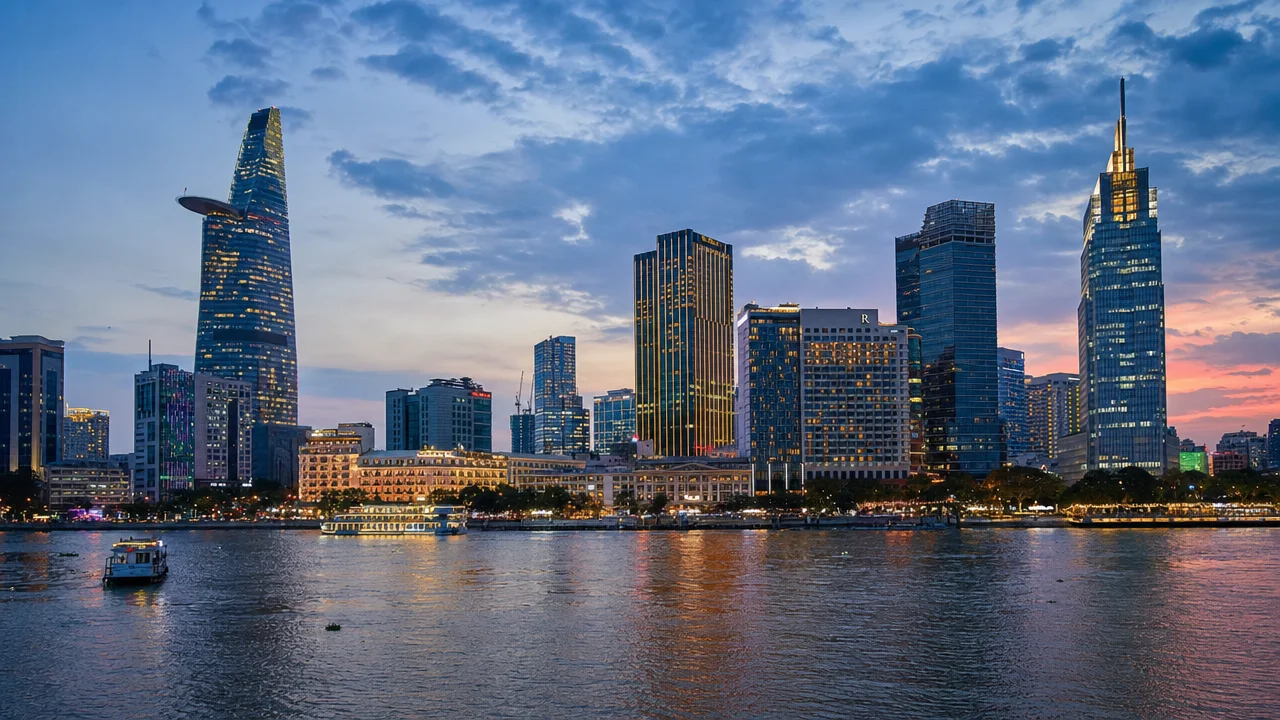

Vietnam Becomes Leader in Wealth Growth in Asia-Pacific Region
Analysts at New World Wealth forecast that Vietnam will demonstrate the highest rate of private capital accumulation among all countries in the world over the next decade - 125% growth by 2035. The indicator is measured both by GDP per capita growth and by the increase in the number of dollar millionaires. India ranks second with expected growth of 110%, while Thailand, the region's traditional magnet for foreign investment, remains outside the top three leaders.
According to New World Wealth data as of early 2025, Vietnam has 19,400 millionaires and 58 billionaires. Company analyst Andrew Amoils notes that the country is becoming the preferred manufacturing base for international technology, automotive, electronics, and textile corporations. Strategic location - a land border with China and proximity to major maritime trade routes - combined with low labor costs makes Vietnam the "number one destination" for global investors.
Three Decades of Growth: How Vietnam Built a Middle-Income Economy
The French Development Agency (AFD) in its three-year assessment of the Vietnamese economy, conducted since early 2023, recorded an average annual growth rate of 7% over the past thirty years. The country has moved into the category of middle-income countries and signed numerous free trade agreements, integrating into global value chains.
Hervé Conan, AFD Director in Vietnam, emphasizes that the country maintained impressive growth rates even amid high inflation that affected most global economies in 2022-2024. The domestic market with a hundred million population remains an important advantage. Manufacturing activity continued uninterrupted even during the COVID-19 pandemic years.
The World Bank notes that ten years ago, Vietnam's GDP per capita was about $2,190 USD. Today this indicator has nearly doubled and reached $4,100. Growth has affected most segments of the population, making it socially sustainable.
Four Waves of Foreign Direct Investment: From Textiles to High Technology
Brian Lee, economist and Assistant Vice President at Maybank, identifies three completed waves of foreign direct investment (FDI) in Vietnam over the past thirty years. The first wave focused on light industry and textiles in the 1990s. The second - on electronics and auto components in the 2000s. The third - on high-tech manufacturing and logistics in the 2010s. Now the country is on the threshold of a fourth wave, related to semiconductors, artificial intelligence, and green energy.
However, Lee warns of risks. Vietnam's workforce needs deeper training to perform complex knowledge-intensive tasks. Labor productivity remains lower than in Thailand or Malaysia. The potential for technology transfer from foreign companies to local manufacturers is not fully utilized due to weak cooperation between international corporations and Vietnamese contractors.
Comparison with Thailand: Why Investors Are Reallocating Capital
Thailand has long remained the main recipient of FDI in mainland Southeast Asia. However, political instability of the 2010s, population aging, and slow adoption of digital technologies have reduced the country's attractiveness for new manufacturing. According to the Thailand Board of Investment (BOI), in 2024 the volume of approved FDI projects amounted to 687 billion baht (about $19.6 billion), which is 12% lower than the 2023 figure.
Vietnam, in contrast, attracted about $36.6 billion in foreign direct investment in 2024, according to the Ministry of Planning and Investment of Vietnam. The difference is almost twofold. The largest investors - South Korea, Singapore, and Japan - are actively relocating production facilities from China and Thailand to Vietnam.
Consulting firm McKinsey explains Vietnam's success as a combination of three factors: geographic proximity to China allows use of existing logistics routes, labor costs are 20-30% lower than in Thailand, and infrastructure of export zones is developing faster thanks to targeted government programs.
Impact on Real Estate Market: Growing Demand for Commercial and Residential Properties
The increase in the number of millionaires directly affects demand for premium real estate. According to Knight Frank Vietnam, the average price per square meter in new condominiums in Ho Chi Minh City increased by 18% in 2024 and reached $4,200 per square meter in central business district areas. Hanoi showed 14% growth, to $3,600 per square meter.
For comparison: in Bangkok, the average price of new premium housing in central districts is about $6,800 per square meter, according to CBRE Thailand for the fourth quarter of 2024. In Pattaya, similar properties cost $3,200-4,500 per square meter. The Vietnamese market is still cheaper, but price growth rates are higher.
Commercial real estate is also experiencing a boom. Class A office rental rates in Ho Chi Minh City increased by 9% over the year and amounted to $48 per square meter per month. Vacancy decreased to 6.2%, indicating a supply shortage. Logistics facilities near ports and industrial zones are rented at 100% capacity even at the construction stage.
Risks and Limitations: What Could Slow Vietnam's Growth
Despite optimistic forecasts, experts identify several risk factors. The first - restrictions on foreign property ownership. In Vietnam, foreign citizens can own no more than 30% of apartments in one residential complex and no more than 10% of land plots in one district. The ownership term is limited to 50 years with possibility of extension. These rules are stricter than in Thailand, where foreigners can own up to 49% of condominium area on freehold basis without time limitation.
The second risk - bureaucracy. The property registration process in Vietnam takes an average of 57 days, according to the World Bank, while in Thailand - 4-7 days with all documents available. Transaction transparency also remains a problem: Transparency International's 2024 Corruption Perceptions Index places Vietnam at 83rd place (41 points out of 100), Thailand - at 104th (35 points), making both countries high-risk zones for foreign investors.
The third factor - infrastructure. Despite rapid development, Vietnam lags behind Thailand in road quality, availability of international schools, and Western-level medical facilities. For affluent expats seeking not only investment returns but also high quality of life, Thailand remains more attractive for now.
What This Means for Buyers in Pattaya
Vietnam's rise as an investment destination does not negate Thailand's advantages, but changes the balance of power in the Southeast Asian market. For Russian-speaking buyers considering property in Pattaya, three practical consequences emerge.
First: competition for capital is intensifying. Developers in Thailand are forced to offer more flexible terms to retain investors. In 2025, several major developers in Pattaya launched guaranteed return programs of 6-7% annually for three years for foreign buyers. Such offers were rare in 2020-2023. Buyers get more negotiating leverage.
Second: portfolio diversification. Investors who already own property in Thailand are beginning to consider Vietnam as an additional destination. However, it's important to understand the difference in legal regimes. In Thailand, a foreigner can buy a condominium in full ownership and pass it on by inheritance without restrictions. In Vietnam, property rights are limited to 50 years, making the property less liquid in the long term. For speculative investments of 5-10 years, Vietnam may be interesting, but for long-term ownership Thailand remains more reliable.
Third: price growth in Pattaya may slow down. If some Asian and Western investors redirect capital to Vietnam, demand for Thai real estate will decrease. According to CBRE Thailand forecasts, condominium price growth in Pattaya in 2026 will be 3-5%, which is lower than the average of 7-9% in 2022-2024. For buyers, this means an opportunity to negotiate a discount or receive additional bonuses - furniture package, transfer cost coverage, free management for a year.
Thailand retains advantages in the form of developed infrastructure, transparent legal system for foreigners, and high quality of life. Vietnam offers higher growth rates, but with greater risks and restrictions. The choice depends on investment horizon and readiness for legal complexities. For those seeking stability and simplicity of ownership, Pattaya remains the optimal option in the region.