Building Permit Issuance in Pattaya Falls to Two-Decade Low
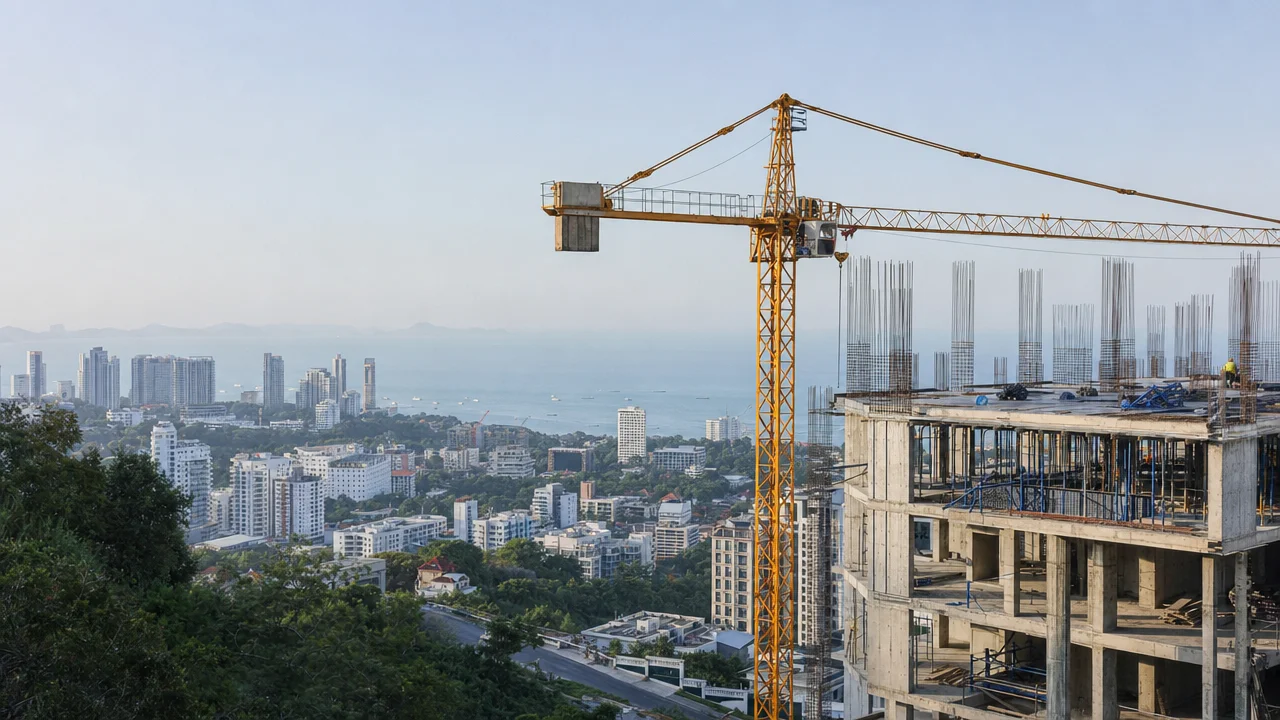
Developers in Pattaya and Thailand's Eastern Seaboard are scaling back new project launches amid a sharp decline in building permit issuance and land allocation for development. According to the Chonburi Province Land Department, the number of approved condominium building permits in the first half of 2026 decreased by 43% compared to the same period in 2025 - down to 127 permits from 223 the previous year. This is the lowest figure since 2006, when statistics for individual Pattaya districts began being tracked.
Pratumnak and Na Jomtien: Land Shortage Changes Market Structure
The most significant decline was recorded in Pratumnak and Na Jomtien - traditional zones of active development for foreign buyers. The number of allocated land plots for residential development in these areas decreased by 38% over the past 18 months. The reason is the depletion of available plots with Chanote title deeds (Nor Sor 4), which allow foreigners to purchase condominium units with full ownership rights.
In the Pratumnak Hill area, fewer than 20 plots ranging from 3 to 8 rai (4,800-12,800 m²) suitable for high-rise construction remain. Most land is already developed or privately owned by Thai families not planning to sell. Na Jomtien faces a similar situation: beachfront plots are virtually unavailable, and first-line land prices have risen to 180-220 million baht per rai (approximately 112-137 million baht per hectare).
Pattaya City administration has introduced additional restrictions on building heights in coastal zones - no more than 23 floors for new projects approved after January 2026. This reduces construction profitability for major developers who previously planned towers of 35-40 floors.
How Supply Decline Affects Prices: Statistics by District
The shortage of new projects is already reflected in prices. According to DDproperty, the average price per square meter in new Pratumnak condominiums rose from 89,000 baht at the end of 2025 to 104,000 baht in July 2026 - a 16.8% increase over seven months. In the secondary market, prices grew more moderately: from 76,000 to 82,000 baht per m² (7.9% growth).
Na Jomtien shows different dynamics. The average price in new developments was 92,000 baht/m² in July 2026 versus 84,000 baht/m² in December 2025 (+9.5%). The secondary market showed minimal growth - 68,000 baht/m² versus 66,000 baht/m² (+3%).
The difference is explained by demand structure. Pratumnak traditionally attracts premium segment buyers - Europeans and wealthy Asian investors willing to pay for bay views and proximity to infrastructure. Na Jomtien has more mid-range projects oriented toward long-term rentals and retirees with limited budgets.
Developer Response: Shifting Focus to Banglamung and Huay Yai
Major developers are redirecting investments to Banglamung and Huay Yai districts, where land is cheaper and administrative restrictions are fewer. Sansiri launched the Base Central Pattaya project in the Nong Prue area (Banglamung) in May 2026 - a condominium with 1,248 units priced from 1.89 million baht for a 24 m² studio. The project is located 4.5 km from Jomtien Beach but compensates for the distance with developed internal infrastructure: two pools, co-working space, and an 800 m² fitness center.
Origin Property has focused on Huay Yai - a zone 15 km from central Pattaya where land prices are three times lower than in Pratumnak. In June 2026, the company announced the Origin Huay Yai Retreat low-rise project with 384 units priced from 2.1 million baht for a 32 m² one-bedroom apartment. The target audience is Thai buyers and long-term tenants working in the Eastern Economic Corridor (EEC) industrial zone.
According to the Thai Condominium Association, the share of projects launched outside Pattaya's traditional tourist zone (Pratumnak, Jomtien, Wongamat) grew from 22% in 2025 to 41% in the first half of 2026.
Why Developers Are Not Rushing to Launch New Projects: Four Factors
The first factor is rising construction costs. Cement prices in Thailand increased by 11% from January to June 2026 due to higher coal and logistics costs. Reinforcement steel prices rose by 8%. The average construction cost per square meter in a middle-class condominium increased from 38,000 to 42,000 baht.
The second factor is stricter project financing requirements. Since March 2026, the Bank of Thailand requires developers to pre-sell a minimum of 35% of units (previously 25%) before obtaining construction loans. This delays project launches by 4-6 months.
The third factor is uncertainty regarding visa policies for long-term residents. The Long-Term Resident Visa (LTR) program, launched in 2022, has not shown expected results: fewer than 18,000 visas have been issued over four years versus the projected 50,000. Developers who were counting on an influx of wealthy foreigners are revising their marketing strategies.
The fourth factor is excess supply in the secondary market. According to CBRE Thailand, approximately 14,600 apartments in completed condominiums are listed for sale in Pattaya - 22% more than a year ago. Average time on market increased from 4.2 to 5.8 months. Developers fear that new projects will compete not only with each other but also with declining secondary market properties.
Second Half 2026 Forecast: Stabilization or Further Decline
Analysts at Colliers Thailand expect permit numbers to stabilize at 220-240 per year through the end of 2027. This is half the peak 2018 figure (487 permits) but sufficient to maintain market supply.
Knight Frank Thailand chief economist Piti Dissakul forecasts new construction prices in Pratumnak will rise another 8-12% by the end of 2026. Na Jomtien will see more modest growth - 4-6%. The secondary market will remain under pressure: owners will be forced to reduce prices by 5-7% to accelerate sales.
An increase in the share of low-rise projects (up to 8 floors) and townhouses in total construction volume is expected. Such properties require smaller investments, have faster payback periods, and are in demand among middle-class Thai buyers.
What This Means for Russian Buyers in Pattaya
For Russian-speaking buyers, the current situation creates both risks and opportunities. The shortage of new projects in Pratumnak and Na Jomtien means prices in these areas will rise faster than inflation. If you were planning to purchase a sea-view apartment for personal residence or tourist rentals, delaying the decision is disadvantageous. Apartments in projects receiving building permits in 2026-2027 will cost 10-15% more than similar units launched in 2024-2025.
Simultaneously, the secondary market becomes more attractive. Owners of apartments purchased at the 2018-2019 peak are ready to sell with 10-12% discounts from original prices. This is an opportunity to acquire property in a completed condominium with developed infrastructure at below-market prices. Document verification (due diligence) is mandatory: ensure the apartment is free of encumbrances and the condominium complies with the 49% quota for foreign owners.
Buyers with limited budgets should consider Banglamung and Huay Yai districts. Yes, they're farther from the beach, but infrastructure is developing rapidly: shopping centers, international schools, and medical clinics are opening. Projects in these zones offer more space for the same money - the difference can reach 30-40%.
If the purchase goal is investment with subsequent resale, focus on projects by major developers (Sansiri, Origin, Pruksa) within 3 km of the beach. Such properties are more liquid and easier to sell to both Thais and foreigners. Avoid studios smaller than 24 m² - demand for them is falling, and banks are reluctant to issue mortgages for such units.
Administrative Changes: What to Know Before Buying
Since April 2026, the Chonburi Province Land Office has introduced mandatory source of funds verification for all foreign buyers purchasing property valued over 5 million baht. Bank statements for the past six months and documents confirming the legal origin of funds must be provided. The procedure takes 10-15 business days and may delay ownership registration.
Money transfer rules from abroad have changed. The Bank of Thailand requires the payment order to specify the transfer purpose - "purchase of condominium unit." Without this notation, the receiving bank will not issue a Foreign Exchange Transaction Form (FETF), which is necessary for registering the apartment to a foreigner at the Land Office.
The ownership transfer tax remains at 2% of cadastral value, but some Pattaya districts (including Pratumnak) increased cadastral valuations by 15-20% from January 2026. This effectively increased the tax burden on purchases.
Alternative Strategies: Land Purchase and Construction
Some wealthy buyers are considering land purchase and villa construction as an alternative to condominiums. A 400-600 m² plot in Huay Yai or Ban Amphur can be purchased for 4-6 million baht. Construction of a 150-200 m² villa will cost 6-8 million baht. Total cost - 10-14 million baht versus 15-18 million for a comparable developer villa.
Limitation: foreigners cannot own land in Thailand with full ownership rights. Options include long-term land lease (leasehold) for 30 years with renewal rights, or purchase through a Thai company (requires legal support and annual audits).
Construction takes 10-14 months. During this time, work quality can be controlled and materials chosen. Risk - dependence on contractors and possible delays due to construction material or labor shortages.
Conclusions: Pattaya Real Estate Market Enters Supply Shortage Phase
The reduction in building permit issuance and land shortages in popular districts are shifting the supply-demand balance in favor of sellers. Prices for new construction in Pratumnak and Na Jomtien will rise faster than market averages. Secondary housing will become more competitive, especially if owners are flexible in negotiations.
For Russian buyers, this is the time to make decisions, not wait. Projects launched in 2024-2025 are still available at relatively low prices. In a year, the situation will change: supply will shrink and prices will rise by 10-15%. Choose districts with developed infrastructure, verify developer reputation, and don't skimp on legal transaction support.