

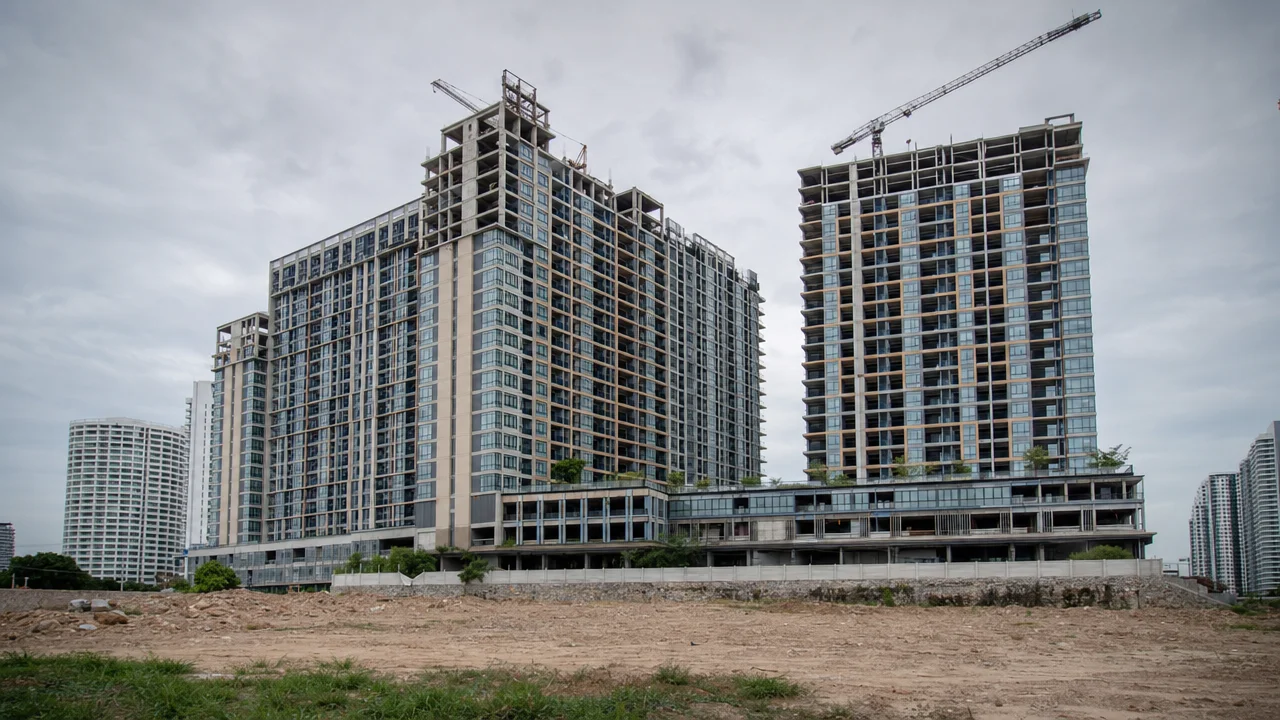

Three Developer Associations Appeal to Government for Emergency Measures
Thailand's real estate market is experiencing a prolonged downturn that has prompted the largest industry associations to make an open appeal to authorities. Although the Cabinet on June 30, 2026, extended preferential registration fee rates until June 30, 2027, developer representatives argue: this is not enough. The Ministry of Finance forecasts that extending the measure will stimulate transactions worth approximately 540,810 million baht annually and add 1.06% to GDP. However, developers insist on more radical steps.
What Exactly the Government Extended
The Cabinet decided to maintain reduced registration fee rates for another year. Ministry of Interior notifications were published in the government gazette on July 1, 2026. The measures apply to purchases and mortgage lending of residential and commercial real estate subject to certain conditions.
The property registration fee rate has been reduced from the standard 2% to 0.01% of the appraised value. Mortgage registration costs 0.01% of the loan amount instead of the standard 1%. The benefit applies only when purchase and mortgage are registered simultaneously.
Who Can Use the Benefit
Requirements for the property and buyer are strictly defined. The buyer must be a Thai citizen-an individual. Foreigners are not covered by this program, which limits its applicability for Russian-speaking investors.
Eligible real estate includes detached houses, townhouses, commercial buildings, land with such structures, and condominium units. The purchase price, official appraisal, and mortgage amount must not exceed 7 million baht for each parameter. Partial sale of shares is excluded.
| Parameter | Standard Rate | Preferential Rate (until 30.06.2027) |
|---|---|---|
| Property registration | 2% of appraisal | 0.01% of appraisal |
| Mortgage registration | 1% of loan amount | 0.01% of loan amount |
| Maximum property value | No restrictions | 7 million baht |
| Buyer | Anyone | Thai nationals-individuals only |
Why Developers Are Dissatisfied
Fee reductions help Thai buyers save several tens of thousands of baht on transactions. For a property worth 5 million baht, savings will be approximately 99,500 baht on property registration and the same amount on mortgage. But developers point out: the problem runs deeper.
New property sales in major cities have fallen due to economic uncertainty and consequences of the Middle East conflict, as directly stated in government materials. The population's purchasing power is declining. Developers face rising construction costs, project freezes, and falling profitability.
Industry associations demand expanded support measures. Proposals include removing the buyer citizenship restriction, raising the value threshold to 10-15 million baht, tax deductions for investors, and simplifying credit procedures. So far, the government has not responded to these initiatives publicly.
Investment Visa as an Alternative Stimulus
Parallel to tax benefits, authorities are developing a program to attract foreign capital through real estate. An investment visa based on property purchase has become available for any age with an investment from 3 million baht in a condominium with full ownership rights or when renting housing worth from 85,000 baht per month.
The purchase must be registered to a foreigner with funds transferred from abroad. The Immigration Bureau verifies the transaction through the Land Office within 30-45 days, after which it issues a one-year visa with renewal rights. This mechanism works independently of registration fee benefits and is specifically oriented toward non-residents.
Thus, foreign buyers retain the opportunity to obtain long-term residence through investment, but transaction registration savings are unavailable to them.
Land and Buildings Tax Remains at Full Rate
Since 2020, Thailand has had an annual land and buildings tax that replaced the previous fee system. Reduced rates applied in the first years, but by 2026 the government did not extend discounts. Tax is calculated at full rates depending on the property's purpose.
For residential real estate valued up to 50 million baht, the rate is 0.02%, from 50 to 75 million baht-0.03%, from 75 to 100 million baht-0.05%, over 100 million baht-0.1%. Commercial real estate is taxed at 0.3-0.7% depending on appraisal. Vacant plots may be subject to increased rates up to 1.2%.
Tax is paid annually by the end of April. Local administrative organizations may provide additional benefits at their discretion, but there are no nationwide discounts for 2026. Owners must account for these expenses when planning property ownership budgets.
Loss of Local Budget Revenue
Reducing registration fees has hit the finances of local administrative organizations that receive part of these revenues. The Cabinet instructed the Budget Bureau and relevant agencies to find funds to compensate for lost revenue so municipalities can continue normal operations.
However, the compensation mechanism has not yet been publicly detailed. Local authorities fear a shortage of funds for infrastructure and social programs, especially in resort zones where the share of real estate transactions in the budget is traditionally high.
What This Means for a Buyer in Pattaya
For foreign investors considering purchases in Pattaya and the Eastern Seaboard, the current situation has several practical consequences. Preferential registration fees are unavailable to non-residents, so savings on this expense item won't work. You still pay the standard 2% when registering ownership of a condominium.
Pressure on developers may lead to price reductions in the primary market or special promotions for foreign buyers. Developers are interested in quick inventory turnover, and this opens room for negotiations. Projects launched in 2024-2025 are now reaching completion stage, and sellers are motivated to close deals.
The investment visa remains a working tool for those planning long-term residence. The 3 million baht threshold corresponds to the mid-price segment in Pattaya-studios and one-bedroom apartments in new projects with sea views or in central districts. Visa processing adds value to the purchase, turning real estate into an asset with additional function.
The secondary market in Pattaya currently offers more opportunities than the primary market. Owners facing rising operating costs and lack of tenants after the pandemic are ready to sell at a discount. Checking the legal cleanliness of the property and ownership history becomes critically important-the market is saturated with offers, and haste can turn into problems.
Land and buildings tax now constitutes a noticeable expense item for owners of expensive real estate. An apartment worth 10 million baht will cost 20,000 baht in annual tax, which needs to be factored into return calculations for investment purchases. For properties valued over 50 million baht, the tax burden grows progressively.
If the government accommodates developers and extends benefits to foreign buyers, this will signal market activation. Until such a decision is made, a reasonable strategy is careful property selection, tough price negotiations, and focus on liquid locations with proven infrastructure. A buyer's market gives an advantage to those ready to act without haste and with full understanding of legal nuances.
Conclusions
Extending registration fee benefits until mid-2027 supports Thai economy and middle-class home buyers but doesn't solve systemic market problems. Developers continue to demand broader measures, including foreign access to the program and raising the value threshold. The government balances between stimulating demand and protecting local budget revenues.
For buyers from Russia and CIS countries, the investment visa and secondary market opportunities are of key importance. Reduced developer activity creates a window for profitable purchases but requires increased caution when checking properties. Thailand's real estate market is entering a correction phase, and the next 12-18 months will show how effective the support measures prove to be.