
Circular of May 15, 2026 Changed Land Transaction Registration Rules
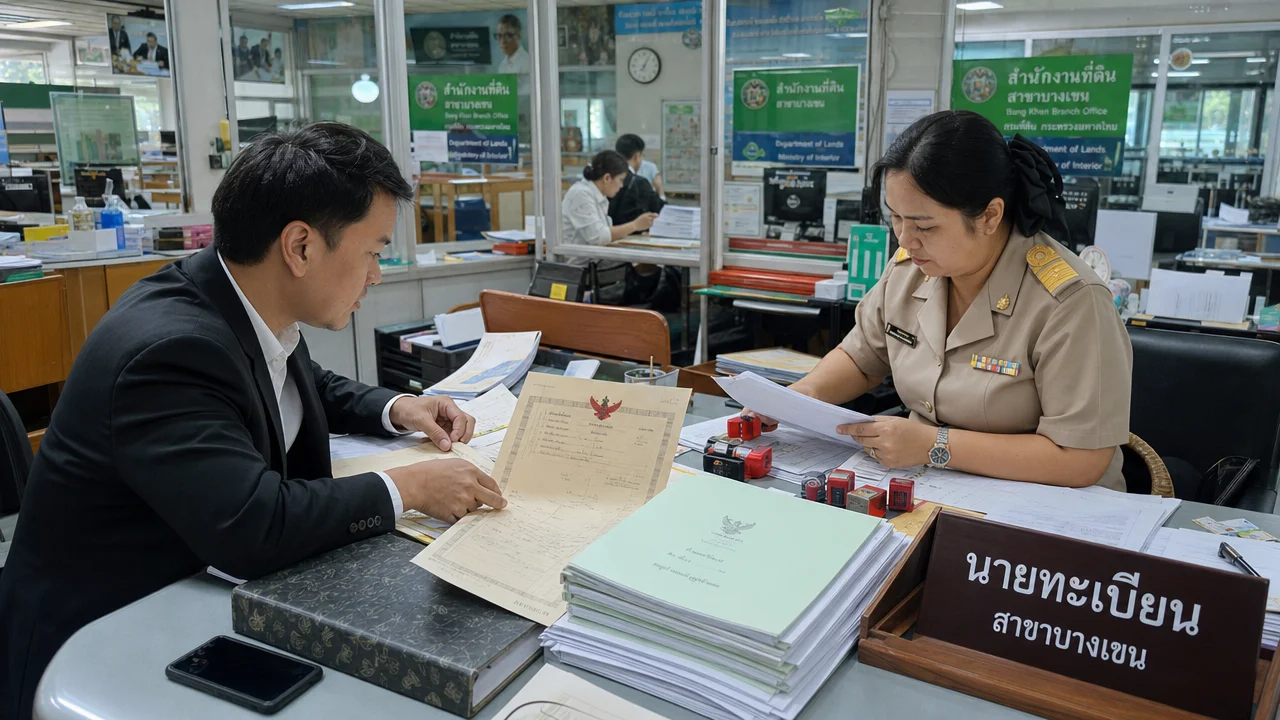
The Land Department of Thailand has launched a nationwide campaign to identify nominee land ownership schemes by foreigners. Urgent Circular No. มท 0515.2/ว 10722 dated May 15, 2026 requires land office staff to conduct additional verification for transactions with cash payments from 2 million baht or an assessed value from 5 million baht. An exception is made only for inheritance transfers to legal heirs. Verification is mandatory even for smaller amounts if there is reasonable suspicion of land registration in the name of a Thai person for the benefit of a foreigner.
How the New Verification System Works
Land office employees are now required to examine buyers' incomes, occupations, financial positions and sources of funds. Control does not end with transaction registration. Local offices must monthly verify companies that own land if there are foreigners among shareholders or directors, and report quarterly on results.
Risk indicators include capital increases, shareholder changes and share ratio alterations. Authorities assess capital sources, ownership structure and financial stability of companies to determine the legality of transactions.
Scale of Enforcement
The Department of Business Development has transferred selected cases to relevant agencies. The Revenue Department is checking 14,800 companies, the Land Department is examining real estate of 17,556 companies, a Royal Police special team is conducting 2,713 in-depth investigations. The Economic Crime Suppression Division is pursuing 2,257 companies, the Department of Special Investigation has opened 2,236 cases.
Field inspections since October 2025 have covered 35 locations in 11 provinces: Phuket, Surat Thani (Samui and Phangan), Krabi, Chonburi (Pattaya), Chiang Mai and Bangkok.
High-Profile Cases of 2026
On July 17, 2026, police conducted a major operation in Chonburi Province. Four Russian suspects were detained, 41 search warrants were issued, 33 companies were inspected. The broader investigation network covered approximately 495 companies and 775 houses in six projects. This involves 32 land plots with a total value of approximately 235 million baht.
In Bangkok, police reported investigating an alleged network of 33 companies connected to 33 luxury homes worth over 1.275 billion baht. In Krabi, Phuket and Phang Nga, authorities are checking 89 plots with a total area of more than 49 rai (78,400 square meters) and a value of approximately 1.05 billion baht.
What Constitutes a Nominee Scheme Under Law
Article 97 of the Land Code establishes two formal criteria. A company is considered foreign if foreigners own more than 49% of the capital or they constitute more than half of all shareholders.
Meeting these thresholds is not sufficient. Articles 96 and 113 apply when a Thai person acquires or holds land for the benefit of a foreigner. When checking a nominee structure, officials determine:
- who paid for Thai participants' shares and land purchase;
- whether Thai shareholders had their own funds and bear real economic risk;
- who controls bank accounts, votes and key decisions;
- whether the company conducts business activities;
- who uses the property and benefits from it.
The participation of Thai shareholders in a company itself does not violate the law. Questions arise if they contribute nothing, do not participate in management and are needed only for formal compliance with quotas.
Consequences of Violations Discovery
If a Thai citizen acquired land for the benefit of a foreigner, Article 96 allows ordering them to sell it according to the procedure of Article 94. For companies considered foreign under Articles 97 or 98, the same procedure applies through Article 99.
| Parameter | Conditions |
|---|---|
| Sale period | From 180 days to one year |
| Consequences | Mandatory disposal of land |
| Automatic confiscation | Not provided for by current law |
Current law requires disposal of land, not its automatic transfer to the state. The sale period varies from 180 days to one year depending on the circumstances of the case.
Legal Property Ownership Options for Foreigners
Condominium Apartments
A foreigner can register an apartment in ownership if the building is registered as a condominium and the selected apartment is available within the foreign quota. The quota is limited to 49% of the total apartment area in the building.
Quota verification is conducted for a specific property. This option does not require company formation and remains the safest way to purchase property in Thailand.
Registered Land Lease
Lease provides contractual right to use the property. As a general rule, real estate lease can be registered for a term of up to 30 years. A contract for a term exceeding three years is concluded in writing and registered with the Land Department. Without registration, it is enforceable only within three years.
Change of land owner does not terminate registered lease. The right can be transferred or mortgaged, it passes by inheritance, but does not grant land ownership rights.
Usufruct (sap-ing-sit)
Sap-ing-sit is a separate registered right to use property and derive benefits from it for a term of up to 30 years. It can be established with respect to land with chanote, such land together with a building, or a condominium apartment.
The right can be transferred or mortgaged, it passes by inheritance. Change of owner does not terminate it. Usufruct does not grant land ownership rights, but provides broader powers compared to ordinary lease.
Investment Exception
There is a narrow exception for persons who have invested at least 40 million baht in state-designated assets. With permission from the Minister of Interior, such an investor can obtain up to one rai of land (1,600 square meters) exclusively for residence. This procedure is rarely applied and is not a common way to purchase a resort villa.
How to Check Existing Ownership Structure
Verification is best started before an official request. It is necessary to establish who paid for shares and property, how much each Thai shareholder contributed, who made decisions and what the company was engaged in.
Verification should begin with the land title document. It is necessary to confirm the owner, plot boundaries, mortgages, easements, court restrictions and access to public road.
With a corporate structure, it is important to establish the actual owners of the company, the source of Thai shareholders' capital and vote distribution. A formal 49% share does not protect an investor if documents show that the local majority exists only on paper.
Impact on Villa Market
The short-term effect will be opposite to promises of stabilization. Inspections increase approval times, lawyer expenses and document requirements. Some buyers may choose a condominium instead of a villa or switch to projects where land remains with a large Thai developer and is transferred by registered lease.
Increased inspections will not necessarily lead to an immediate decrease in villa values. Owners of expensive properties often do not have large mortgages and can wait for a suitable buyer.
The first consequence is a decrease in the number of transactions and an increase in time on market. Published prices remain the same, and discounts are provided individually and not reflected in advertising.
What This Means for a Buyer in Pattaya
Pattaya and Chonburi Province fell on the priority inspection list. The operation of July 17, 2026 affected 495 companies and 775 houses in six projects precisely in this region.
For an apartment buyer, the situation has not changed. A condominium can be registered in the foreign quota without company formation. Only quota availability in a specific building and legality of source of funds for amounts from 2 million baht in cash are checked.
When purchasing a villa, one must abandon the scheme with nominee Thai shareholders. The safe option is registered land lease for 30 years from a developer or private owner. The house can be registered in ownership separately from the land.
Projects in Pattaya where land belongs to a large Thai developer and is transferred by registered leasehold now look preferable to secondary villas with corporate structures of unclear origin.
If you already own a villa through a company, order an independent structure audit. A lawyer should verify sources of Thai shareholders' capital, company bank statements, meeting minutes and actual distribution of control. The presence of risk factors does not automatically mean an offense has been committed, but authorities investigate each case individually based on evidence and financial reports.
Buyers of secondary villas in Pattaya need to check the entire chain of rights: land title document, building registration, terms of registered leasehold or usufruct. Transaction approval time has now increased by two to four weeks due to additional land office requests.
Practical Recommendations
Choose a condominium for investment and permanent residence. This is the most transparent option without legal risks.
For a villa, require registered land lease from a verified developer. The 30-year term can be extended for another 30 years by agreement of the parties, although the second extension is not guaranteed by law.
Refuse offers to register a villa through a company with Thai shareholders if you are not prepared to prove their actual participation and sources of capital. The promise of "we'll register 49/51" no longer protects against inspection.
Order legal due diligence before making a deposit. A lawyer should check the chanote, plot boundaries, encumbrances, road access and transaction history. For an existing company, an audit of financial documents and corporate structure is needed.
Consider increased times and expenses. Registration of a villa transaction now takes two to four weeks longer. Legal support expenses have increased by 30-50% due to additional inspections and document preparation for the land office.