
Bangkok's Office Market Chokes on Supply: Why 119,000 sqm of New Space in Q4 2026 Could Be the Last Straw
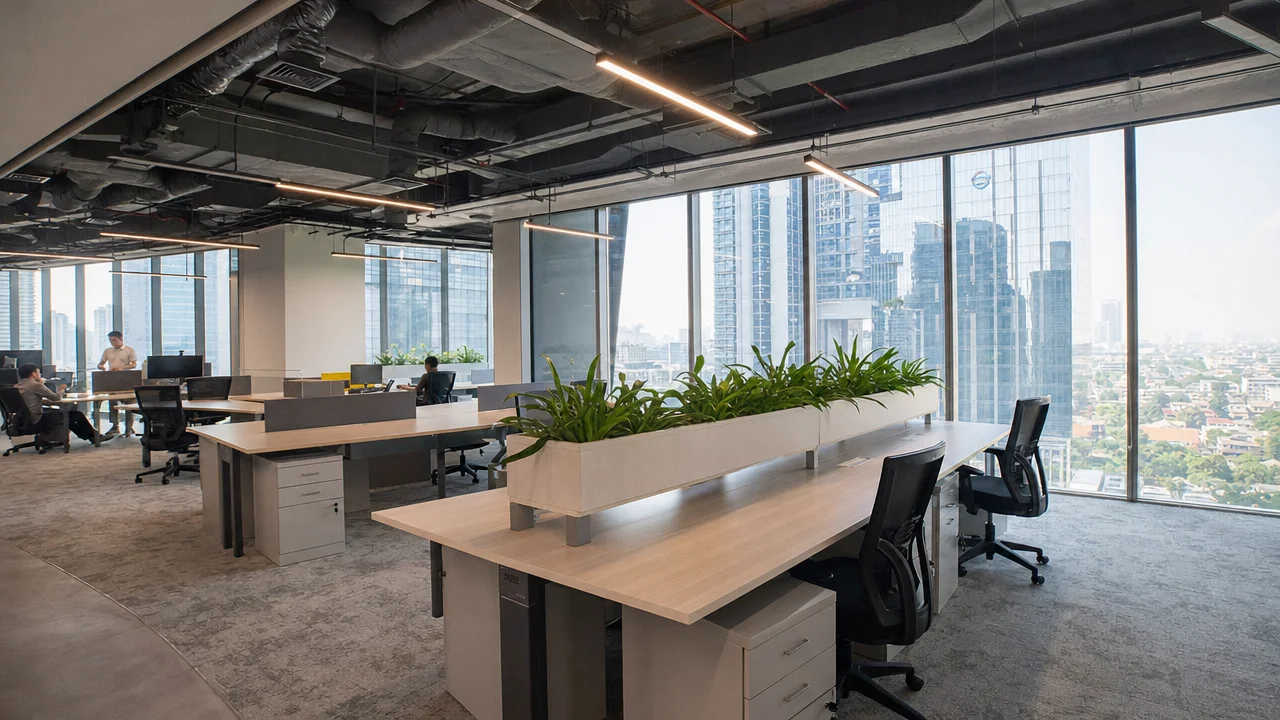
Bangkok's office market is closing 2026 with a record surplus of space. In the third quarter, total vacancy reached 1.6 million square meters with an average occupancy rate of 76.4% - notably below the ten-year average of 83%. The fourth quarter will add another 119,000 sqm of commercial space from the One Bangkok Tower 2 and Summit Tower projects, entering a market where landlords have been maintaining rates for two consecutive years through concessions and rent-free periods. According to Knight Frank Thailand, the average asking rent remained at 858 baht per square meter per month, but actual deal terms include months without payment, fit-out contributions, and flexible indexation schedules.
The situation appears paradoxical. In the second quarter of 2026, five buildings with a total area of 207,000 sqm entered the market - the largest supply addition in recent years. About 39% of the new space was pre-leased before construction completion, ensuring net absorption of 76,000 sqm. However, overall occupancy fell by 1.3 percentage points because supply grew faster than demand. The third quarter brought stabilization: occupancy rose by 0.1%, and net absorption reached 51,000 sqm. Gross demand hit 109,000 sqm, but tenants vacated 59,000 sqm in existing buildings.
New Buildings Take Tenants from Older Stock: Who's Winning the Quality Race
The gap between modern towers and the rest of the market continues to widen. Four projects - BTS Visionary Park, Cloud 11, One Origin, and AIA Connect - recorded an increase in occupied space of 66,000 sqm in the third quarter. The rest of the market lost about 16,000 sqm of net absorption. Companies are relocating from Grade B and C buildings to certified properties with modern engineering systems, flexible layouts, and environmental standards.
Panya Jenkitwatanalaert, Partner and Executive Director of Office Services at Knight Frank Thailand, noted that the market has begun to stabilize after the massive influx of supply, but full recovery remains a distant prospect. Demand is concentrated in buildings that meet tenant requirements for quality and functionality.
Certified green space grew by 1.8% during the quarter to 3.03 million sqm, representing 44% of total supply. This trend reflects a structural shift: companies prefer to pay a premium for buildings with LEED or TREES certification, which reduce operating costs and align with corporate ESG strategies. Buildings without certification lose tenants even when reducing rates.
Tenants Dictate Terms: How High Vacancy Changes Negotiating Power
The surplus of space has given companies leverage over landlords. Standard concessions include discounts on base rates, rent-free periods, additional incentives, and contributions to office fit-outs. These conditions can amount to 20-30% of the total lease cost over the entire contract term, so companies evaluate not only the stated rate but the full package of benefits.
Dynamics vary by building class. Grade A offices showed occupancy growth of 1.6% to 79%, and the average asking rate increased by 0.3% to 1,271 baht per sqm per month. Grade B lost 0.6% occupancy, dropping to 73%, despite a 0.7% rate increase to 869 baht. Grade C added 0.4% occupancy to 80%, with rates rising symbolically by 0.1% to 545 baht.
Building owners are protecting occupancy and limiting vacant space, forgoing short-term rental income growth. This is a rational strategy in conditions where each empty floor increases operational losses and reduces building attractiveness to potential tenants.
Economy Slows: How 1.9% GDP Growth Affects Office Expansion Decisions
Thailand's gross domestic product grew 1.9% year-on-year in the second quarter of 2026, down from 2.8% in the first quarter. On a seasonally adjusted basis, the economy contracted 0.2% compared to the previous quarter. Slowing growth forces companies to focus on cost control, relocating to cheaper locations, or consolidating existing offices instead of expanding space.
The confidence index for the next three months rose to 50.8 points thanks to expectations of the tourist season and government support measures. However, this is insufficient for mass expansion of office space. Companies prefer flexible short-term contracts and coworking spaces to long-term leases of entire floors.
In these conditions, the new 119,000 sqm in the fourth quarter will require time to fill. Completion of the Boonmitr Silom and Project O has been postponed to 2027, partially reducing market pressure, but not solving the problem of existing 1.6 million sqm of vacant space.
Districts Outside the Center Grow Faster: Phahonyothin and Bang Na Outpace CBD Dynamics
Locations outside the central business district (CBD) attracted 49,000 sqm of net absorption in the third quarter versus 2,000 sqm in the CBD. The average asking rate outside the center rose 0.5% to 699 baht per sqm per month, with occupancy increasing 0.2 percentage points to 78%.
The Phahonyothin-Vibhavadi district recorded occupancy growth of 5.1 percentage points to 80%, with rates rising 0.6% to 724 baht. Bang Na-Srinakarin added 3.5 percentage points of occupancy to 69%, with rates increasing 0.3% to 690 baht. These districts benefit from new buildings, convenient transportation access, and competitive rental rates.
Phetchaburi-Rama IX-Ratchada showed a different picture. The asking rate grew 0.7% to 733 baht, but occupancy fell 3.7 percentage points to 78%. The reason - AIA Connect's market entry with initial occupancy of 30%, temporarily increasing vacancy in the area. Each new building requires time to build a tenant base.
Supply to Slow from 2027: 530,000 sqm Remain in Pipeline Through 2031
Total office space in Bangkok reached 6.82 million sqm after AIA Connect's completion in the third quarter. No buildings were withdrawn from the market during the period. The pipeline of new projects through 2031 has shrunk to 530,000 sqm, of which about 54% is under construction. After 2026, average annual supply will be 82,000 sqm.
In 2027, projects totaling 50,000 sqm are expected to complete. For 2028, no projects are currently planned. The slowdown in development will reduce competitive pressure, but sustained absorption is still needed to reduce the current 1.6 million sqm of vacant offices.
Panya Jenkitwatanalaert noted that long-term prospects are beginning to show positive signs due to declining new supply, but the scale of existing vacancy means any recovery will be gradual. The immediate test is absorption of 119,000 sqm in the fourth quarter. Future dynamics will depend on economic conditions and companies' ability to expand rather than simply move between buildings or consolidate existing space.
What Bangkok's Office Crisis Means for Mixed-Use Development in Pattaya
The surplus of commercial space in the capital directly affects developers' investment decisions throughout Thailand. Two major developers postponed condominium launches in Pattaya scheduled for the fourth quarter of 2026 after losses on office projects in Bangkok. Companies are reallocating capital, curtailing programs in regional cities and concentrating on stabilizing existing assets.
Mixed-use projects in Pattaya that include office components or commercial space face additional risks. Investors evaluate not only the residential component but also prospects for filling retail and office space. Bangkok's experience shows that even premium certified buildings require 12-18 months to reach target occupancy.
For residential property buyers in Pattaya, the situation creates two effects. Developers become more conservative in pricing and launching new phases, stabilizing the market and reducing oversupply risk. Simultaneously, companies reducing offices in Bangkok are moving some employees to remote work, increasing demand for housing in coastal cities with good infrastructure.
Specific numbers matter. Average Grade B office rent in Bangkok is 869 baht per sqm at 73% occupancy. In Pattaya, similar space leases for 450-600 baht, but demand is limited by a small number of large companies. Projects planning office components exceeding 5,000 sqm should consider that filling may take two to three years even with aggressive lease terms.
Investors in Pattaya real estate should pay attention to project structure. Complexes with minimal commercial components and focus on residential units show more predictable demand dynamics. Buildings with large retail galleries or office blocks carry additional risk of under-occupancy, which can reduce overall project attractiveness and resale value.
Conclusions: Bangkok's Office Crisis as an Indicator of Caution for Thailand's Entire Commercial Real Estate Market
Bangkok's office market is closing 2026 with a surplus of 1.6 million sqm of vacant space and 76.4% occupancy, 6.6 percentage points below the ten-year norm. The fourth quarter will add 119,000 sqm of new supply competing with existing buildings for limited demand amid an economy slowing to 1.9% GDP growth. Landlords maintain nominal rates at 858 baht per sqm, but actual deal terms include rent-free months and fit-out contributions, reducing effective yield by 20-30%.
The pipeline slowdown from 2027 to 82,000 sqm annually will give the market time to absorb the surplus, but full recovery will take several years. The structural shift toward certified buildings continues: 44% of supply already has environmental certification, and this figure will grow as companies translate ESG requirements from recommendations to mandatory office selection criteria.
For Pattaya's real estate market, the capital's office crisis serves as a caution signal. Developers are curtailing launch programs, investors are avoiding projects with large commercial components, and residential buyers get a more stable market without oversupply risk. Bangkok's experience shows that even in the country's largest business center, supply can outpace demand for years ahead if development doesn't account for actual economic dynamics and changes in corporate strategies for office space utilization.