
Thailand's Condominium Market Experiencing Worst Year in Two Decades
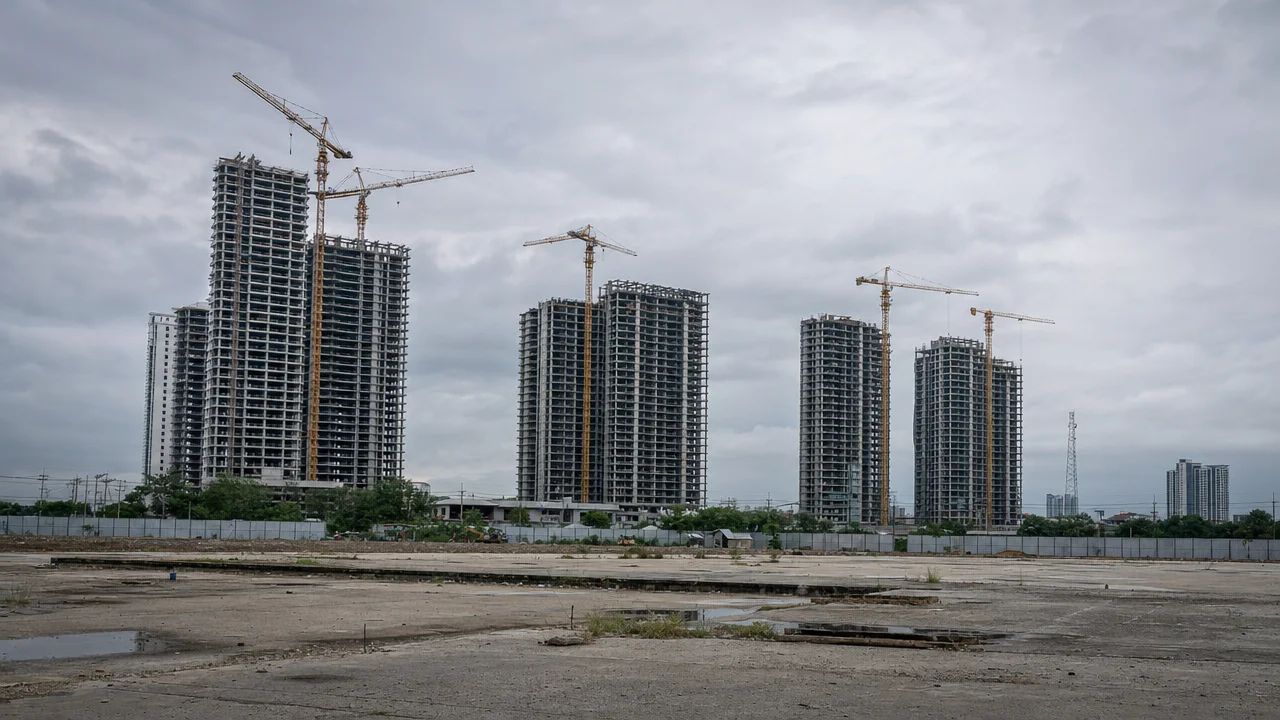
In 2026, the number of new condominium projects in Thailand will drop to 17,000 units-the lowest figure in 20 years. The reason is not only weak demand but also a 10-20% increase in construction costs, strict bank requirements for borrowers, and accumulated unsold housing inventory subject to land tax. Developers have slowed the launch of new towers, focusing on selling off completed properties and shifting to affordable segments outside central Bangkok.
Why Developers Are Slowing Down New Projects
According to Cushman & Wakefield, only 7,169 housing units were launched in Bangkok and suburbs in the first quarter of 2026. The annual forecast remains at 15,000-17,000 units, which is 36.3% lower than the 2024 figure (18,997 units) and comparable to the crisis year of 2025.
The main reason is rising costs. Prices for energy, transportation, and materials (steel, concrete, aluminum) have increased due to the Middle East conflict. For small projects, the increase reached 20%. With construction materials accounting for 25-30% of cost structure, the overall increase in expenses is estimated at 2.5-6%. Developers can absorb this for now, but margins are shrinking.
The second factor is land tax on unsold properties. Inventory of completed but unsold housing has reached 350,000 units with an average ownership transfer rate of around 60,000 units per year. Keeping such volumes on the balance sheet is becoming unprofitable.
Banks Are Rejecting Every Second Borrower
Financial institutions have tightened mortgage lending criteria. The rejection rate has reached 40-60%, sharply reducing the pool of potential buyers. High household debt levels are forcing banks to assess creditworthiness more strictly.
In response, developers are revising sales models. "Rent to Own" schemes have emerged, allowing buyers with insufficient credit history to enter the market through rental with subsequent credit of payments toward the apartment cost. The government is discussing easing LTV rules (loan-to-value ratio), reducing ownership and mortgage registration fees.
Average Price of New Projects Fell 56.8% Quarter-on-Quarter
In the first quarter of 2026, the average price of new launches was 84,300 baht per square meter-a 56.8% drop compared to the fourth quarter of 2025. The reason is not a market collapse but a geographical shift: 68% of new projects were in suburbs with prices below 80,000 baht per sqm. There were no new launches in Bangkok's Central Business District (CBD) in the first quarter at all.
Developers have switched to the mass segment: apartments priced at 1.5-3 million baht in areas with accessible transport infrastructure. Demand from first-time home buyers and middle-class families remains the only stable market support.
Foreign Buyers Maintain 18-20% Share
Against the backdrop of weak domestic demand, foreigners retain a significant role. In 2025, the number of ownership transfers to foreign buyers increased 2.2% to 14,899 units, although the total transaction value decreased 10.7% to 60.9 billion baht. Foreigners are increasingly choosing compact apartments: average purchase area is 41.3 sqm, average price is 4.1 million baht.
Foreigners account for about 15% of total ownership transfers by unit count, but 25% by value. They concentrate in expensive locations: Bangkok, Chonburi (Pattaya), Phuket.
The government has introduced a long-stay visa program tied to purchasing a condominium worth at least 3 million baht. The program targets retirees, investors, and digital nomads. How it will affect demand will become clear by year-end. An extension of leasehold terms from 30 to 60 years is also being discussed to increase market attractiveness for foreigners.
Distribution of New Launches by Bangkok District in Q1 2026
| District | Total Supply (units) | Unsold (units) | Unsold Share | Average Price (baht/sqm) | Average Area (sqm) |
|---|---|---|---|---|---|
| Central Lumpini | 8,814 | 789 | 10% | 305,000 | 876.82 |
| Narat-Rama 3 | 15,867 | 2,014 | 15% | 136,315 | 391.88 |
| Pathum Wan-Phaya Thai | 17,753 | 2,500 | 16% | 373,486 | 1,073.70 |
| Sathorn-Silom | 27,648 | 4,953 | 22% | 266,333 | 765.66 |
| Sukhumvit | 48,467 | 8,872 | 22% | 242,130 | 696.08 |
Cushman & Wakefield data shows that the largest unsold housing inventory is concentrated on Sukhumvit (8,872 units) and in Sathorn-Silom (4,953 units). The share of unsold apartments reaches 22%, confirming oversupply in premium locations.
Examples of New Projects from Q1 2026
Among launched projects, affordable complexes outside the center predominate:
- Love Charoen Nakorn (Sansiri PCL, Riverside district): 1,111 units, average price 115,000 baht/sqm
- Supalai Loft Thaphra Interchange (Supalai PCL, Thaphra district): 913 units, 77,500 baht/sqm
- D:CODE Srinakarin (BTS Group Holding PCL, Srinakarin district): 4,150 units, 66,500 baht/sqm
- Vay Chinnakhet (Sansiri PCL, Ngamwongwan district): 144 units, 65,000 baht/sqm
- LIFE RATCHADA-RAMA 9 (AP Thailand PCL, Ratchadapisek 3 district): 851 units, 97,500 baht/sqm
All projects target buyers with budgets up to 3 million baht per apartment. Premium towers in the center have temporarily withdrawn from new launches.
Sales Speed Dropped to 20.3%
The absorption rate (share of sold apartments from total launched volume) fell to 20.3% in 2025. For comparison: in 2017-2019, the average sales speed was 45.5%. Buyers are not rushing decisions, waiting for economic stabilization and easing of lending conditions.
The number of ownership transfers in 2025 fell to a decade low. Total transaction value also decreased. The market has entered a buyer's phase: developers are offering discounts, installment plans, and flexible payment terms.
What This Means for Pattaya Buyers
Pattaya and the Eastern Seaboard (Chonburi) traditionally depend on foreign demand more than Bangkok. The share of foreigners in transactions here is above the national average. The slowdown in capital launches means developers will seek alternative markets-Pattaya may receive more new projects in the mid-segment.
However, rising construction costs will also affect Pattaya. Prices for new properties are unlikely to decrease, but growth rates will slow. Buyers would benefit from looking at completed properties with unsold inventory: developers are willing to offer discounts of 10-15% and flexible installment terms.
The long-stay visa program tied to purchases from 3 million baht opens opportunities for retirees and remote workers. Pattaya is one of the program's target cities along with Bangkok, Phuket, and Chiang Mai.
Tightening mortgage conditions barely affect foreigners, who typically buy with cash or use overseas financing. But Rent to Own schemes that have appeared on the market may interest those who want to test life in Thailand before buying.
The discussed extension of leasehold from 30 to 60 years will increase the attractiveness of villas and townhouses on leased land. This is less relevant for condominiums, as foreigners own them freehold within the 49% quota.
Forecast for the Remainder of 2026
The condominium market will remain in a stagnation phase until year-end. Total new launch volume will not exceed 17,000 units-the worst result since the early 2000s. Developers will continue focusing on affordable segments and locations with real demand.
Price growth will be minimal. Sales speed will remain low. Unsold inventory of 350,000 units will pressure the market for several more years.
Foreign demand will remain at the current level of 18-20% of total transaction volume. Government support measures (LTV easing, fee reductions, visa programs) may have an effect in the second half of the year but won't fundamentally change the situation.
Buyers should use the current market weakness to negotiate discounts and improved terms. Developers are more interested in sales than at any time in the past 20 years.