Pattaya Condominium Market Experiencing Historic Low in Supply
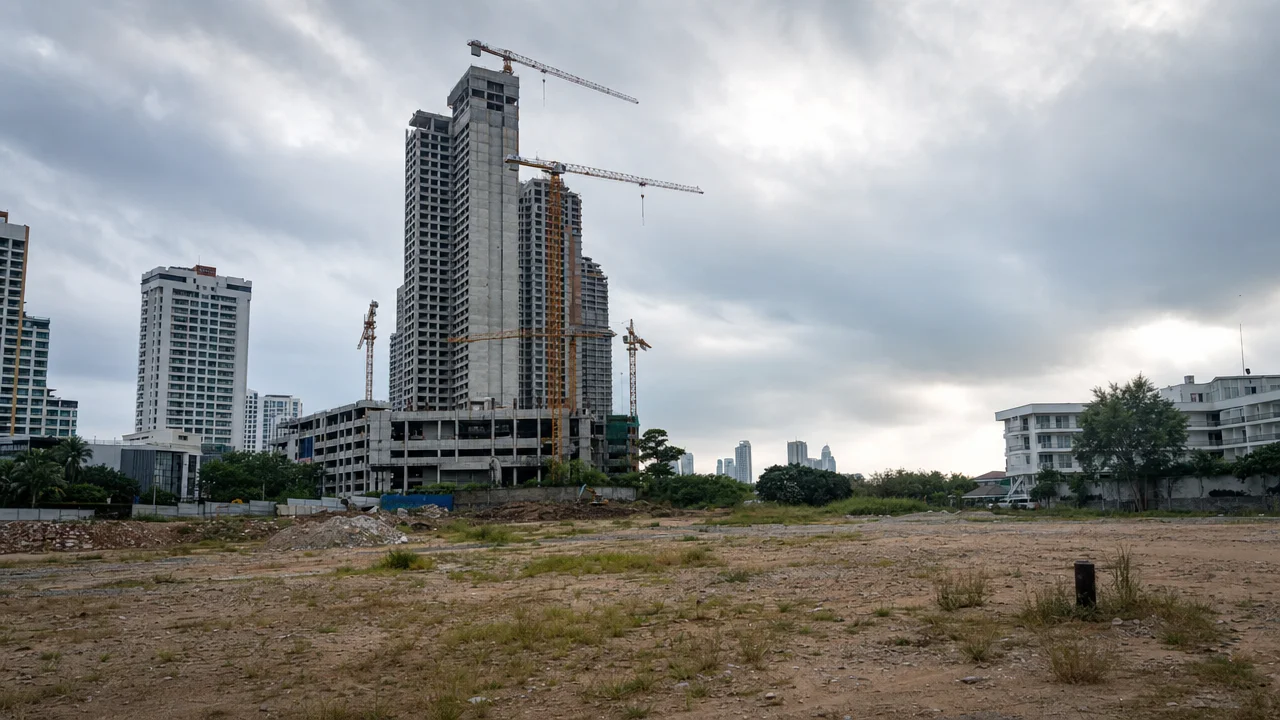
In the first quarter of 2026, the number of new residential projects receiving construction permits in Thailand plummeted by 50.2% to 27,870 units. The condominium segment was hit hardest: permits were issued for just 2,950 apartments, 71.3% fewer than a year earlier. According to the Real Estate Information Center of Thailand (REIC), the projected volume of new condo launches in 2026 will range from 15,000 to 18,000 units nationwide-the lowest figure in two decades.
Pattaya, Jomtien, and Naklua found themselves at the epicenter of this contraction. Developers are massively postponing project announcements, focusing on selling off existing inventory. The average asking price for new condos dropped to 84,500 baht per square meter (approximately $2,300 USD)-a 55% quarterly decline, as developers shift their focus to suburbs with price tags below 80,000 baht.
Three Reasons Why Developers Are Rolling Back New Projects
Construction Costs Rising 10-20%
The cost of steel, concrete, and aluminum has increased due to higher energy and logistics expenses. Small-project developers have felt the impact more severely than major players with their own procurement chains. Interest expenses on construction loans have also risen, making new project launches less profitable at current sales levels.
Previously, the condominium development cycle in Pattaya took 2-3 years. Now it has stretched to 5-6 years. Developers bear tax burdens on unsold units under the "other" category of the Land and Buildings Tax, which has been in effect for five years. The longer a property remains unsold, the higher the cumulative costs.
Strict Bank Lending Policies: Mortgage Rejection Rates Reach 40-50%
Even buyers with sufficient income face financing rejections. Thai banks have tightened borrower requirements following the rise in delinquent debts in 2024-2025. The approval rate for mortgage applications for condominiums has dropped critically.
A new phenomenon has emerged-"self-rejection." Buyers who formally qualify for loans consciously refuse to purchase due to uncertainty about future income and the economic situation. This was confirmed by Kessara, a representative of the Thai Housing Business Association: the problem is not only bank rejections, but also that people themselves decide not to take on long-term obligations.
The Bank of Thailand has extended the easing of LTV (loan-to-value) ratio requirements until June 30, 2027, but this measure has not yet reversed the trend.
Excess Unrealized Properties Among Developers
Major Pattaya developers-such as Sansiri, Raimon Land, and SENA-have publicly announced their transition from growth strategy to cash flow management in the second half of 2026. Instead of launching new towers, they are focusing on liquidating inventory built at lower costs.
Some developers have begun selling land plots and entire projects at early stages to free up cash. In conditions of uncertainty, cash is more valuable than assets.
Regional Picture: Eastern Thailand Lost 54.3% of Permits
The Eastern region, including Pattaya, Chonburi, and Rayong, recorded a 54.3% drop in construction permits in the first quarter of 2026. This is one of the highest decline rates in the country, second only to the South (-65.2%) and West (-59.2%).
Jomtien and Naklua-two key areas for foreign buyers-have received virtually no announcements of major new projects since the beginning of the year. The only launches are concentrated in the low-rise segment: townhouses and houses targeting Thai buyers with real demand for residential housing, not investment.
For comparison: in the first quarter of 2025, the Eastern region was issued more than twice as many construction permits. The difference is particularly noticeable in the high-rise condominium segment with sea views-traditionally popular among Russian-speaking buyers.
Foreign Buyers: 18-20% Share, But Not a Salvation
Foreign investors continue to play a role in Pattaya's market. Their share accounts for 18-20% of total transactions. Main groups:
- Citizens of Myanmar fleeing political instability
- Investors from Taiwan
- Buyers from Russia
The Thai government has introduced a long-term visa scheme tied to condominium purchases of 3 million baht or more (approximately $81,500 USD). The program targets retirees, investors, and digital nomads wishing to settle in Phuket, Chiang Mai, Pattaya, or Bangkok.
However, this volume is insufficient to compensate for declining domestic demand. The foreign ownership quota in condominiums (maximum 49% of space in one building) means developers cannot fully reorient toward overseas clients.
New Sales Models: Rent-to-Own as a Response to the Credit Crisis
In response to high mortgage rejection rates, developers have begun testing alternative schemes. The most notable is the Rent-to-Own format.
A buyer rents an apartment for several years, with part of the rent going toward a future purchase. This allows clients with unstable income or insufficient credit history to gradually gain ownership without immediate bank loan approval.
Developer SENA is actively promoting this model in its projects. The scheme has not yet gained widespread adoption, but interest is growing, especially among young Thai buyers and expats with non-traditional income sources (freelancers, remote workers).
Price Forecast: Growth of 3-8%, But With Limitations
Despite weak demand, residential property prices in Pattaya will continue to rise. Expected price increase-3-8% over the next 12-18 months. Reasons:
- Developers factor increased costs into final prices
- Reduced new supply decreases competition
- Inflationary pressure on materials and labor
However, growth will be limited by low purchasing power, high competition among existing projects, and the need to maintain sales liquidity. Developers understand: inflated prices will lead to even longer sales cycles.
Houses and condominiums priced above 30 million baht per unit will continue to find buyers, although transaction pace will slow. The segment up to 5 million baht will face serious difficulties due to mortgage restrictions, which may affect cash flows of smaller developers.
Government Support Measures: Extension of Benefits Until Mid-2027
Thailand's Cabinet of Ministers decided to extend the reduction of registration and mortgage fees to 0.01% until June 30, 2027. This measure directly reduces the cost of purchasing housing and stimulates buyers who had postponed completing transactions.
Surachet Kongchip, head of research at Cushman & Wakefield Thailand, noted that the residential property market in 2026-2027 is unlikely to return to an active cycle where all developers can show strong financial results. New condominium launches in 2026 are expected at 17,000-20,000 units nationwide, but the final figure may be closer to the lower bound if negative factors-especially the Middle East conflict-do not improve.
Industry associations are also lobbying for:
- Extending land lease terms (leasehold) from 30 to 60 years
- Accelerating environmental impact assessment (EIA) approval from 1-2 years to 3-5 months
- Implementing soft loan programs
- Debt consolidation mechanisms to increase buyer solvency
So far, these measures remain at the discussion stage.
What's Happening With Unit Transfers: 11.2% Growth Masks Structural Problems
Housing transfers throughout Thailand grew by 11.2% in number of units and 3.1% in value in the first quarter of 2026. Approved housing loans increased by 11.1% year-over-year.
At first glance, the figures look encouraging. But detailed analysis shows: growth is concentrated in the segment up to 3 million baht-housing for actual residence, not investment. The upper segment, from 7.51 million baht and above, showed a decline in transfers of 14.9% by quantity and 16.4% by value.
For Pattaya, this means: sea-view apartments in premium towers are selling more slowly than a year ago. Buyers are either waiting for better conditions or switching to the secondary market, where prices are more flexible.
What This Means for Buyers in Pattaya
For Russian-speaking investors and property buyers in Pattaya, the 2026 situation creates both risks and opportunities.
Risks for Pre-Construction Buyers:
If you've made a down payment on an apartment in an unfinished project, there's a possibility of delayed completion. Developers transitioning to cost-saving mode may freeze or postpone construction. Check the status of permits, transfer schedules, and the developer's financial condition. Request confirmation that the project has passed environmental impact assessment (EIA) and has all necessary approvals.
Secondary Market Opportunities:
The reduction in new supply makes the secondary market more competitive. Apartment owners in Jomtien and Naklua who previously couldn't sell due to excess new construction are now receiving more buyer attention. Secondary market prices may rise more slowly than in the primary market, creating a window for favorable deals.
Developer Verification Now Critical:
In conditions where major developers are selling assets and rolling back projects, purchasing from a small or financially weak developer carries increased risk. Ensure the company has liquidity to complete construction. Review the portfolio of unrealized properties: if a developer has more than 50% unsold units in current projects, this is a warning sign.
Alternative Purchase Schemes:
If you cannot obtain a mortgage from a Thai bank, look at projects with Rent-to-Own programs. This will allow you to lock in a price and start the path to property ownership without immediate credit approval. The scheme is particularly relevant for freelancers, remote workers, and those receiving income in cryptocurrency or from abroad.
Geographic Choice:
Projects in suburban areas of Pattaya (not on the first line) are now offered at prices below 80,000 baht per square meter. This is 30-40% cheaper than in Naklua or central Jomtien. If you're willing to sacrifice sea views for price, this may be a reasonable choice in current conditions.
Long-Term Visas:
The long-term visa program for property purchases from 3 million baht works, but its effectiveness depends on market stability. If you plan to use this scheme, ensure the selected property meets program requirements and that the developer is ready to provide necessary documents for submission to immigration services.
Practical Advice:
Don't rush your decision. The market is in a restructuring phase, and the next 6-12 months will show how deep the downturn will be. If you're buying for residence, current conditions allow more aggressive negotiation than a year ago. If for investment-assess rental yields in a specific micro-area: without reliable rental rates, a condominium in Pattaya remains a high risk.
Conclusion: Market in Survival Mode Until End of 2026
Pattaya's condominium market has entered a stagnation phase due to a combination of rising costs, weak purchasing power, and tight lending. The projected volume of new launches in 2026 will be the lowest in 20 years. Developers have switched from aggressive growth to inventory management and cash flow preservation.
Recovery will be slow. It directly depends on government support, easing of financial conditions, and overall improvement in the economic situation. Buyers should be cautious when choosing early-stage projects and more actively consider the secondary market, where competition among sellers is growing.